• Twenty47HealthNews
  • Health & Wellness
  • Disclaimer
    • Terms of Use
    • Privacy Policy
    • DMCA Notice
  • Twenty47HealthNews
  • Health & Wellness
  • Disclaimer
    • Terms of Use
    • Privacy Policy
    • DMCA Notice
24/7 Health News
No Result
View All Result
Struggling with energy, weight, or blood sugar?
Get personalized medical & wellness support at My Healing 365.
Book Your Wellness Strategy Session
Home Article

What I found when I scanned the brains of kids creating tunes on the piano

July 29, 2026
in Article
What I found when I scanned the brains of kids creating tunes on the piano

Research shows that improvisation and creativity are good for the brain. In an episode of the Greater Good Science Center’s “Science of Happiness” podcast, host Shuka Kalantari talked to Karen Barrett about what happens in the brain when people improvise music. Barrett is an assistant professor in the Institute for Health & Aging at the University of California, San Francisco who researches the effects of music on aging and health.

Shuka Kalantari:  What led you to improv?

Karen Barrett: My dad was a scientist and classical guitarist, and my mom played piano. So I actually started playing piano when I was 5 years old and ended up going to Wellesley College to double-major in music and neuroscience.

I did my master’s in piano performance and then found out about this Ph.D. in music cognition which could blend music and neuroscience. That’s how I got started on this career path.

Then, I started my postdoc at UCSF with Charles Limb, who’s a jazz musician. He was a big improviser and was already studying it. I found it a little bit magical and fascinating because it’s not something I do very easily.

 I think improv has made me less rigid. There’s no right or wrong way; there just is. If you make a mistake, do it over and over again, and it’s no longer a mistake. It can lead you to your next motive.

Kalantari:  What happens in the brain when a person is playing something memorized versus improvised?

Barrett:   Music is what we call multimodal. It activates all sorts of domains in the brain: the listening center, pattern perception, visual, emotional, motor and proprioception areas. It is biologically powerful that way.
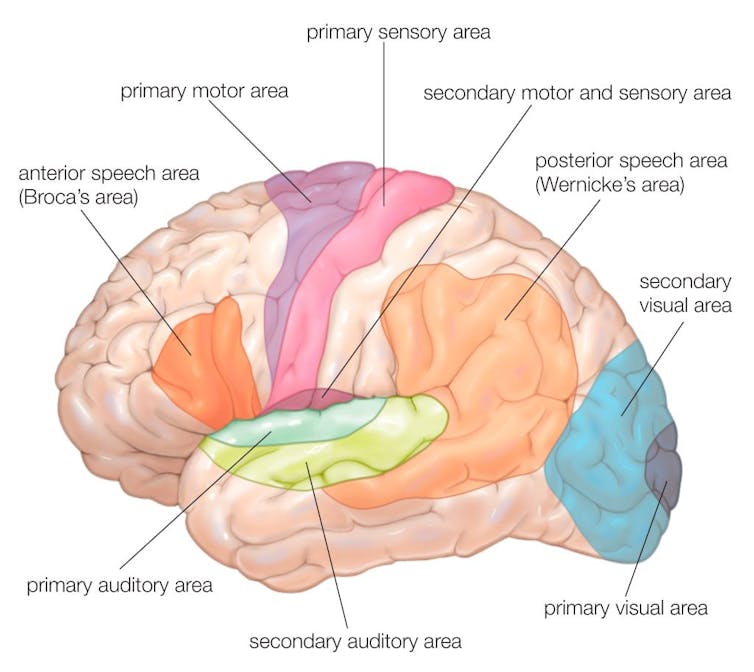
A lateral-view diagram of the human brain, showing the functional areas.
Music is multimodal, meaning it activates many areas of the brain.
Encyclopaedia Britannica/Universal Images Group via Getty Images

Charles Limb’s original study from 2008 took expert jazz pianists and had them either improvise or play something that they had memorized. When they improvised, they deactivated a portion of the brain called the dorsolateral prefrontal cortex, which is like turning off self-judgment. They activated a portion of the brain called the medial prefrontal cortex, which is involved when you want to increase your own artistic voice.

Elevate Your Health for Just $29.99/Month

Join the Precision Wellness Subscription at My Healing 365 and get discounted services, priority coaching access, virtual care, and exclusive wellness resources to support your physical, emotional, and hormonal health.

Join for $29.99/Month

We found that when you’re improvising, you have a different set of activities in your brain compared to when you’re playing. In other words, improvisation is a form of generative creativity. You’re suddenly on the spot, within a certain context, trying to create music. And so that’s why we have unique neural areas that are involved in improvisation.

Kalantari:  Recently you published research on musical improv with children. How did it come about that you went from studying trained professionals to children?

Barrett:  There’s all this work in creativity about expertise. These trained musicians have had years of practice. They have all these schemas and licks in their brain from having studied for so long that they can pull out when they’re playing. But what about the beginners? What about kids?
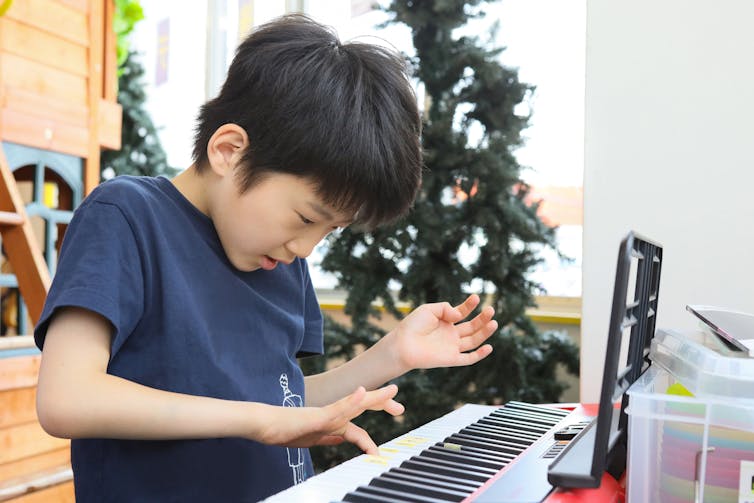
A young boy wearing a blue shirt presses on a key of a piano.
As part of her study, Karen asked children to play a simple scale.
Tayutau/Moment via Getty Images

From a neuroplasticity and a brain activity perspective, we know that kids are highly able to learn new things, right? They don’t operate the same way adults do, and I wanted to see if I could capture the kind of raw creativity that kids have.

We prepped them a lot for the fMRI, a special type of MRI machine that allows us to image the brain. I had them play the “statue game” to show them how still they needed to be. And I had this little mini-keyboard hooked up to my laptop, and I kind of acted like their first piano teacher. First, I taught them a scale. Then, I had them play the notes in whatever order they wanted.

Kalantari: Tell us what you found, and how that affects the way that you think about creativity.

Barrett:  First off, like many of the other studies from our lab, we found that improvising was a very different process from playing the scale. That in itself shows that maybe there’s something innate about this creativity.

The main thing about their brains when they’re improvising as opposed to playing that scale is that it’s mostly about deactivation. When we plot this in brain maps, we use red to show activation and blue to show deactivation. Their brains were mostly blue.
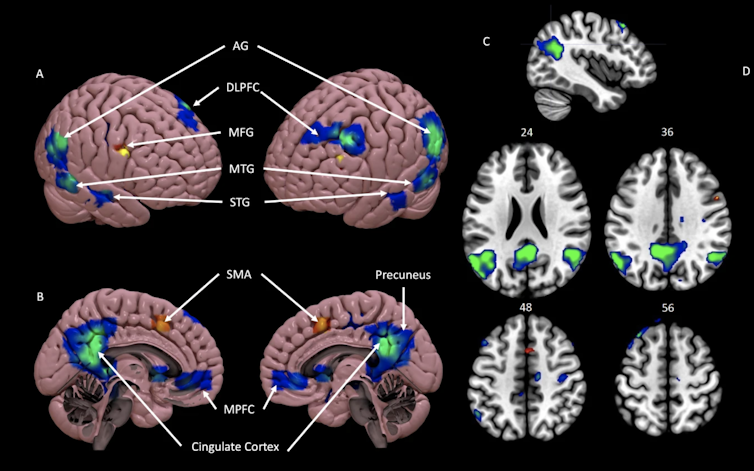
Images of the human brain with blue and green highlighted areas.
Brain scans taken while the children were playing improvised music showed neural deactivation, represented in blue.
Karen Barrett/Scientific Reports, CC BY

The places that they were deactivating are all sensory hubs, meaning they’re not having some sort of artistic voice that’s coming out. Unlike the jazz musicians, where the medial prefrontal cortex just activates to show their own artistic voice, these kids are just kind of doing this activity, and they’re not doing it from this artistic place.

But then on top of that, those structures are actually all areas of the brain that are involved in creativity in adults. The kids haven’t had a chance to develop the way adults have, so maybe these areas are the beginning of the creativity network that we eventually see in adults.

The most surprising finding was that improvisation engages reward structures more than playing that scale. And that wasn’t found as easily in the jazz musicians. What does that tell us about creativity being something possibly built into how the brain works, rather than something that’s learned through training?

I think the fMRI scanning kind of captures the beginner’s mind and shows that we all have a capability to be creative without training at all.

Kalantari: What is your coolest takeaway from the study?

Barrett:  I think what I want people to realize is that doing the arts is inherently valuable, but also very good for the brain and health. We can leverage the fact that creativity and music uses these unique parts of your brain for our own health and benefit.

My biggest takeaway is that we need to get out of our own way, turn off that critic and be creative. Maybe it’s not music; maybe it’s coloring, painting or embroidery. Just doing it is rewarding for the brain, so I’m going to do it, and I don’t need to be good at it.

Knowing we all have the capacity to be creative has really taken off a lot of these shackles that I would normally put on myself. When you realize that improvisation is really fundamental to all our lives, that we’re doing it all the time, it makes it a little easier to do.


ShareTweetSharePin
Next Post
Cholera still kills thousands each year – in places without clean water, it’s far from history

Cholera still kills thousands each year – in places without clean water, it’s far from history

Most Read

What causes stuttering? A speech pathology researcher explains the science and the misconceptions around this speech disorder

What causes stuttering? A speech pathology researcher explains the science and the misconceptions around this speech disorder

December 15, 2022
In war-torn Iran, air pollution from burning oil depots and bombed buildings unleashes invisible health threats

In war-torn cities, air pollution from burning oil depots and bombed buildings unleashes invisible health threats

March 25, 2026
3 women stroke prevention

Silent Stroke Symptoms in Women: What You Might Be Overlooking

February 27, 2026
morning back pain

Morning Again Ache Trigger Is Not the Mattress

October 11, 2021
lower back pain relief exercises

5 decrease again ache aid workouts

October 11, 2021

4 steps to building a healthier relationship with your phone

January 28, 2025

Why Circadian Rhythms Matter for Your Health

July 30, 2024
bleeding in gum

When The Bleeding in gum Is Severe ?

October 11, 2021
Good Night Sleep

6 Causes of Good Evening Sleep

October 11, 2021
3 years after legalization, we have shockingly little information about how it changed cannabis use and health harms

3 years after legalization, we have shockingly little information about how it changed cannabis use and health harms

October 15, 2021
Nasal vaccines promise to stop the COVID-19 virus before it gets to the lungs – an immunologist explains how they work

Nasal vaccines promise to stop the COVID-19 virus before it gets to the lungs – an immunologist explains how they work

December 14, 2022
Kick up your heels – ballroom dancing offers benefits to the aging brain and could help stave off dementia

Kick up your heels – ballroom dancing offers benefits to the aging brain and could help stave off dementia

January 3, 2023
Socialising, work, exercise: what makes a good day and is there a ‘formula’ for making it better?

Socialising, work, exercise: what makes a good day and is there a ‘formula’ for making it better?

April 12, 2026
Biden is getting prostate cancer treatment, but that’s not the best choice for all men − a cancer researcher describes how she helped her father decide

Biden is getting prostate cancer treatment, but that’s not the best choice for all men − a cancer researcher describes how she helped her father decide

May 20, 2025
Ten small changes you can make today to prevent weight gain

Ten small changes you can make today to prevent weight gain

October 12, 2021

COVID vaccines: how one can pace up rollout in poorer international locations

October 5, 2021
GLP-1 drugs may fight addiction across every major substance, according to a study of 600,000 people

GLP-1 drugs may fight addiction across every major substance, according to a study of 600,000 people

March 6, 2026

Multiple sclerosis: the link with earlier infection just got stronger – new study

October 12, 2021
Support and collaboration with health-care providers can help people make health decisions

Support and collaboration with health-care providers can help people make health decisions

December 16, 2021
Greece to make COVID vaccines mandatory for over-60s, but do vaccine mandates work?

Greece to make COVID vaccines mandatory for over-60s, but do vaccine mandates work?

December 1, 2021
Five ways to avoid pain and injury when starting a new exercise regime

Five ways to avoid pain and injury when starting a new exercise regime

December 30, 2022

This Simple Hygiene Habit Could Cut Your Risk of Stroke, New Research Reveals

February 1, 2025

Maximize Your Performance – Sync with Your Circadian Rhythms

August 9, 2024
woman covered with white blanket

Exploring the Impact of Sleep Patterns on Mental Health

August 4, 2024
Six ways to improve your cat’s one wild and precious life

Six ways to improve your cat’s one wild and precious life

June 6, 2026
Four ways to avoid gaining weight over the festive period – but also why you shouldn’t fret about it too much

Four ways to avoid gaining weight over the festive period – but also why you shouldn’t fret about it too much

December 22, 2022
GPs don’t give useful weight-loss advice – new study

GPs don’t give useful weight-loss advice – new study

December 16, 2022
As viral infections skyrocket, masks are still a tried-and-true way to help keep yourself and others safe

As viral infections skyrocket, masks are still a tried-and-true way to help keep yourself and others safe

December 14, 2022
You’ve reached your weight loss goal on GLP-1 medications – what now?

You’ve reached your weight loss goal on GLP-1 medications – what now?

February 5, 2026
How to protect your well-being, survive the stress of the holiday season and still keep your cheer

How to protect your well-being, survive the stress of the holiday season and still keep your cheer

December 21, 2025

Ready to take control of your health?

Get a personalized plan for your weight, energy, hormones, and blood sugar with My Healing 365.

Book Your Session Now – Limited Weekly Spots
  • Twenty47HealthNews
  • Health & Wellness
  • Disclaimer

© 2020 DAILY HEALTH NEWS

  • Twenty47HealthNews
  • Health & Wellness
  • Disclaimer
    • Terms of Use
    • Privacy Policy
    • DMCA Notice

© 2020 DAILY HEALTH NEWS















