• Twenty47HealthNews
  • Health & Wellness
  • Disclaimer
    • Terms of Use
    • Privacy Policy
    • DMCA Notice
  • Twenty47HealthNews
  • Health & Wellness
  • Disclaimer
    • Terms of Use
    • Privacy Policy
    • DMCA Notice
24/7 Health News
No Result
View All Result
Struggling with energy, weight, or blood sugar?
Get personalized medical & wellness support at My Healing 365.
Book Your Wellness Strategy Session
Home Article

How we found a new transmissible cancer in bullhead catfish

August 19, 2026
in Article
How we found a new transmissible cancer in bullhead catfish

For more than a decade, anglers on Lake Memphremagog — which straddles the Québec-Vermont border — have been catching brown bullhead catfish marked with distinctive black lesions.

In 2019, scientists from the United States Geological Survey (USGS) and the Vermont Fish and Wildlife Department confirmed the lesions to be malignant melanoma. Yet, until recently, there was no confirmed explanation for how the disease emerged.

When my colleagues and I at the University of Vermont turned to whole-genome sequencing, we expected to find a genetic explanation for why some brown bullheads had melanoma and others didn’t. Instead, we discovered evidence of something seen only in a handful of cases in the animal kingdom: transmissible cancer.

That’s not where anyone expected the investigation to lead.

Table of Contents

  • Various theories
  • Uncovering a transmissible cancer
  • Unlocking cancer’s deepest mysteries

Various theories

When scientists first documented cases in 2012, the most likely explanation seemed to be environmental factors. The previous year, Hurricane Irene had caused devastating flooding across Vermont.

Could the bullhead’s habitat have been tainted by pollutants stirred up during the hurricane? This seemed to be a more likely culprit than ultraviolet exposure, which is the leading cause of human melanoma. The brown bullhead is a benthic (bottom-dwelling) fish that feeds at night.

Cancer-causing microbes in the waterways were another theory. But a decade of research yielded no evidence to support these hypotheses. After years of dead ends, DNA offered a way to ask a fundamentally different question.

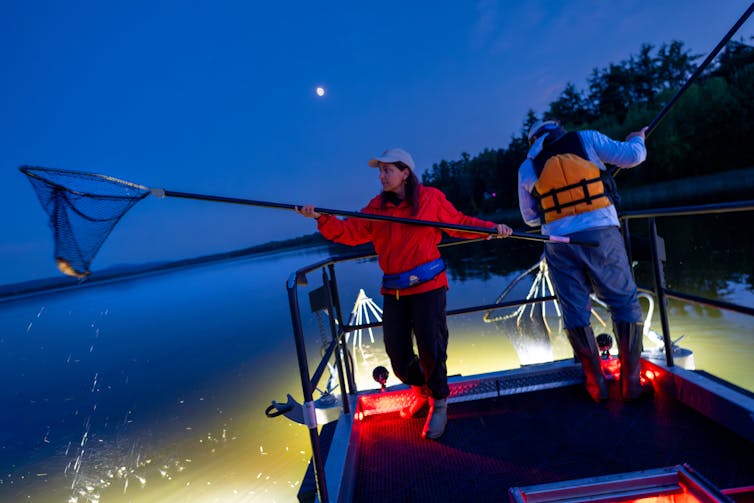
two people on a boat on a lake. One holding a fishing net

Julie Dragon and a biologist from the Vermont Fish and Wildlife Department electro-fishing on Lake Memphremagog.
(Joshua Brown), Author provided (no reuse)

USGS and Vermont Fish and Wildlife scientists contacted the University of Vermont, where I am a genomics and data scientist and a member of the UVM Cancer Center. My team and I sequenced the DNA of more than 80 brown bullheads, with and without disease, caught in 2023, as well as some previously caught by Vermont Fish and Wildlife in 2019.

We also sequenced both tumours and healthy tissue in the diseased fish. My hypothesis was that each tumour would be most closely related to the fish from which it came. This would place all of the diseased fish on an evolutionary “branch” linked by some shared variants, perhaps in genes that contribute to melanoma.

That is not what we found.

Uncovering a transmissible cancer

Tumours from different fish appeared to be more closely related to one another than they were to the fish carrying them. In some cases, the tumours were more genetically similar to healthy fish from other bodies of water than they were to their host fish.

Elevate Your Health for Just $29.99/Month

Join the Precision Wellness Subscription at My Healing 365 and get discounted services, priority coaching access, virtual care, and exclusive wellness resources to support your physical, emotional, and hormonal health.

Join for $29.99/Month

The data was baffling. We checked and rechecked our analysis multiple times, expecting to find an error. Yet the pattern was clear: the tumours had not independently formed; rather, they were clones of one another, sharing an overwhelming number of variants not found in the host fish, and only distantly related to their hosts.

The evidence clearly indicated that the disease represented a previously unknown transmissible cancer that spreads from fish to fish, making it the fourth known transmissible cancer in the world. The others occur in dogs, Tasmanian devils and bivalves.

Once we realized the cancer might be transmissible, we found more evidence of diseased brown bullheads through historical anecdotes. In 1852, the essayist Henry David Thoreau wrote of seeing bullhead catfish with black velvety patches in a Massachusetts river.

Sixty years later, zoologist Raymond Osburn investigated Thoreau’s report and other similar ones throughout New England. He even grew bullhead tumour cells in a lab and successfully transferred them into a healthy bullhead.

There is no way to confirm whether these examples are one and the same as the disease we uncovered (now known as brown bullhead transmissible melanoma, or BBTM), nor that they were transmitted from one fish to another, as ours was.

These historical reports suggest this disease could be older and more widespread than previously believed. Perhaps it’s existed for a while but was largely overlooked. As one angler in Cape Cod told me: “No one looks for those fish.”

a whitish/greenish fish with black marks on its body

A brown bullhead with melanoma on its body.
(Joshua Brown), Author provided (no reuse)

Unlocking cancer’s deepest mysteries

As a cancer researcher, I’m particularly interested in understanding how these cancer cells evade the immune defences of their hosts. Is it possible that gene mutations suppressing the host’s immune system also promote the development and spread of melanoma? What can this discovery tell us about human melanoma and immune dysfunction?

Perhaps this naturally occurring model will shed light not only on how cancers evolve, but how they evade detection by the immune system — a central question in cancer biology.

Collaboration is key to unlocking future discoveries about transmissible cancer. My colleagues and I are teaming up with several other scientists studying these kinds of diseases, including oncology and genetics professor Elizabeth Murchison, who specializes in Tasmanian devil facial tumour disease and canine transmissible venereal tumours; and cancer researcher Michael Metzger, who discovered bivalve transmissible neoplasia.

Together, we hope to learn how these diseases emerge, spread and evolve. No doubt the outcomes of our investigations will extend far beyond the boundaries of Lake Memphremagog, delving into some of cancer’s deepest mysteries.

What began as an effort to explain black lesions on a common catfish may help us better understand cancer, evolution and infectious disease in all animals, including ourselves.


ShareTweetSharePin

Most Read

What causes stuttering? A speech pathology researcher explains the science and the misconceptions around this speech disorder

What causes stuttering? A speech pathology researcher explains the science and the misconceptions around this speech disorder

December 15, 2022
In war-torn Iran, air pollution from burning oil depots and bombed buildings unleashes invisible health threats

In war-torn cities, air pollution from burning oil depots and bombed buildings unleashes invisible health threats

March 25, 2026
3 women stroke prevention

Silent Stroke Symptoms in Women: What You Might Be Overlooking

February 27, 2026
morning back pain

Morning Again Ache Trigger Is Not the Mattress

October 11, 2021
Socialising, work, exercise: what makes a good day and is there a ‘formula’ for making it better?

Socialising, work, exercise: what makes a good day and is there a ‘formula’ for making it better?

April 12, 2026

4 steps to building a healthier relationship with your phone

January 28, 2025
lower back pain relief exercises

5 decrease again ache aid workouts

October 11, 2021

Why Circadian Rhythms Matter for Your Health

July 30, 2024
bleeding in gum

When The Bleeding in gum Is Severe ?

October 11, 2021
Good Night Sleep

6 Causes of Good Evening Sleep

October 11, 2021
Nasal vaccines promise to stop the COVID-19 virus before it gets to the lungs – an immunologist explains how they work

Nasal vaccines promise to stop the COVID-19 virus before it gets to the lungs – an immunologist explains how they work

December 14, 2022
3 years after legalization, we have shockingly little information about how it changed cannabis use and health harms

3 years after legalization, we have shockingly little information about how it changed cannabis use and health harms

October 15, 2021
Kick up your heels – ballroom dancing offers benefits to the aging brain and could help stave off dementia

Kick up your heels – ballroom dancing offers benefits to the aging brain and could help stave off dementia

January 3, 2023
Ten small changes you can make today to prevent weight gain

Ten small changes you can make today to prevent weight gain

October 12, 2021
Biden is getting prostate cancer treatment, but that’s not the best choice for all men − a cancer researcher describes how she helped her father decide

Biden is getting prostate cancer treatment, but that’s not the best choice for all men − a cancer researcher describes how she helped her father decide

May 20, 2025

COVID vaccines: how one can pace up rollout in poorer international locations

October 5, 2021

Maximize Your Performance – Sync with Your Circadian Rhythms

August 9, 2024
GLP-1 drugs may fight addiction across every major substance, according to a study of 600,000 people

GLP-1 drugs may fight addiction across every major substance, according to a study of 600,000 people

March 6, 2026
woman covered with white blanket

Exploring the Impact of Sleep Patterns on Mental Health

August 4, 2024

This Simple Hygiene Habit Could Cut Your Risk of Stroke, New Research Reveals

February 1, 2025
Five ways to avoid pain and injury when starting a new exercise regime

Five ways to avoid pain and injury when starting a new exercise regime

December 30, 2022
Support and collaboration with health-care providers can help people make health decisions

Support and collaboration with health-care providers can help people make health decisions

December 16, 2021
Greece to make COVID vaccines mandatory for over-60s, but do vaccine mandates work?

Greece to make COVID vaccines mandatory for over-60s, but do vaccine mandates work?

December 1, 2021

Multiple sclerosis: the link with earlier infection just got stronger – new study

October 12, 2021
Six ways to improve your cat’s one wild and precious life

Six ways to improve your cat’s one wild and precious life

June 6, 2026
GPs don’t give useful weight-loss advice – new study

GPs don’t give useful weight-loss advice – new study

December 16, 2022
Four ways to avoid gaining weight over the festive period – but also why you shouldn’t fret about it too much

Four ways to avoid gaining weight over the festive period – but also why you shouldn’t fret about it too much

December 22, 2022
How regulatory agencies, not the courts, are imposing COVID-19 vaccine mandates

How regulatory agencies, not the courts, are imposing COVID-19 vaccine mandates

October 24, 2021
You’ve reached your weight loss goal on GLP-1 medications – what now?

You’ve reached your weight loss goal on GLP-1 medications – what now?

February 5, 2026
Backlash to transgender health care isn’t new − but the faulty science used to justify it has changed to meet the times

Backlash to transgender health care isn’t new − but the faulty science used to justify it has changed to meet the times

January 30, 2024

Ready to take control of your health?

Get a personalized plan for your weight, energy, hormones, and blood sugar with My Healing 365.

Book Your Session Now – Limited Weekly Spots
  • Twenty47HealthNews
  • Health & Wellness
  • Disclaimer

© 2020 DAILY HEALTH NEWS

  • Twenty47HealthNews
  • Health & Wellness
  • Disclaimer
    • Terms of Use
    • Privacy Policy
    • DMCA Notice

© 2020 DAILY HEALTH NEWS













