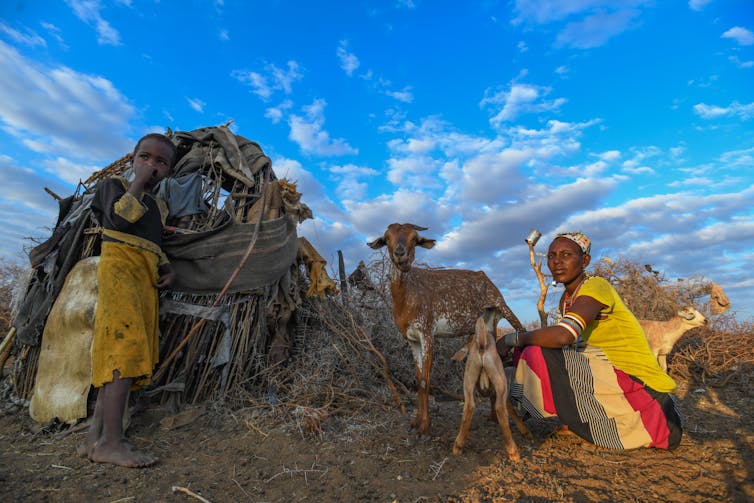
If being outside in the heat for even a few minutes felt miserable this summer, imagine what it’s like for herders who are always out walking with their livestock and rarely get a break.
“We have never experienced such hot days,” a woman herder in northern Kenya told our research team in 2024. “It is difficult to [do things] outside [with] the high temperatures.”
Her experience is echoed by herders in both the U.S. and Kenya, where we study health and climate. Our team’s recent data from Kenya suggests that when drought and heat are particularly bad, herders suffer heat-related illness and symptoms of anxiety and depression.

Gerald Anderson/Anadolu via Getty Images
While there is less data about herders in the U.S., there is reason to be worried about them, as global temperatures rise.
Table of Contents
People on the move – in the sun
In northern Kenya, herders spend much of their lives outdoors with their animals. During dry seasons, herders can move 100 miles (roughly 160 kilometers) with their livestock, sleeping under the stars or in makeshift shacks along the way.
In the U.S., shepherds on the open range often live similar lives. Most hold temporary visas and are paid by their employers to spend 24 hours a day, 7 days a week with flocks of sheep. They often live in portable trailers with no air conditioning, and they spend long hours in the direct sun in states like Colorado and California.
Herding is a livelihood designed for high temperatures – the animals can be moved to where there’s food and water as needed.
Elevate Your Health for Just $29.99/Month
Join the Precision Wellness Subscription at My Healing 365 and get discounted services, priority coaching access, virtual care, and exclusive wellness resources to support your physical, emotional, and hormonal health.
Join for $29.99/MonthHowever, drought and extremely hot summers can mean less food and water for livestock – and more extreme temperatures. As herders search for water and pasture, they may walk with the animals for almost 12 hours a day in the sun, one Kenyan herder told our team.
In Kenya, pastoralists have a higher risk of dehydration at high ambient temperatures, which have become more frequent. In California, extreme temperatures have become more common too. A state report warned that herders can die from heat-related illness and underscored that employers must have heat illness prevention plans with precautions like prompt emergency responses.
The effects of heat on herders’ bodies
Because they are so isolated, herders may only go to the doctor when badly injured or very sick, so researchers usually only get brief glimpses into herders’ health and how it’s affected by heat exposure. In the U.S., often only herders’ employers know where they are and may visit them only once every couple of weeks.

Sylvester Jackson Leruk
In northern Kenya, thanks to reliable cellphone coverage, we’ve been able to study herders’ health in two ways:
-
We visit herders in person. Some of our colleagues are herders themselves; they call participants to get their location and ride to them on motorcycles.
-
We also have herders measure heat exposure and heat-related illness and mental health symptoms in real time using smartwatches, smartphones and temperature loggers the size of matchboxes.
From 2020 to 2023, northern Kenya was hit with an extreme drought that killed 13.2 million livestock across the Horn of Africa and left millions of people with too little food. Some herders moved 100 miles (about 160 kilometers) with their cattle in search of water and grazing land; others stayed closer to home with sheep and goats.
When we asked dozens of herders how they were physically affected by the drought, the majority reported experiencing headaches, breathing abnormalities and extreme sweating – all symptoms of heat-related illness. They also reported stress and feelings of hopelessness. These symptoms likely relate to the drought itself – many herders lost animals – and to heat exposure, which is often associated with anxiety and depression.
In 2026, we used smartwatches to collect real-time heat exposure and heat-related illness symptoms to better understand the physical stress herders were facing. Thirty herders wore these devices every day for three months, charging the devices with solar power banks. Across the study, we recorded daytime temperatures peaking between 88.7 and 97 degrees Fahrenheit (31.5 and 36.1 Celsius).
Looking at herders’ step counts, we first saw that herders walked about the same amount on warm days as cool days. Like herders in the U.S., herders in Kenya don’t have the luxury of not working when it’s hot.
We found a small correlation between a day’s average temperature and the number of heat-related illness symptoms reported by herders: As the temperatures go up, the number of symptoms seem to go up too.
These preliminary results underscore how heat, behavior and health all come together in real time for herders. Not walking on the hottest days is not an option, and the effects on herders’ bodies can be immediate – effects they remember years later.
Making the effects of climate change visible
As temperatures rise, the real-time impacts we’re seeing on herders may lead to chronic health conditions like cardiovascular disease, which agricultural workers can experience. But because herders are difficult for healthcare workers to reach, we researchers know less about how their heat exposure translates into chronic conditions.
Through a combination of interviews and wearable data, we are working to understand the immediate and long-term effects of heat and drought on herders’ health. Studies spanning years, without gaps in funding, will be key to making this happen.
Heat exposure can be dangerous to everyone, but especially to those working outside and without air conditioning that might allow them to cool off – like herders on the open range.























