Smartwatches have become an increasingly popular way for people to monitor their health and fitness. About 100 million – nearly 4 in 10 – U.S. adults own a smartwatch. Worldwide, market research estimates approximately 560 million smartwatch wearers.
Yet a growing body of research demonstrates that one of the most commonly used smartwatch metrics – number of calories burned – is often inaccurate.
I’m an exercise scientist, and I study physical activity behavior and the integration of wearable technology. I recently worked with a team of colleagues at Florida International University’s Medical Photonics Laboratory on a study examining how well commonly used smartwatches measure physiological responses during exercise, and whether that accuracy differs across individuals.
Our team found that not only can these devices err substantially in their measurements of calories burned, but those errors also increase as the wearer’s body fat percentage rises.
Table of Contents
Smartwatch basics
Most smartwatches contain accelerometers that measure movement and use a light-based sensor to estimate heart rate. With each heartbeat, the amount of blood flowing through the vessels in your wrist changes. Blood absorbs light, allowing the watch to track changes in the light reflected back to the sensor. That pattern allows the watch to estimate your heart rate.
The watch combines the data from these sensors with information about the user, such as age, sex, height and weight. It then uses an algorithm to estimate how much energy that person expended.
Heart rate and movement are relatively accessible signals for a wrist-worn device, but caloric expenditure is much more complex. It requires the watch to use several pieces of information that it can measure reasonably well to predict something it cannot measure directly. But differences in the wearers’ body composition, fitness, movement efficiency and physiological responses to exercise can all affect that prediction.
Elevate Your Health for Just $29.99/Month
Join the Precision Wellness Subscription at My Healing 365 and get discounted services, priority coaching access, virtual care, and exclusive wellness resources to support your physical, emotional, and hormonal health.
Join for $29.99/MonthHow we did the study
For our study, we recruited 58 Hispanic adults from Miami, where our lab is located, representing a wide range of body fat percentages and skin tones. These differences allowed us to ask not only whether the watches were accurate overall, but whether their accuracy changed depending on who was wearing them.
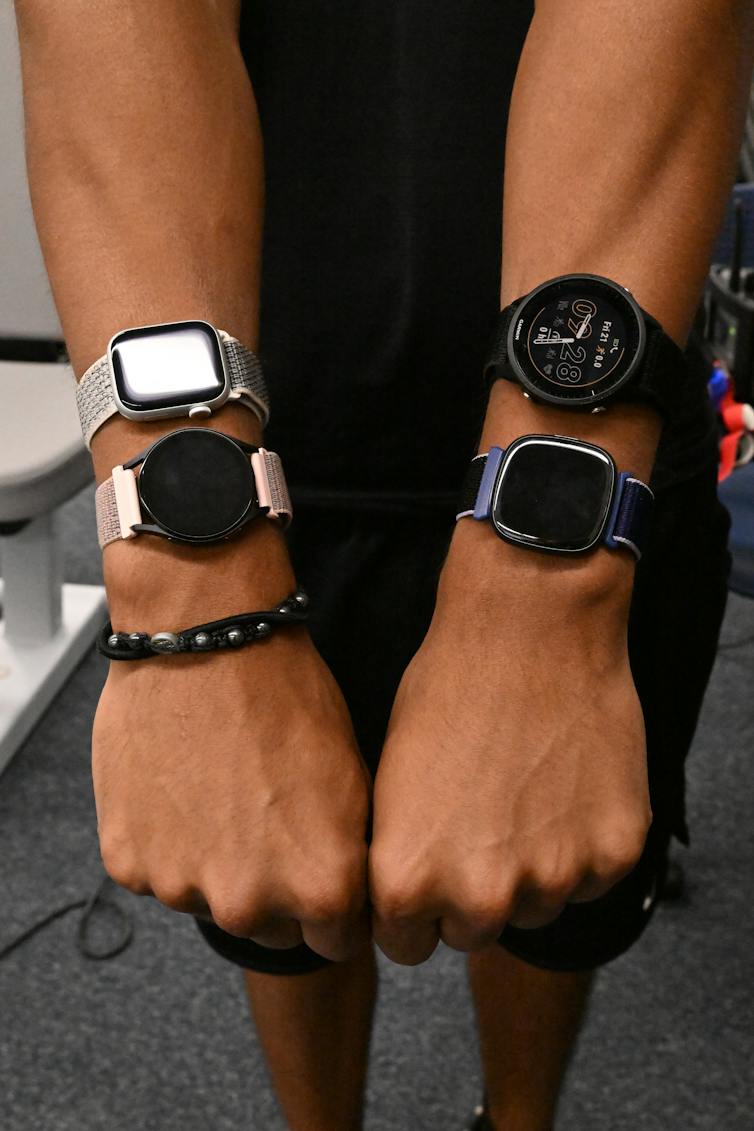
Each participant completed a standardized cycling session while wearing four popular consumer devices: an Apple Watch Series 8, Garmin Forerunner 955, Samsung Galaxy Watch5 and Fitbit Sense 2. Participants alternated between moderate- and vigorous-intensity exercise on a recumbent bicycle for 10 minutes.
As they pedaled, we measured their energy expenditure using a metabolic analyzer, which captures and measures the gases a person inhales and exhales via a mask. In exercise science, this is considered the most reliable way to measure calorie expenditure. That measurement gave us a value against which we could compare each watch’s calorie estimate.
Our protocol provided the watches with a relatively controlled environment in which to perform. We intentionally used recumbent cycling because it allowed us to tightly control exercise intensity while reducing wrist movement, which can interfere with the heart rate measurement used by wearable devices.
Each participant wore two watches on each wrist. We randomized their placements just in case one position provided an advantage. We didn’t find any evidence it did.
Substantial error
All four watches demonstrated substantial error in measuring caloric expenditure. The median error across the devices was about 15% to 25%, meaning that even before considering individual differences, the watches’ estimates were often meaningfully different from our laboratory measurement.
Apple, Garmin and Samsung all systematically overestimated caloric expenditure. Apple had the smallest average systematic error, while Garmin and Samsung produced larger overestimates.
Fitbit presented a different problem. Although its average error was not systematically positive or negative after data-quality exclusions, it produced several clearly implausible estimates, which we treated as device errors, including seven readings exceeding 450% of the value measured by the metabolic system.
The general inaccuracy was not particularly surprising and has been well-documented in previous research. What surprised us was the strength of the relationship between body fat percentage and error. We found that as body fat percentage went up – meaning the more body fat the wearer had – the more inaccurate the watch’s measurements of calories burned.
This was true for all the devices we tested, although the magnitude of the effect varied significantly by brand. The errors for some watches ranged from about 50% to 100% or even more for the study participants with higher body fat percentages.
To put that into more practical terms, imagine that our gold-standard metabolic analyzer measured an energy expenditure of 100 calories during an exercise session. A 50% overestimate would result in the watch displaying approximately 150 calories. A 100% overestimate would result in the watch displaying approximately 200 calories.
We did not find that skin tone had a significant effect on caloric expenditure error under the conditions we tested.

Taimy Alvarez/Florida International University
What this means for smartwatch users
We cannot determine from this study why body fat percentage had such a substantial effect. How the estimation algorithms are developed and calibrated may also play an important role, but because each device uses its own version of a proprietary algorithm, we can’t know exactly how it is measuring caloric expenditure.
People with higher body fat percentages are likely among those most interested in using wearable devices to support weight loss. Yet our results indicate that they may also receive the least accurate estimates of caloric expenditure.
An error of 50 or 100 calories in a single short exercise session may not seem particularly important, but that error can add up over time. In practical terms, if you have a body fat content of 35% or more and you’re exercising 4 hours a week, your watch could be 1,200-2,400 calories off per week. If you’re trying to manage your weight using your watch’s output, you could be consuming nearly an entire day’s worth of calories in error, thinking you’d burned them in your workouts during the week.
What consumers can do
This does not mean smartwatches have no value.
In a companion study using the same exercise protocol, our team found that these devices measure heart rate with reasonable accuracy. Depending on the activity, these devices can also provide useful information about other metrics, including workout duration, distance and pace.
Based on the results of our study, I recommend that smartwatch users treat the calorie number as an estimate rather than an exact measurement. If your goal is to lose weight, I would be conservative about using that number to determine how much to eat or to evaluate the success of a workout.
Looking at patterns over time may also be useful, particularly when considered alongside heart rate, exercise intensity, changes in body weight and your own experience. However, a consistent number is not necessarily an accurate number. A device can systematically overestimate caloric expenditure and still appear very consistent from workout to workout.
Wearable technology will continue to improve. Better sensors may contribute to that progress, but improving how energy expenditure is estimated across people with different body compositions may be just as important.
In our lab, we are now extending our experiments with smartwatches to strength training, where the combination of wrist and whole-body movement, along with varying exercise intensity, may make accurate estimation even more challenging. Other labs around the world are also working to improve these technologies and learn how they can better inform health decisions.























