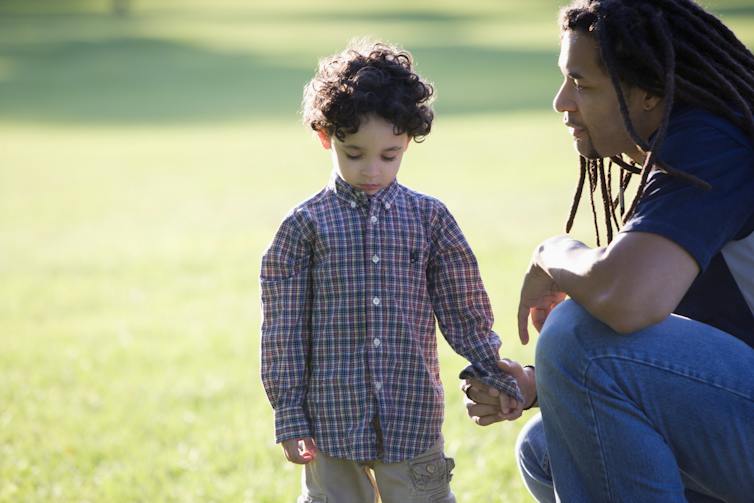
Imagine your child asks you out of the blue, “If we speak Spanish, will they take you away?” Or imagine them suddenly asking what an offensive slur means. When a child asks these types of questions, it can be difficult to trace them back to a specific news story or event. But you may not need to. The question itself tells you that your child is trying to make sense of something they heard.
As parents, we’ve each had some version of these conversations with our young children.
The fear takes different forms in different families. For some children, it’s a question about whether their family may be harmed because of the language they speak. For others, it may be about their skin color, gender, religion or the person they love. Underneath is often the same concern that young people across the country are grappling with: What do these messages mean for people like me?
Children whose identities aren’t directly targeted are listening too. Public discourse teaches children which differences are treated as ordinary, which are treated as suspect and who is allowed to belong without having to explain themselves.
As psychologists who study and treat anxiety and depression as well as research resilience among diverse groups of children and families, we frequently hear versions of this question in our work and at our kitchen tables.
Parents cannot control every message their child encounters, but they can help their child understand what those messages do and do not mean.
Table of Contents
Listen for the sideways question
Parents often imagine that an important conversation will announce itself clearly: “Something I heard on the news made me worried about being Latina.”
Usually, it doesn’t. A younger child may ask whether a classmate’s family is safe or whether something that happened to someone else could happen to them too. An older child may repeat something they saw online, make a joke or suddenly go quiet when a topic related to identity comes up.
Children often don’t have the vocabulary to name a fear directly or the confidence that a topic is safe to raise. We’ve seen this pattern again and again when we work with families in the clinic: Teasing a fear out by going sideways, such as through someone else’s situation or a hypothetical, can allow a child to gauge how an adult will react before deciding whether to ask their real question.

Ed Bock/The Image Bank via Getty Images
In our experience, younger children sometimes find it easier to talk about a worry through a drawing, a stuffed animal or a story about “a kid who felt scared about something” rather than addressing it head-on. If a direct question stalls out, shifting the format – rather than repeating the question – can help children open up.
Instead of immediately correcting or reassuring your child, get curious first. Research on how children respond to different kinds of questions has consistently found that open-ended prompts like “tell me more” draw out far more than direct or yes or no questions. That principle can be useful at the dinner table too: “What made you think about that?” may get further than “Are you scared about something?”
If a child says “I don’t know,” resist the urge to press further in that moment. Not knowing yet is a normal response; sometimes kids may need more time to make sense of a feeling before they can put words to it. You can leave the door open instead: “That’s OK. If you think of it later, I’m here.” This tells your child the invitation still stands without turning it into an interrogation.
Don’t leave the meaning blank
Parents sometimes avoid talking about difficult news because they don’t want to frighten their children. But if a child has heard people like them described as dangerous, defective, unwanted or less worthy, changing the subject doesn’t erase the message. Neither does staying silent. It simply leaves children to work out on their own what that message means about them.
Instead of changing the subject, minimizing what they heard or saying “don’t worry about it,” parents can answer directly: “Some people believe that, but we don’t.” They can tell their child directly that comments that demean someone because of who they are aren’t acceptable.
Research on ethnic-racial socialization – that is, the ways parents teach children about race and ethnicity – suggests that messages about cultural history, traditions and pride can be just as important for children’s self-esteem and sense of identity as conversations that prepare them for prejudice.
Studies on LGBTQ+ youth show a similar pattern: Greater family acceptance during adolescence is associated with higher self-esteem and better health, as well as lower rates of depression, substance use and suicidal thoughts.

Raja J/iStock via Getty Images
Parents can reassure their child that there is nothing wrong with being autistic or that they don’t need to be afraid of people who pray differently from them. They can confirm that they and their family belong – in this home, community and country – regardless of what anyone else says.
The goal isn’t to pretend discrimination doesn’t exist. It’s to help children – whether they are the ones being targeted or are watching it happen to someone else – separate what people say about an identity from what that identity actually means about a person’s worth.
Children deserve explicitly positive messages from trusted adults. Even when those messages seem obvious or your child already knows them, saying them out loud anyway could help reinforce that their worth was never actually in question. It can also give children something to hold onto when they encounter hurtful messages in the future.
Don’t wait for a crisis to talk about identity
Silence itself can take a toll. Research has linked avoiding conversations about ongoing threats to worse mental health in children during times of crisis.
Making identity an ordinary part of family life can help children experience it as a source of pride rather than only a subject of conflict. Families can talk casually about culture and history, and challenge stereotypes when they encounter them. They can present difference as natural instead of as a tragedy or include people of different identities in everyday conversations.

Miljan Živković/iStock via Getty Images Plus
These conversations don’t need to start with a big, formal sit-down, and starting small may actually work better. Research suggests the earlier and more casually these topics about identity come up, the more normal they become. This could look like pointing out a character’s different skin tone in a board book, or noticing aloud why a toy aisle is divided by color. Waiting for a “big talk” can actually make the topic feel heavier than it needs to.
The message is simple: This part of you did not become unworthy of love, respect or belonging because someone attacked it. It was worthy before the headline appeared.
Come back to the conversation
Whereas adults may be able to more quickly move on with their daily lives after feeling disturbed or frightened by upsetting media, children may experience more elevated and prolonged stress.
A child who heard someone on the news describe people like those in their family as a threat in May may still be carrying that message in August. Studies that followed African American adolescents and Latino/a adolescents have found a link between experiences of discrimination and depressive symptoms that linger years later.
So come back to the conversation. Let a week or two pass, and then follow up with your child. For example: “Remember when you told me about the comment you heard that made your stomach feel yucky? Have you thought about it or had that yucky feeling again?”
Your child may say they haven’t thought about it. Nonetheless, research suggests that repeated conversations that promote pride in a young person’s identity can protect them against ongoing racial discrimination. One study found that for LGBTQ+ youth who often experience frequent and ongoing stress and discrimination related to their identity, continuous explicit affirmation from their parents can serve as a powerful buffer: “I will always love and support you and make sure you get the respect that you deserve.”
Why parents should speak now
Often, the question a child is actually asking, underneath the silence, the joke or the shrugged-off comment is simple: Am I OK? Is there something wrong with people like me?
The majority of children in the U.S. are children of color, LGBTQ+ or neurodivergent, or they live in households with at least one undocumented family member.
These children are growing up in a world where parts of who they are are debated, stigmatized or portrayed as problems in public discourse, and the news is not background noise. They may encounter stories about immigration raids and deportation threats; anti-trans political advertising; violence targeting people because of their race or religion; commentary portraying autism, dyslexia or mental health care in demeaning or misleading ways.
Elevate Your Health for Just $29.99/Month
Join the Precision Wellness Subscription at My Healing 365 and get discounted services, priority coaching access, virtual care, and exclusive wellness resources to support your physical, emotional, and hormonal health.
Join for $29.99/MonthAcross these stories, children may hear the same underlying question: Are people like me accepted and valued, or are we considered a problem?
Research has linked racial and ethnic discrimination and identity-related stigma to a wide range of negative outcomes in adolescence, including depression, poor self-esteem and declines in academic engagement. A 2023 report from The Trevor Project, a nonprofit focusing on suicide prevention among LGBTQ+ youth, documented that 86% of transgender and nonbinary youth said public debates over anti-trans bills had negatively affected their mental health.
The point isn’t that every identity or every form of discrimination works the same way. But parents giving consistent messages of “you are worthy and you belong” to their children can help them heal.

Aflo Images/Getty Images
When our own children express fears that who they are may put their family in danger, we don’t have a perfect answer ready. What we tell them, more or less, is that they heard some scary and untrue things, and that who we are and where we come from are things we never need to be ashamed of. It’s not the last time we’ll talk about it, and that’s the point.
Parents cannot create a world where their children never encounter prejudice or misinformation about who they are. But they can help their children make sense of what they heard, separate someone else’s hate from their self-worth and return to the conversation after everyone else has moved on.
So speak now. And continue to speak. Not because the news reminded you to, but because your child will be listening.






















