

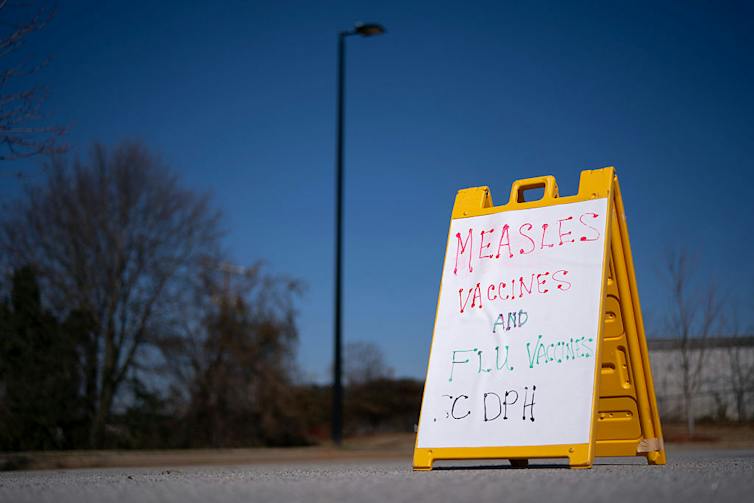
Pennsylvania is experiencing its worst measles outbreak in more than three decades, with more than 1,400 confirmed cases and six measles-associated deaths so far in 2026, according to statistics compiled by the state.
Each new case brings a new warning of a measles exposure in that community. Exposures have occurred at hospitals and doctors’ offices, grocery stores and restaurants, and K-12 schools and universities.
Exposure alerts come with the same instructions: Check your MMR vaccine status, and watch for symptoms for the next three weeks. People are told that two doses of the measles, mumps and rubella vaccine are 97% effective at preventing measles. The underlying message is that if you’re vaccinated, you’re protected.
The MMR vaccine is highly effective at preventing disease, but it isn’t a guarantee. People may hear that 97% figure and wonder about the other 3%.
Parents ask me: Should I be worried? How do I know if my kid has measles? Do I need an MMR booster? Most recently, my teenage daughter texted me to ask about her MMR vaccine status. She was worried about what would happen if she were exposed.
These are questions I can answer as both a mother and an epidemiologist in northwestern Pennsylvania. I became both at once. My daughter was born at the start of my doctoral program, and I read epidemiology textbooks aloud to her while studying for my comprehensive exams. I defended my dissertation on my son’s due date. I’m a better mother because I’m an epidemiologist, and a better epidemiologist because I’m a mom.
Table of Contents
Are these measles exposure alerts cause for alarm?
The advice in each public measles exposure alert matches the guidance doctors follow when a patient may have been exposed.
Everyone is asked to watch for symptoms, whether or not they’re vaccinated. The number of unvaccinated people across Pennsylvania is growing. As a result, many communities, including Allegheny County, no longer have herd immunity.
Four of the over 1,400 confirmed measles cases in Pennsylvania were people who had been vaccinated. These cases are known as breakthrough infections.

Sean Rayford/Stringer via Getty Images News
The term “herd immunity” wasn’t coined until 1918. That year, a veterinarian wrote about an outbreak of “contagious abortion” in sheep and cattle, a literal herd. Today, herd immunity means that the risk of disease for susceptible people, those without immunity, drops when they are surrounded by people who are immune.
In other words, if the people around you are immune, you’re unlikely to get sick even if you’re susceptible. For measles, that protection depends on about 95% of people being immune. In a school or community where fewer than 95% of people are vaccinated, measles can spread more easily.
In Allegheny County, 93.8% of children are fully vaccinated against measles. Some neighborhoods are above 97% uptake, while others are below the necessary 95% needed for herd immunity.
What happens after an exposure?
Measles exposures are announced publicly by the Department of Health and local healthcare providers. During a measles outbreak, public health departments may get in touch with close contacts to alert them to an exposure.
Public exposure alerts, like the one made in October after there was a measles exposure at a Target near Pittsburgh, are also used. Public alerts are for settings where exposed people can’t be identified and contacted individually. Measles is so contagious that a single case can infect up to 18 susceptible people.
Measles spreads through the air and through respiratory droplets, like those released when someone sneezes. The virus can also survive outside the body, lingering in the air and on surfaces.
Imagine I have measles and walk into my local grocery store. I’m contagious from about four days before the rash appears until four days after. Every time I breathe out, I release virus particles into the air, and those particles can stay infectious for up to two hours. If I sneeze in the produce section, the virus can survive on surfaces for up to two hours.
However, if you’ve had measles or were vaccinated with two doses of the MMR vaccine, you are protected. Two doses provides 97% lifetime protection against measles. This means that even without herd immunity, fewer than 3% of individuals with immunity are likely to contract measles. Adults who have had measles, or who have documentation of the recommended doses of the MMR vaccine, don’t need a booster.
People who were vaccinated between 1963 and 1967, or who aren’t sure which vaccine they received, should talk to their primary care provider about whether they need another dose. This is because the measles vaccine used between those years was not as effective as the MMR vaccine that is currently given.
Today, children typically get their first dose of the MMR vaccine at 12 to 15 months old and a second dose at 4 to 6 years old. Because the vaccine is given in early childhood, people born in the early to mid-1960s are the most likely to have received the older vaccine. People born before 1957 are generally considered immune, because measles was so widespread then that almost everyone caught it as a child.
What are the symptoms of measles?
Symptoms of measles include a high fever that can reach 105 degrees Fahrenheit (40.6 degrees Celsius), a cough, a runny nose and conjunctivitis, also known as pin keye. These symptoms overlap with those of other respiratory viruses, such as flu and COVID-19.
Most people with measles develop a red, blotchy rash. It starts on the face and spreads down the body, like paint poured from a bucket. People who are immunocompromised or were previously vaccinated, even with one dose of the MMR vaccine, may not develop the rash. Between 25% and 40% of immunocompromised people with measles never get the rash.
A telltale sign of measles is Koplik spots, tiny white spots inside the mouth that can show up a day or two before the rash.
Why does measles keep making headlines?
Measles can have serious consequences. About 1 in 20 people with measles develop pneumonia, and up to 3 in 1,000 cases end in death. Children younger than 5 and adults older than 20 are most likely to experience these severe complications.
Without herd immunity in many communities, measles cases, hospitalizations and deaths in Pennsylvania are likely to keep rising. The state Department of Health reports community spread of measles in 14 of Pennsylvania’s 67 counties.
Each of these cases is mostly preventable with the MMR vaccine. The U.S. declared measles eliminated in 2000, meaning it was no longer spreading continuously here. This year’s outbreak shows how quickly that can change and the negative health consequences it can have in our communities.
Read more of our stories about Pittsburgh and Pennsylvania.