

Disclosure: This site contains some affiliate links. We might receive a small commission at no additional cost to you.
Medically Reviewed
Dr. Jose Rossello, MD, PhD, MHCM
Preventive Medicine & Public Health Specialist
Last Reviewed: August 1, 2026
Table of Contents
Introduction: Why This Lab Value Gets So Much Attention
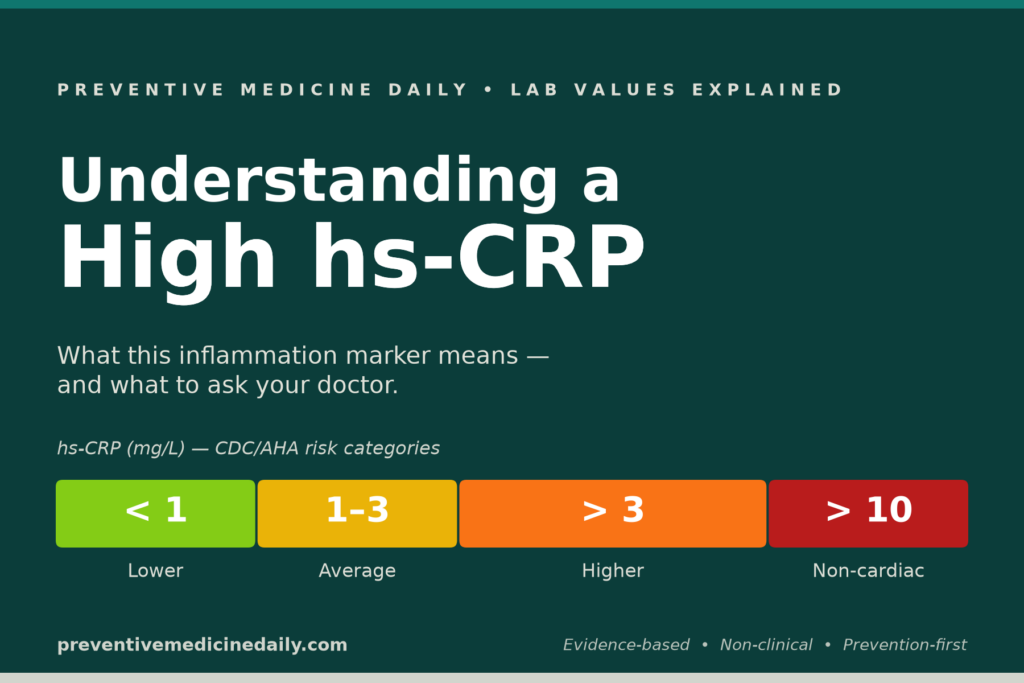
High-sensitivity C-reactive protein (hs-CRP) is one of the most talked-about lab values in preventive cardiology — and one of the most misunderstood. If your result came back “high,” you may be wondering whether something is wrong inside your body, whether your heart is at risk, or whether the number will simply go back down on its own.
The short, honest answer is that a high hs-CRP is a signal, not a diagnosis. It tells your clinician that your body is producing more C-reactive protein than usual, which usually reflects some level of inflammation somewhere. That “somewhere” can range from a passing cold to a chronic condition that quietly raises long-term cardiovascular risk.¹,²
This article explains what hs-CRP actually measures, how the numbers are interpreted, what typically drives elevations, and what questions are reasonable to bring to your next appointment.
What hs-CRP Actually Measures
C-reactive protein (CRP) is a protein made by the liver in response to inflammatory signals — mainly interleukin-6 (IL-6) — released by immune cells and tissues under stress.¹ The “high-sensitivity” version of the test (hs-CRP) can detect very low levels, which is why it is used in cardiovascular risk assessment rather than only in acute illness.²,³
Regular CRP is typically used when clinicians suspect infection, a flare of an autoimmune disease, or another acute inflammatory event. Hs-CRP is used to pick up the low-grade, chronic inflammation linked to atherosclerosis and long-term cardiovascular risk.²,³
Both tests measure the same protein. The difference is the sensitivity of the assay and the clinical question being asked.
How the Numbers Are Interpreted
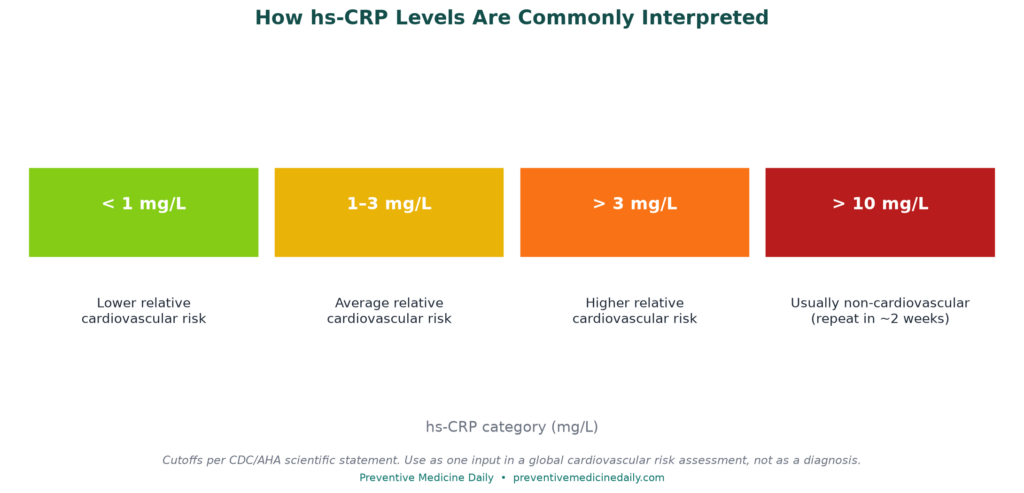
The most widely referenced cutoffs come from the CDC/AHA scientific statement on inflammatory markers and cardiovascular disease:²
- Less than 1 mg/L — lower relative cardiovascular risk
- 1 to 3 mg/L — average relative cardiovascular risk
- Greater than 3 mg/L — higher relative cardiovascular risk
- Greater than 10 mg/L — usually reflects a non-cardiovascular cause (infection, injury, flare of an inflammatory condition) and is generally repeated after 2 weeks before it is used for cardiovascular risk assessment²
These cutoffs are used in the context of overall risk, not as a stand-alone verdict. Guidelines specifically recommend hs-CRP be considered as an adjunct to global risk assessment, most useful in adults at intermediate risk where it may refine the decision about preventive therapy.²,³
 10 mg/L (red, usually non-cardiovascular; repeat in ~2 weeks).” class=”wp-image-38258″ srcset=”https://twenty47healthnews.com/wp-content/uploads/2026/08/hscrp_1_cutoffs-1024×493-1.png 1024w, https://www.preventivemedicinedaily.com/wp-content/uploads/2026/08/hscrp_1_cutoffs-300×144.png 300w, https://www.preventivemedicinedaily.com/wp-content/uploads/2026/08/hscrp_1_cutoffs-768×370.png 768w, https://www.preventivemedicinedaily.com/wp-content/uploads/2026/08/hscrp_1_cutoffs-1536×740.png 1536w, https://www.preventivemedicinedaily.com/wp-content/uploads/2026/08/hscrp_1_cutoffs-2048×986.png 2048w” sizes=”auto, (max-width: 1024px) 100vw, 1024px”>
What Happens Inside the Body When hs-CRP Is Persistently High
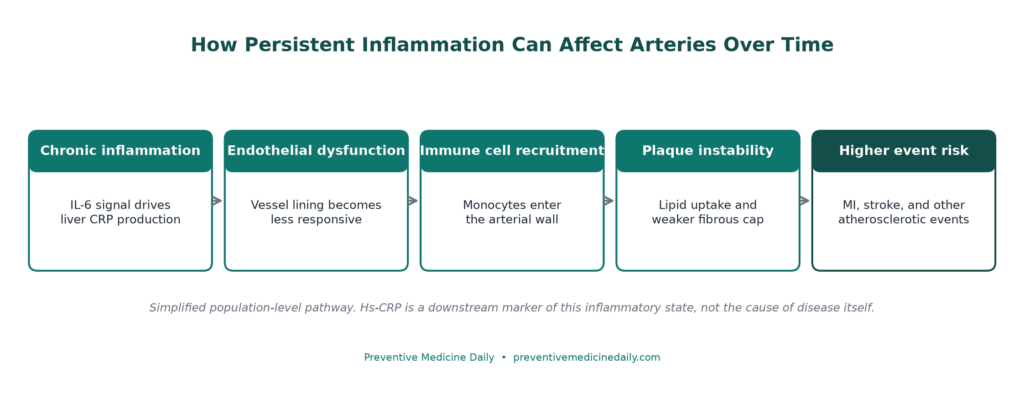
When hs-CRP stays elevated over time, it usually reflects ongoing low-grade inflammation. In large cohort studies, cumulative exposure to higher hs-CRP is associated with a dose-dependent increase in cardiovascular disease and myocardial infarction risk, independent of traditional risk factors like LDL cholesterol.⁴,⁵
Mechanistically, chronic inflammation contributes to:¹,⁶
- Endothelial dysfunction (the inner lining of blood vessels becomes less responsive and more permeable)
- Recruitment of immune cells into arterial walls
- Plaque formation and, importantly, plaque instability
- A more pro-thrombotic environment
This is why cardiology now speaks of two parallel drivers of risk: residual cholesterol risk and residual inflammatory risk. The landmark CANTOS trial showed that lowering inflammation with an anti-IL-1β therapy reduced cardiovascular events without changing LDL, confirming that inflammation itself contributes causally to atherosclerotic disease.⁷
It is important not to overinterpret this at the individual level. Hs-CRP improves risk stratification in populations, but on its own it does not perform better than standard risk equations, and adding it produces modest improvements in reclassification.⁸
Common Non-Cardiovascular Reasons hs-CRP Can Be High
Because CRP responds to inflammation from many sources, a single high result does not automatically point to the heart. Common contributors include:²,¹
- Recent infection (even minor viral illness)
- Recent injury, surgery, or dental procedure
- Autoimmune or inflammatory conditions (rheumatoid arthritis, lupus, inflammatory bowel disease, psoriasis)
- Obesity and metabolic syndrome (adipose tissue itself produces inflammatory signals)
- Smoking
- Poor sleep and chronic psychological stress
- Periodontal disease
- Pregnancy and hormonal factors
- Certain medications and, conversely, some medications (like statins) can lower hs-CRP
This is why guidelines suggest repeating hs-CRP roughly 2 weeks apart and using the average of two measurements when the goal is cardiovascular risk assessment, and evaluating persistently elevated values ≥10 mg/L for non-cardiovascular causes.²
What “High” May Mean for You, in General Terms
If your hs-CRP is elevated, general population-level evidence suggests a few things worth understanding:
- A single elevated value is not diagnostic. Timing and context matter.²
- Persistently elevated hs-CRP is associated with higher long-term cardiovascular event risk, particularly in people with other risk factors.³,⁴,⁵
- Elevated hs-CRP may prompt a closer look at modifiable factors: weight, blood pressure, lipids, glucose, physical activity, sleep, tobacco use, and stress.¹,³
- In some intermediate-risk adults, hs-CRP can inform (not decide) conversations about preventive strategies.²,³
None of this substitutes for individualized evaluation by your clinician, who can weigh your full history, other labs, and risk profile.
General, Population-Level Ways Inflammation Tends to Improve
Evidence-based lifestyle patterns associated with lower systemic inflammation in populations include:¹,³
- Regular moderate physical activity
- Dietary patterns rich in vegetables, fruits, legumes, whole grains, nuts, and fatty fish (e.g., Mediterranean-style eating)
- Achieving and maintaining a healthy weight
- Not smoking
- Adequate, consistent sleep
- Management of chronic conditions (blood pressure, diabetes, autoimmune disease) with a clinician
- Good oral and periodontal health
These are general educational points, not a prescription.
Questions to Discuss With Your Clinician
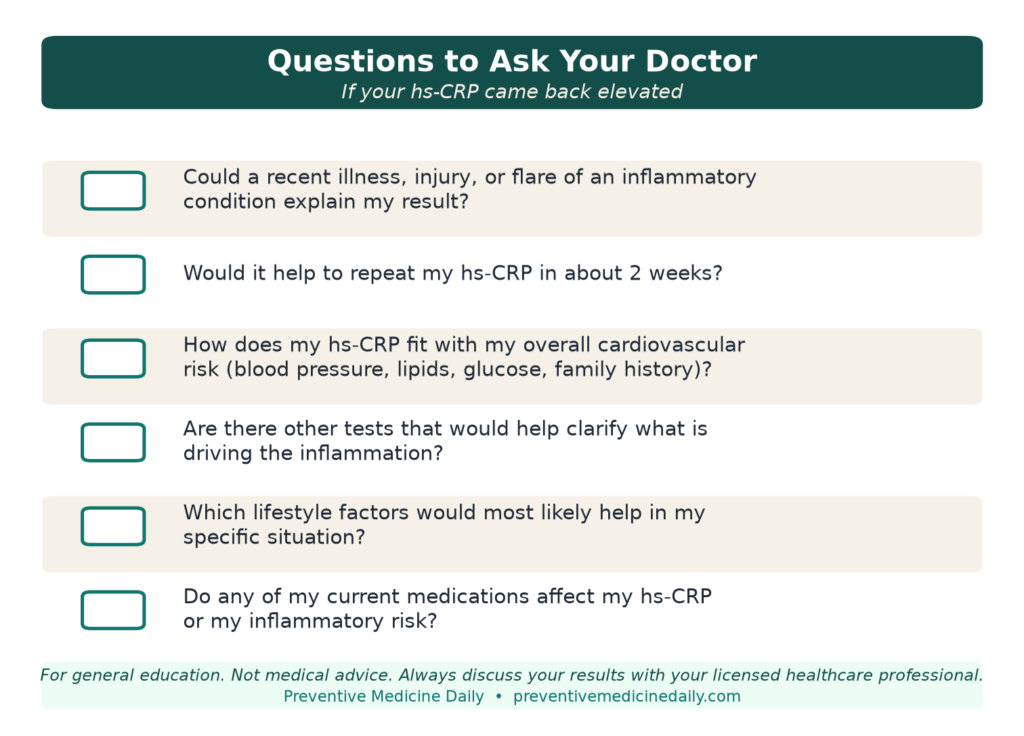
Consider bringing questions like these to your next visit:
- Could a recent illness, injury, or flare explain my result?
- Would repeating hs-CRP in about 2 weeks be helpful?
- How does my hs-CRP fit with my overall cardiovascular risk (blood pressure, lipids, glucose, family history)?
- Are there other tests that would help clarify what is driving inflammation?
- Which lifestyle factors would most likely help in my specific situation?
- Does my current medication list affect my hs-CRP or my inflammatory risk?
Key Takeaways
- Hs-CRP measures low-grade inflammation and is used mainly to refine cardiovascular risk assessment.²,³
- Common cutoffs: 3 mg/L; values >10 mg/L usually reflect non-cardiovascular causes and are typically repeated.²
- Persistently elevated hs-CRP is linked in population studies to higher long-term cardiovascular risk.⁴,⁵,⁷
- Many non-cardiac factors can raise hs-CRP, so context and repeat testing matter.²
- Hs-CRP is one input among many; interpretation belongs in a conversation with your clinician.²,³
Frequently Asked Questions
Is a high hs-CRP dangerous by itself?
Not on its own. It is a marker of inflammation, not a disease. Its meaning depends on your overall picture and whether it stays elevated over time.²,³
Can hs-CRP go back down?
Yes. Values often fluctuate with acute illness, injury, or short-term stressors, and can improve with sustained changes in weight, activity, smoking status, and management of underlying conditions.¹,²
Should everyone get hs-CRP tested?
No. Guidelines position hs-CRP as most useful in adults at intermediate cardiovascular risk, not as a universal screen.²,³
Is a very high hs-CRP (>10 mg/L) always serious?
It is generally not used for cardiovascular risk assessment at that level and typically prompts evaluation for infection, injury, or an active inflammatory condition, with a repeat test after ~2 weeks.²
Disclaimer
This content is for general educational purposes only and is not medical advice. It does not create a doctor-patient relationship. Always talk to your licensed healthcare professional about your specific situation.
References
- Silva-Obregón A, Viana-Llamas M, Avanzas P, Arroyo-Espliguero R. The role of C-reactive protein in patient risk stratification and treatment. Eur Cardiol. 2021;16:e22. Available from: PubMed Centralpmc.ncbi.nlm.nih[1]
- Pearson TA, Mensah GA, Alexander RW, et al. Markers of inflammation and cardiovascular disease: application to clinical and public health practice: a statement for healthcare professionals from the Centers for Disease Control and Prevention and the American Heart Association. Circulation. 2003;107(3):499–511. Available from: AHA Journalsahajournals
- Teoh H, Oh J, Leiter LA. Should C-reactive protein be a target of therapy? Diabetes Care. 2011;34(Suppl 2):S155–S160. Available from: PubMed Centralpmc.ncbi.nlm.nih[2]
- Wang A, Liu J, Li C, et al. Cumulative exposure to high-sensitivity C-reactive protein predicts the risk of cardiovascular disease. J Am Heart Assoc. 2017;6(10):e005610. Available from: PubMed Centralpmc.ncbi.nlm.nih[3]
- Lee H, Lee JH. Early elevation of high-sensitivity C-reactive protein as a predictor for cardiovascular disease incidence and all-cause mortality: a landmark analysis. Sci Rep. 2023;13:14118. Available from: PubMed Centralpmc.ncbi.nlm.nih[4]
- Fatima Z, Shakeel R, Chaudhry SAA, et al. The relation between C-reactive protein and risk of incident heart failure in patients with cardiovascular disease: a narrative review. Ann Med Surg. 2025. doi:10.1097/MS9.0000000000003455. Available from: LWW Journalsjournals.lww[5]
- Ridker PM. Canakinumab for residual inflammatory risk. Eur Heart J. 2017;38(48):3545–3548. Available from: Oxford Academicacademic.oup[6]
- Shah T, Casas JP, Cooper JA, et al. Critical appraisal of CRP measurement for the prediction of coronary heart disease events: new data and systematic review of 31 prospective cohorts. Int J Epidemiol. 2009;38(1):217–231. Available from: PubMed Central[7]
Views: 241
References
- Arroyo-Espliguero R, Viana-Llamas MC, Silva-Obregón A, Avanzas P. The Role of C-reactive Protein in Patient Risk Stratification and Treatment. European Cardiology Review [Internet]. 2021. doi: 10.15420/ecr.2020.49. Available from: https://pmc.ncbi.nlm.nih.gov/articles/PMC8280753/. Accessed November 7, 2026
- Oh J, Teoh H, Leiter LA. Should C-Reactive Protein Be a Target of Therapy?. Diabetes Care [Internet]. 2011. doi: 10.2337/dc11-s211. Available from: https://pmc.ncbi.nlm.nih.gov/articles/PMC3632154/. Accessed November 7, 2026
- Wang A, Liu J, Li C, Gao J, Li X, Chen S, et al. Cumulative Exposure to High‐Sensitivity C‐Reactive Protein Predicts the Risk of Cardiovascular Disease. Journal of the American Heart Association [Internet]. 2017. doi: 10.1161/JAHA.117.005610. Available from: https://pmc.ncbi.nlm.nih.gov/articles/PMC5721824/. Accessed November 7, 2026
- Lee HS, Lee JH. Early elevation of high-sensitivity C-reactive protein as a predictor for cardiovascular disease incidence and all-cause mortality: a landmark analysis. Scientific Reports [Internet]. 2023. doi: 10.1038/s41598-023-41081-w. Available from: https://pmc.ncbi.nlm.nih.gov/articles/PMC10465521/. Accessed November 7, 2026
- Fatima Z, Shakeel R, Chaudhry SAA, Qadri M, Kakar AI, Ahmad B, et al. The relation between C-reactive protein (CRP) and risk of incident heart failure in patients with cardiovascular disease: a narrative review. Annals of Medicine & Surgery [Internet]. 2025. doi: 10.1097/MS9.0000000000003455. Available from: https://journals.lww.com/10.1097/MS9.0000000000003455. Accessed November 7, 2026
- [VERIFY] [Title unavailable — verify manually | academic.oup.com]. [Internet]. Available from: https://academic.oup.com/eurheartj/article/38/48/3545/4767710. Accessed November 7, 2026
- Shah T, Casas JP, Cooper JA, Tzoulaki I, Sofat R, McCormack V, et al. Critical appraisal of CRP measurement for the prediction of coronary heart disease events: new data and systematic review of 31 prospective cohorts. International Journal of Epidemiology [Internet]. 2008. doi: 10.1093/ije/dyn217. Available from: https://pmc.ncbi.nlm.nih.gov/articles/PMC2639366/. Accessed November 7, 2026