

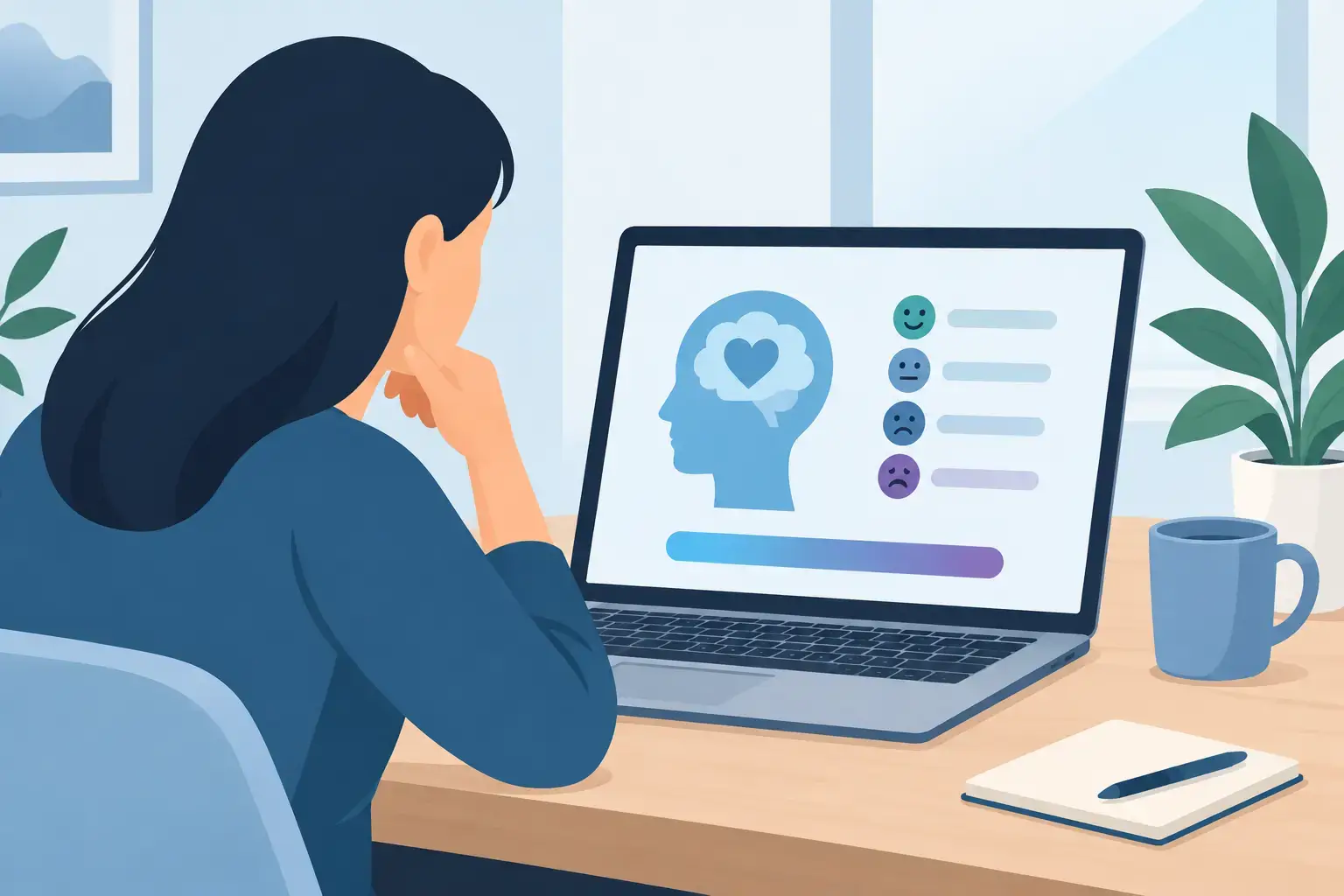
Some days, depression looks less like sadness and more like letting emails pile up, sleeping at odd hours, or feeling disconnected from people you love. An online depression screening can give those experiences a name and help you decide whether it is time to seek support. It is private, quick, and often easier to start than explaining everything face-to-face before you are ready.
A screening is not meant to label you or replace a clinical evaluation. It is a practical first step that can help you notice patterns, understand the level of concern, and move toward care with more clarity.
Table of Contents
What online depression screening measures
Most reputable screenings ask about common symptoms over a recent period, often the past two weeks. Questions may cover low mood, loss of interest, changes in sleep or appetite, fatigue, concentration, self-critical thoughts, and how much these experiences are affecting daily life.
The goal is not to judge your answers. It is to identify whether your symptoms may be consistent with depression and whether professional support could be helpful. Some tools use a validated questionnaire, such as the PHQ-9, while others use similar clinical questions as part of an intake process.
Your result may suggest minimal, mild, moderate, or more significant symptoms. That can be useful information, but it is still only one part of the picture. Grief, burnout, anxiety, medication changes, chronic health conditions, alcohol use, trauma, and major life transitions can all affect how you feel. A licensed provider can look beyond a score and help make sense of what is happening in your life.
Why a screening can be easier than waiting
Many people wait for a moment when they feel certain that something is wrong. Depression rarely works that neatly. Symptoms can build gradually, and you may keep functioning at work or at home while feeling increasingly exhausted underneath it all.
An online screening lowers the barrier to checking in. You can complete it from home, between meetings, after the kids are asleep, or whenever you have enough privacy to answer honestly. For people who have put off care because of travel, long appointment waits, cost concerns, or stigma, that first small step matters.
It can also give you language for a conversation with a provider. Instead of saying, “I just haven’t felt like myself,” you may be able to describe changes in sleep, motivation, focus, and mood more clearly. That makes it easier to begin a treatment discussion that fits your needs.
A result is information, not a diagnosis
A high score does not automatically mean you have a depressive disorder, and a low score does not mean you should ignore what you are feeling. Screenings are designed to flag possible concerns, not deliver a final diagnosis.
Context matters. For example, a person grieving a recent loss may report several symptoms that overlap with depression. Another person may score in a lower range but still feel unable to get through the day. In both cases, talking with a qualified clinician can be worthwhile.
Think of the screening as a check engine light, not a full repair report. It can tell you that something deserves attention. A provider helps identify what support may be appropriate next.
What to do after an online depression screening
The right next step depends on your symptoms, their duration, and how much they are disrupting your life. If your results suggest mild symptoms, you may decide to monitor changes, improve sleep routines, reconnect with supportive people, or speak with a provider before symptoms become more difficult to manage.
If symptoms are persistent, worsening, or interfering with work, relationships, parenting, or self-care, consider scheduling an evaluation with a licensed mental health professional. Online care can be a practical option for adults who want discreet access without adding another commute or waiting room to an already demanding week.
A clinical evaluation is more personal than a screening. A provider may ask about your health history, current medications, stressors, past treatment, and goals. From there, they can discuss options such as therapy, lifestyle support, medication when clinically appropriate, or a combination of approaches. There is no single treatment plan that works for everyone.
At My Healing 365, licensed providers can evaluate symptoms online and create individualized treatment plans for eligible adults. Ongoing messaging and treatment guidance can make it easier to stay connected to care, especially when life makes regular office visits difficult.
When to seek help sooner
You do not need to wait for symptoms to become unbearable before reaching out. Prompt support is especially worth considering if you are withdrawing from others, struggling to complete basic tasks, using substances to cope, or feeling hopeless most days.
If you are having thoughts of harming yourself, feel unable to stay safe, or believe someone else may be in immediate danger, do not rely on an online screening alone. Call or text 988 to reach the Suicide & Crisis Lifeline in the United States, call 911, or go to the nearest emergency room. If possible, tell someone you trust and avoid being alone while you get immediate help.
How to choose a screening you can trust
Not every online quiz is built the same way. A useful depression screening should explain that it is a screening tool rather than a diagnosis. It should use clear symptom-based questions, protect your privacy, and point you toward appropriate care rather than making dramatic promises.
Be cautious with quizzes that claim to diagnose you in minutes, recommend a specific medication without a clinical evaluation, or use your answers mainly to pressure you into a purchase. Mental health support should feel respectful and informed, not rushed.
If you decide to continue with telehealth treatment, look for a service that connects you with licensed providers, explains how privacy is handled, and gives you a clear picture of costs and follow-up care. Convenience is valuable, but it should come with real clinical oversight.
Getting the most honest result
A screening only reflects what you share, so try to answer based on your typical experience rather than your best day or your worst moment. Consider the recent time frame in each question. If you are unsure, choose the response that feels most accurate overall.
It may help to complete the screening somewhere you will not feel interrupted or watched. Privacy can make it easier to acknowledge symptoms you have minimized, especially irritability, loss of interest, or thoughts that you are a burden. Depression does not always look like crying or staying in bed. Sometimes it looks like numbness, overworking, frustration, or feeling like every small task takes too much effort.
If you have screened before, comparing results over time can be helpful, but do not treat the numbers as a grade. Progress is rarely perfectly linear. A changing score is simply another piece of information to bring to your provider.
You deserve a next step that feels manageable
Taking an online depression screening does not commit you to medication, therapy, or any one path. It gives you a private moment to check in with yourself and consider what kind of support could help. If your answers show that you have been carrying more than you realized, reaching out can be a strong and practical choice.
You do not have to wait until you can no longer push through. Start with an honest check-in, then choose the next step that makes care feel possible.