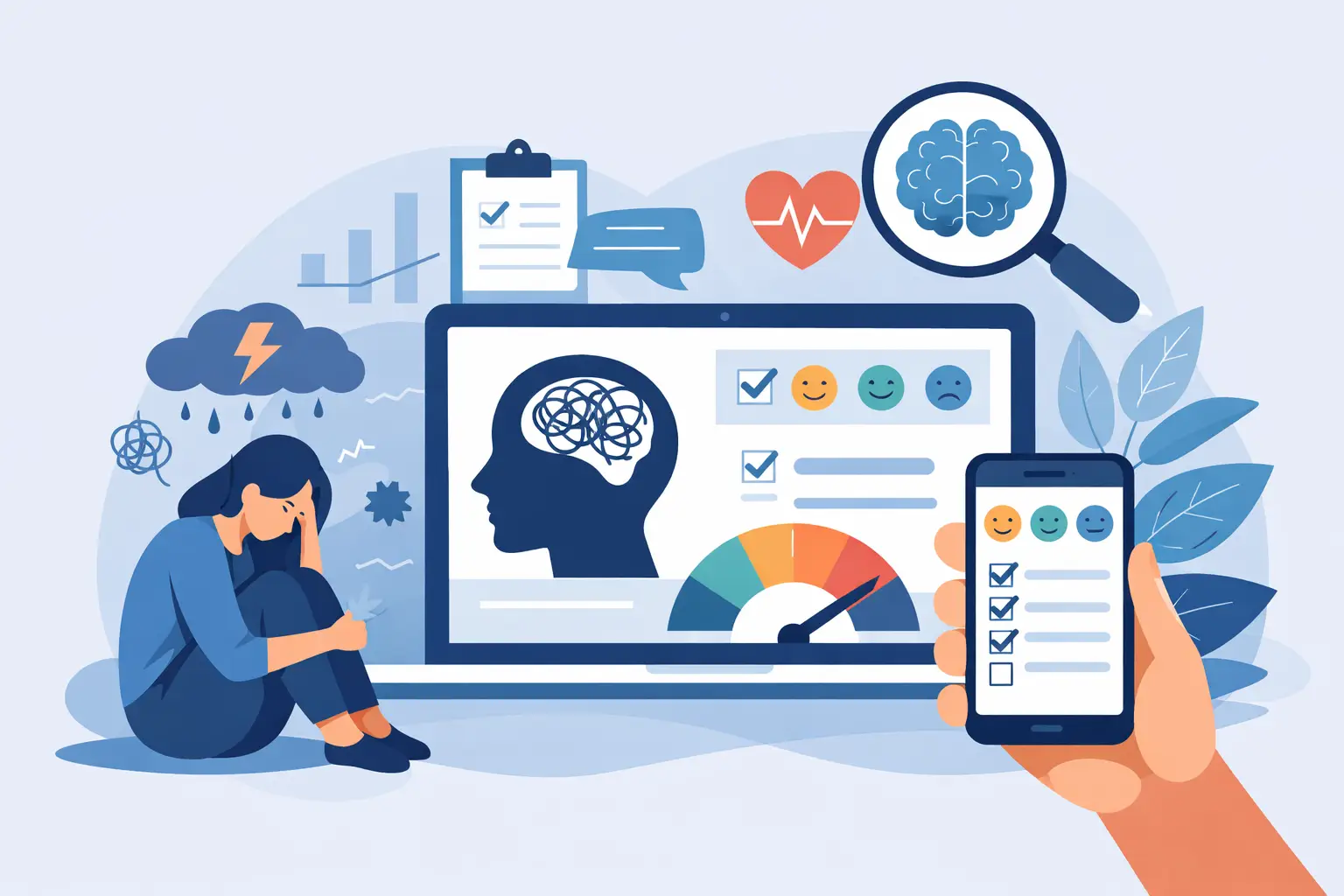
Your heart races before a meeting. You replay a short text message for an hour. Sleep feels lighter, your shoulders stay tense, and ordinary tasks require more effort than they should. The best online anxiety assessment tools can give those experiences a clearer name and help you decide on a practical next step.
A good assessment does not diagnose you or replace a conversation with a licensed provider. It is a screening tool: a structured set of questions that helps identify whether anxiety symptoms may be affecting your daily life. That distinction matters. A score can be useful information, but it is not the whole story of what you are carrying.
Table of Contents
What an online anxiety assessment can tell you
Online anxiety screenings generally ask about symptoms over a recent period, often the last two weeks. Questions may cover excessive worry, feeling on edge, restlessness, irritability, trouble concentrating, muscle tension, sleep changes, and how difficult these symptoms make work, relationships, or everyday responsibilities.
The value is not just the final score. Completing a short questionnaire can help you pause and notice patterns you may have been minimizing. Maybe your worry is mostly tied to a major life change. Maybe it shows up as physical discomfort or disrupted sleep. Maybe it has become hard to turn your mind off, even during time that is supposed to feel restful.
For many people, privacy and convenience make an online assessment easier than waiting for a traditional appointment. You can answer honestly from home, at a time that works for you, without having to explain everything perfectly on the first try.
Still, an assessment has limits. Anxiety can overlap with depression, attention concerns, trauma responses, medication effects, thyroid conditions, sleep problems, substance use, and other health issues. A high or low result should be considered alongside your symptoms, health history, and what is happening in your life.
The best online anxiety assessment tools use validated screening questions
Not every online quiz is equally helpful. Some are designed mainly for entertainment or collect personal information without clearly explaining how it will be used. Look for an assessment based on a recognized clinical screening measure, with clear language about what the results can and cannot tell you.
GAD-7
The Generalized Anxiety Disorder-7, commonly called the GAD-7, is one of the most widely used anxiety screening questionnaires. It asks seven questions about common anxiety symptoms over the past two weeks. Because it is brief and focused, it is often a useful starting point for someone who feels persistently worried, tense, or unable to relax.
The GAD-7 is a screening measure, not a diagnosis. It can flag symptoms that deserve more attention, but a licensed provider will consider the larger picture before recommending treatment.
OASIS
The Overall Anxiety Severity and Impairment Scale, or OASIS, focuses on how much anxiety affects your life. It asks about the frequency and intensity of anxiety, avoidance, and interference with responsibilities or relationships.
This can be especially helpful if you are unsure whether your anxiety is “bad enough” to seek support. Symptoms do not need to look dramatic to deserve care. If anxiety is shrinking your routines, limiting your choices, or taking up too much mental space, that impact is meaningful.
Beck Anxiety Inventory
The Beck Anxiety Inventory, often called the BAI, places more emphasis on physical symptoms such as numbness, dizziness, trembling, sweating, or a racing heart. It can help identify the body-based side of anxiety, but it also requires context. Some physical symptoms can have medical causes, so do not assume anxiety is the only explanation.
DASS-21 anxiety scale
The Depression, Anxiety, and Stress Scales short form, known as the DASS-21, looks at related emotional experiences through separate subscales. It may be useful when anxiety feels mixed with low mood, stress, or burnout.
Elevate Your Health for Just $29.99/Month
Join the Precision Wellness Subscription at My Healing 365 and get discounted services, priority coaching access, virtual care, and exclusive wellness resources to support your physical, emotional, and hormonal health.
Join for $29.99/MonthA broader tool can offer helpful perspective, but it can also leave you with more questions. If your results suggest symptoms across more than one area, a provider conversation can help sort through what support makes sense.
How to choose an anxiety screening you can trust
The most useful assessment is one that respects both your time and your privacy. Before entering personal details, check whether the platform explains who created the questionnaire, whether it uses validated questions, and how it protects your information.
Also look at what happens after your results appear. A responsible tool should explain that screening results are not a diagnosis and offer appropriate next steps. It should not pressure you with alarming language, promise a cure, or make medication recommendations based only on a quiz.
The best experiences make it easy to move from insight to support. That could mean tracking symptoms, discussing results with your primary care clinician, speaking with a therapist, or meeting with a licensed telehealth provider. If a platform offers treatment, it should be transparent about provider credentials, costs, communication options, and how follow-up care works.
How to get a more useful result
Take the assessment during a relatively calm moment, rather than in the middle of a panic response or a rushed workday. Read each question carefully and answer based on your typical experience during the stated time frame, not just your best day or worst day.
Try not to edit your answers to make them sound more acceptable. Anxiety often encourages people to second-guess themselves. Honest answers give you a better starting point, whether your result is low, moderate, or high.
It can help to write down a few details before or after the screening: when symptoms began, what seems to trigger them, how they affect sleep or concentration, and what you have already tried. These notes can make a future provider visit feel more focused and less overwhelming.
What to do after an online anxiety assessment
If your result suggests mild symptoms and your daily functioning is mostly intact, you may choose to monitor patterns for a few weeks while building supportive habits. Regular sleep, movement, reduced caffeine if it worsens symptoms, social connection, and structured stress-management practices can all be part of a larger plan. These steps are not a test of willpower, and they may not be enough on their own for everyone.
If anxiety is persistent, worsening, or affecting your work, relationships, sleep, or ability to enjoy life, consider connecting with a licensed provider. Treatment may include therapy, lifestyle support, medication when clinically appropriate, or a combination of approaches. The right plan depends on your symptoms, medical history, preferences, and goals.
Virtual care can be a practical option when scheduling, distance, privacy, or long wait times make in-person care harder to access. My Healing 365 offers online mental health support with licensed providers, individualized treatment plans, and ongoing messaging, so you can discuss symptoms and next steps without adding another clinic visit to your week.
When to seek urgent help
An online screening is not the right tool for an immediate mental health crisis. Seek urgent help right away if you are thinking about harming yourself or someone else, feel unable to stay safe, are experiencing severe confusion, or have sudden physical symptoms such as chest pain, trouble breathing, or fainting. In the US, call or text 988 for the Suicide & Crisis Lifeline, call 911, or go to the nearest emergency room.
You do not need a quiz score to justify getting support. If anxiety has been asking too much of you, one honest assessment can be a quiet, useful first step toward care that meets you where you are.

























