• Twenty47HealthNews
  • Health & Wellness
  • Disclaimer
    • Terms of Use
    • Privacy Policy
    • DMCA Notice
  • Twenty47HealthNews
  • Health & Wellness
  • Disclaimer
    • Terms of Use
    • Privacy Policy
    • DMCA Notice
24/7 Health News
No Result
View All Result
Struggling with energy, weight, or blood sugar?
Get personalized medical & wellness support at My Healing 365.
Book Your Wellness Strategy Session
Home Article

Here’s how scientists aim to speed up drug development for treating new viruses

October 4, 2026
in Article
Here’s how scientists aim to speed up drug development for treating new viruses

When the COVID-19 pandemic hit, one of the first medicines doctors turned to was remdesivir, part of a family of medicines called nucleoside analogues that are also used to treat HIV, hepatitis and some cancers.

These drugs are especially important because there are a surprisingly limited arsenal of drugs that reliably fight viral infections. That’s one of the main reasons why new viral outbreaks cause so much alarm.

For nearly a decade, our chemistry research group — The Britton Lab at Simon Fraser University — has been developing faster ways to build nucleoside analogues. In 2020, we published a method that bypassed most of the traditional steps, reducing the time needed to build these kinds of molecules from months to about a week.

Now, in a new paper published in the journal Science in collaboration with scientists at biopharmaceutical firm Merck, we took this a step further. We have now developed a modular approach that turns one cheap starting material into a wide range of finished drug candidates within weeks. Using this method, we made dozens of new molecules and, in early laboratory tests, identified three with promising anti-HIV activity.

Building nucleosides

Nucleosides are the molecular building blocks of DNA and RNA. Nucleoside analogues are carefully designed lab-made lookalikes that trick cells, or the viruses infecting them, into using these fake building blocks instead of the natural nucleosides they rely on. This disrupts how the virus’s genetic material gets copied, stopping the virus from reproducing. More than 30 approved medicines work in this way.

The problem is that these molecules are notoriously difficult to make.

Traditionally, chemists begin with a naturally occurring sugar molecule, and carry out a long, fixed sequence of chemical reactions — often 15 or more — to produce a single target molecule. If researchers want to test a different version or improve the molecule, it means starting the whole sequence again from the beginning. Early manufacturing of remdesivir was so inefficient that less than two per cent of the starting material ended up as usable drug.

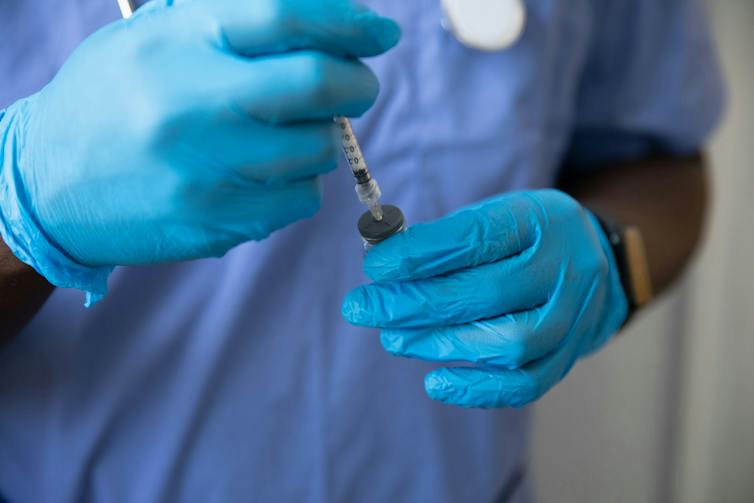
Gloved hands holding a syringe and glass vial

The antiviral drug remdesivir was one of the first medications used to treat COVID-19.
(Unsplash/Nappy)

This one-at-a-time approach clashes with how modern drug discovery works. Researchers typically need to screen thousands of related molecules to find a handful of promising leads, then improve on the best ones. The collection of compounds that led to remdesivir contained only around 1,000 candidates, which is tiny by pharmaceutical industry standards.

Even so, assembling that molecular library took many years and the considerable resources of a major pharmaceutical company. Getting ready for the next viral threat means building and testing much larger and more diverse batches of candidate molecules, as quickly as possible.

Making molecules in fewer steps

Our approach turns the traditional synthetic process on its head. Instead of building every final molecule separately from scratch, we use an amino acid catalyst to build a single versatile core piece, containing a chemical connector. This intermediate can be made in large batches and stored until it’s needed.

Then, in a single step, we use a reaction driven by ordinary visible light to join this core piece to many different molecular fragments, creating several brand-new nucleoside analogues in one go. Because this final step is quick, many different molecules can be made in parallel instead of repeating an entire synthesis for each drug candidate.

Using this strategy, we quickly built a library of more than 70 nucleoside analogues. It includes versions with sulfur or nitrogen atoms replacing the usual oxygen atom in the sugar ring, small changes that are normally difficult to make but can have a huge effect on biological activity. We also made versions designed to get inside cells more easily — the same strategy used by remdesivir and another drug used to treat hepatitis. While this is not a large number in terms of drug discovery, it demonstrates that producing larger libraries is now feasible using this process.

While most of these molecules had never been made before, we also made several previously studied molecules in far fewer steps. One compound that had originally required 16 synthetic steps, we made in just six.

Elevate Your Health for Just $29.99/Month

Join the Precision Wellness Subscription at My Healing 365 and get discounted services, priority coaching access, virtual care, and exclusive wellness resources to support your physical, emotional, and hormonal health.

Join for $29.99/Month

We then handed these compounds off to our Simon Fraser University collaborator Ralph Pantophlet, whose laboratory tested them against HIV in a cell-based assay. Three compounds stood out, blocking the virus about as effectively as some of the medications already approved to treat it. While it would still be a long path to clinical trials, being able to identify starting points more quickly is critical to the entire drug discovery process.

With this platform, we can generate collections of drug candidates 10 to 100 times larger than was previously practical, in weeks rather than months or years. That’s no guarantee of discovering a new medicine, but it meaningfully improves the odds of finding one quickly, whether for a virus that emerges tomorrow or one we already struggle to treat.


ShareTweetSharePin

Most Read

What causes stuttering? A speech pathology researcher explains the science and the misconceptions around this speech disorder

What causes stuttering? A speech pathology researcher explains the science and the misconceptions around this speech disorder

December 15, 2022
3 women stroke prevention

Silent Stroke Symptoms in Women: What You Might Be Overlooking

February 27, 2026
In war-torn Iran, air pollution from burning oil depots and bombed buildings unleashes invisible health threats

In war-torn cities, air pollution from burning oil depots and bombed buildings unleashes invisible health threats

March 25, 2026
morning back pain

Morning Again Ache Trigger Is Not the Mattress

October 11, 2021
Socialising, work, exercise: what makes a good day and is there a ‘formula’ for making it better?

Socialising, work, exercise: what makes a good day and is there a ‘formula’ for making it better?

April 12, 2026
A job that changed me: My year as a ‘gopher’ taught me that all errand runners are holy

A job that changed me: My year as a ‘gopher’ taught me that all errand runners are holy

July 27, 2026

Why Circadian Rhythms Matter for Your Health

July 30, 2024
lower back pain relief exercises

5 decrease again ache aid workouts

October 11, 2021

4 steps to building a healthier relationship with your phone

January 28, 2025
bleeding in gum

When The Bleeding in gum Is Severe ?

October 11, 2021
Good Night Sleep

6 Causes of Good Evening Sleep

October 11, 2021
3 years after legalization, we have shockingly little information about how it changed cannabis use and health harms

3 years after legalization, we have shockingly little information about how it changed cannabis use and health harms

October 15, 2021
Nasal vaccines promise to stop the COVID-19 virus before it gets to the lungs – an immunologist explains how they work

Nasal vaccines promise to stop the COVID-19 virus before it gets to the lungs – an immunologist explains how they work

December 14, 2022
Kick up your heels – ballroom dancing offers benefits to the aging brain and could help stave off dementia

Kick up your heels – ballroom dancing offers benefits to the aging brain and could help stave off dementia

January 3, 2023
Ten small changes you can make today to prevent weight gain

Ten small changes you can make today to prevent weight gain

October 12, 2021
Biden is getting prostate cancer treatment, but that’s not the best choice for all men − a cancer researcher describes how she helped her father decide

Biden is getting prostate cancer treatment, but that’s not the best choice for all men − a cancer researcher describes how she helped her father decide

May 20, 2025

COVID vaccines: how one can pace up rollout in poorer international locations

October 5, 2021

Maximize Your Performance – Sync with Your Circadian Rhythms

August 9, 2024
GLP-1 drugs may fight addiction across every major substance, according to a study of 600,000 people

GLP-1 drugs may fight addiction across every major substance, according to a study of 600,000 people

March 6, 2026
Five ways to avoid pain and injury when starting a new exercise regime

Five ways to avoid pain and injury when starting a new exercise regime

December 30, 2022
woman covered with white blanket

Exploring the Impact of Sleep Patterns on Mental Health

August 4, 2024

This Simple Hygiene Habit Could Cut Your Risk of Stroke, New Research Reveals

February 1, 2025
Support and collaboration with health-care providers can help people make health decisions

Support and collaboration with health-care providers can help people make health decisions

December 16, 2021
Greece to make COVID vaccines mandatory for over-60s, but do vaccine mandates work?

Greece to make COVID vaccines mandatory for over-60s, but do vaccine mandates work?

December 1, 2021

Multiple sclerosis: the link with earlier infection just got stronger – new study

October 12, 2021
Six ways to improve your cat’s one wild and precious life

Six ways to improve your cat’s one wild and precious life

June 6, 2026
Four ways to avoid gaining weight over the festive period – but also why you shouldn’t fret about it too much

Four ways to avoid gaining weight over the festive period – but also why you shouldn’t fret about it too much

December 22, 2022
How regulatory agencies, not the courts, are imposing COVID-19 vaccine mandates

How regulatory agencies, not the courts, are imposing COVID-19 vaccine mandates

October 24, 2021
You’ve reached your weight loss goal on GLP-1 medications – what now?

You’ve reached your weight loss goal on GLP-1 medications – what now?

February 5, 2026
FDA limits access to COVID-19 vaccine to older adults and other high-risk groups – a public health expert explains the new rules

FDA limits access to COVID-19 vaccine to older adults and other high-risk groups – a public health expert explains the new rules

May 21, 2025

Ready to take control of your health?

Get a personalized plan for your weight, energy, hormones, and blood sugar with My Healing 365.

Book Your Session Now – Limited Weekly Spots
  • Twenty47HealthNews
  • Health & Wellness
  • Disclaimer

© 2020 DAILY HEALTH NEWS

  • Twenty47HealthNews
  • Health & Wellness
  • Disclaimer
    • Terms of Use
    • Privacy Policy
    • DMCA Notice

© 2020 DAILY HEALTH NEWS















