As long as there have been vaccines, there have been people who doubted their science and safety.
Back in 19th-century England, people rioted against a mandatory smallpox vaccine, claiming that it violated civil rights and was an affront to human bodily integrity. In the United States, organizations dedicated to resisting vaccines have existed since the Anti-Compulsory Vaccination League of Brooklyn was established in 1894.
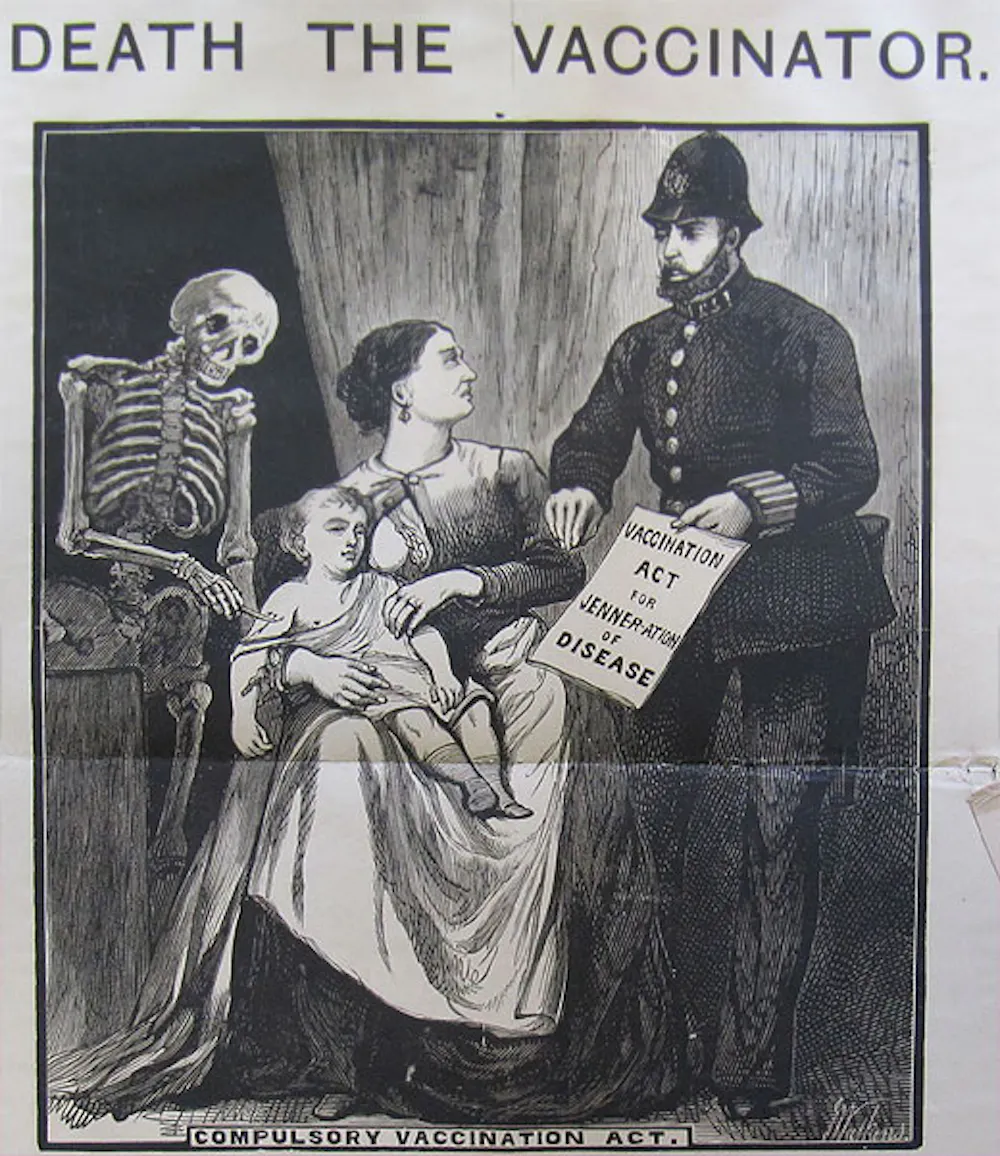
Historical Medical Library of The College of Physicians of Philadelphia
Researchers generally refer to people who do not follow the standard advice of health professionals about vaccines, by either refusing or delaying some or all vaccines, as vaccine hesitant. Today, vaccine hesitancy is most famously associated with the Make America Healthy Again movement and its standard-bearer, Health and Human Services Secretary Robert F. Kennedy Jr.
Public health advocates and science communicators have largely tried to counter these ideas by offering accurate, factual information. But as a medical humanities researcher studying how groups that embrace vaccine hesitancy craft their message, I’ve learned that part of why vaccine hesitancy is so hard to combat is how these groups use storytelling to spread their views.
Vaccine-hesitant groups have fewer limitations than pro-vaccine groups on the kinds of stories they can tell about the development and impact of vaccines. While science-driven messaging that encourages vaccination has to be faithful to the complex and often uneventful reality of science, vaccine-skeptic stories tend to make more dynamic claims.
Table of Contents
Why facts aren’t enough
It’s easy to assume that people who mistrust vaccines are undereducated, and therefore, that providing better information about science and vaccines would increase confidence in vaccines. This is sometimes called the information deficit approach.
In response to this perceived information deficit, public health experts and science communicators have worked hard to create accessibly written, welcoming educational materials about vaccines in order to help improve scientific literacy.
But this approach has had only limited success. One indication: The number of people who express vaccine-hesitant views continues to grow.
This partly relates to a misunderstanding about vaccine hesitancy: It’s not that people don’t understand science or don’t have access to high-quality medical information. Vaccine hesitancy is what policymakers call a “wicked problem” – one that’s particularly hard to solve because it’s fueled by a range of issues, including misinformation, the desire for social belonging and deeply held religious beliefs.
While there are many stereotypes about what kind of person is vaccine hesitant, the truth is that there is no single category of person who expresses skepticism. Vaccine hesitancy includes people with higher education degrees and better-than-average levels of health literacy.
People might embrace these views for many reasons – for example, because they do not trust the medical system, are critical of the government, are trying to protect their child or are connecting with compelling narratives – for example, about personal freedom.
Vaccine symbols
To some degree, all health information mixes science and storytelling. A patient’s medical history, for example, simply strings together a person’s health information into a coherent tale.
But vaccine-hesitant groups are particularly adept at using narrative to craft compelling, nerve-wracking or highly emotion-driven stories of doctors ignoring patient concerns and children developing devastating health conditions after getting vaccinated.
What makes these stories the secret weapons of vaccine hesitancy is that they often are not actually about vaccines at all. When vaccines become detached from medicine, they can function like a symbol or a metaphor in a story, reflecting a worldview that encompasses much more than medicine and is fueled by nonmedical anxieties. These stories use narrative strategies, including some drawn from film and literature, to undermine vaccine confidence.
For example, online forums use vaccine refusal as an example of civil resistance to a totalitarian government, symbolizing a loss of general individual freedom – even when vaccines pose no practical threat to their political or social liberty. In some contexts, refusing the COVID-19 vaccine in particular has been framed as a sign of overall psychological or mental strength.
A new normal
Under Kennedy, the Centers for Disease Control and Prevention has started to release material that matches the messaging, ideas and narrative strategies of vaccine-hesitant groups.
Elevate Your Health for Just $29.99/Month
Join the Precision Wellness Subscription at My Healing 365 and get discounted services, priority coaching access, virtual care, and exclusive wellness resources to support your physical, emotional, and hormonal health.
Join for $29.99/MonthWhen the CDC announced a rollback of the childhood vaccine schedule, for example, the press release characterized the proposed changes as a return to what the agency is calling “individual-based decision-making.” Kirk Milhoan, the Kennedy-appointed head of the Advisory Committee on Immunization Practices, a panel of experts that advises the CDC on vaccines, described vaccine debates as a question of “autonomy versus public health.”
Treating vaccines as representing a challenge to individuality or autonomy highlights a possible philosophical and existential threat, but in the process, it minimizes real physical risk. Here, the story implies that vaccines are a threat to individuality. Medically, that’s not true. But thematically, the references to threatened individuality suggest that people are feeling vulnerable and afraid. In this story, vaccines symbolize perceived dangers to a person’s sense of self, not real medical ones.

Damian Dovarganes/AP Photo
Becoming better readers
As vaccine hesitancy continues to pose a challenge to public health, it seems increasingly clear that promoting health and scientific literacy, on their own, won’t be enough to allay the concerns of people who have aligned their ideas about vaccines with broader narratives about untrustworthy institutions and physical risk.
Yet dismissing the perspectives of people who raise concerns about vaccines risks losing opportunities to better understand the complex reasons that draw someone to vaccine hesitancy. Those reasons are often shaped by people’s experiences with medicine and other institutions. For example, there are many well-founded reasons for vulnerable or marginalized groups to be wary of the medical establishment. For some Black Americans, for example, the legacy of forced medical experimentation and systemic discrimination forms a sound basis for being skeptical of health recommendations from the government.
Some researchers studying public health and communication have started to embrace strategies that engage with literary features, such as symbolism, to address vaccine hesitancy. This includes both identifying the specific storytelling techniques at play to make them less persuasive and acknowledging the perspective, critiques and experiences of vaccine-hesitant people to create a more respectful environment.
Understanding the narratives and learning from the valid critiques that draw people into feeling hesitant about vaccines offers a more nuanced way to understand these views – and may open the way for a more inclusive and respectful approach to healthcare.


























