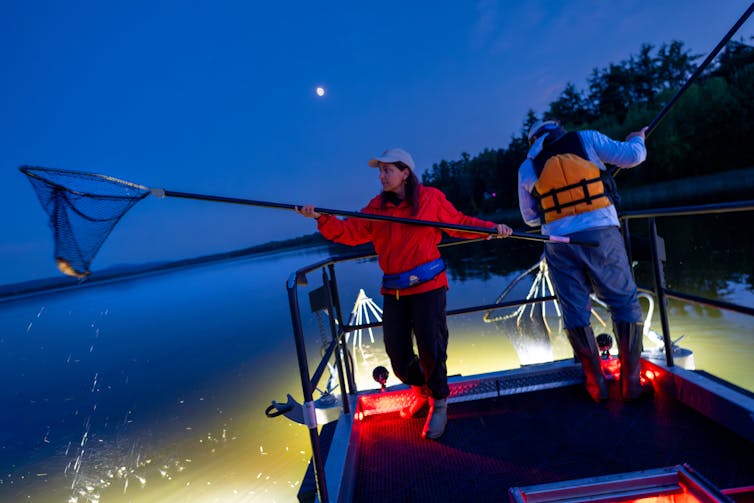
For more than a decade, anglers on Lake Memphremagog — which straddles the Québec-Vermont border — have been catching brown bullhead catfish marked with distinctive black lesions.
In 2019, scientists from the United States Geological Survey (USGS) and the Vermont Fish and Wildlife Department confirmed the lesions to be malignant melanoma. Yet, until recently, there was no confirmed explanation for how the disease emerged.
When my colleagues and I at the University of Vermont turned to whole-genome sequencing, we expected to find a genetic explanation for why some brown bullheads had melanoma and others didn’t. Instead, we discovered evidence of something seen only in a handful of cases in the animal kingdom: transmissible cancer.
That’s not where anyone expected the investigation to lead.
Table of Contents
Various theories
When scientists first documented cases in 2012, the most likely explanation seemed to be environmental factors. The previous year, Hurricane Irene had caused devastating flooding across Vermont.
Could the bullhead’s habitat have been tainted by pollutants stirred up during the hurricane? This seemed to be a more likely culprit than ultraviolet exposure, which is the leading cause of human melanoma. The brown bullhead is a benthic (bottom-dwelling) fish that feeds at night.
Cancer-causing microbes in the waterways were another theory. But a decade of research yielded no evidence to support these hypotheses. After years of dead ends, DNA offered a way to ask a fundamentally different question.

(Joshua Brown), Author provided (no reuse)
USGS and Vermont Fish and Wildlife scientists contacted the University of Vermont, where I am a genomics and data scientist and a member of the UVM Cancer Center. My team and I sequenced the DNA of more than 80 brown bullheads, with and without disease, caught in 2023, as well as some previously caught by Vermont Fish and Wildlife in 2019.
We also sequenced both tumours and healthy tissue in the diseased fish. My hypothesis was that each tumour would be most closely related to the fish from which it came. This would place all of the diseased fish on an evolutionary “branch” linked by some shared variants, perhaps in genes that contribute to melanoma.
That is not what we found.
Uncovering a transmissible cancer
Tumours from different fish appeared to be more closely related to one another than they were to the fish carrying them. In some cases, the tumours were more genetically similar to healthy fish from other bodies of water than they were to their host fish.
The data was baffling. We checked and rechecked our analysis multiple times, expecting to find an error. Yet the pattern was clear: the tumours had not independently formed; rather, they were clones of one another, sharing an overwhelming number of variants not found in the host fish, and only distantly related to their hosts.
The evidence clearly indicated that the disease represented a previously unknown transmissible cancer that spreads from fish to fish, making it the fourth known transmissible cancer in the world. The others occur in dogs, Tasmanian devils and bivalves.
Once we realized the cancer might be transmissible, we found more evidence of diseased brown bullheads through historical anecdotes. In 1852, the essayist Henry David Thoreau wrote of seeing bullhead catfish with black velvety patches in a Massachusetts river.
Elevate Your Health for Just $29.99/Month
Join the Precision Wellness Subscription at My Healing 365 and get discounted services, priority coaching access, virtual care, and exclusive wellness resources to support your physical, emotional, and hormonal health.
Join for $29.99/MonthSixty years later, zoologist Raymond Osburn investigated Thoreau’s report and other similar ones throughout New England. He even grew bullhead tumour cells in a lab and successfully transferred them into a healthy bullhead.
There is no way to confirm whether these examples are one and the same as the disease we uncovered (now known as brown bullhead transmissible melanoma, or BBTM), nor that they were transmitted from one fish to another, as ours was.
These historical reports suggest this disease could be older and more widespread than previously believed. Perhaps it’s existed for a while but was largely overlooked. As one angler in Cape Cod told me: “No one looks for those fish.”

(Joshua Brown), Author provided (no reuse)
Unlocking cancer’s deepest mysteries
As a cancer researcher, I’m particularly interested in understanding how these cancer cells evade the immune defences of their hosts. Is it possible that gene mutations suppressing the host’s immune system also promote the development and spread of melanoma? What can this discovery tell us about human melanoma and immune dysfunction?
Perhaps this naturally occurring model will shed light not only on how cancers evolve, but how they evade detection by the immune system — a central question in cancer biology.
Collaboration is key to unlocking future discoveries about transmissible cancer. My colleagues and I are teaming up with several other scientists studying these kinds of diseases, including oncology and genetics professor Elizabeth Murchison, who specializes in Tasmanian devil facial tumour disease and canine transmissible venereal tumours; and cancer researcher Michael Metzger, who discovered bivalve transmissible neoplasia.
Together, we hope to learn how these diseases emerge, spread and evolve. No doubt the outcomes of our investigations will extend far beyond the boundaries of Lake Memphremagog, delving into some of cancer’s deepest mysteries.
What began as an effort to explain black lesions on a common catfish may help us better understand cancer, evolution and infectious disease in all animals, including ourselves.

























