

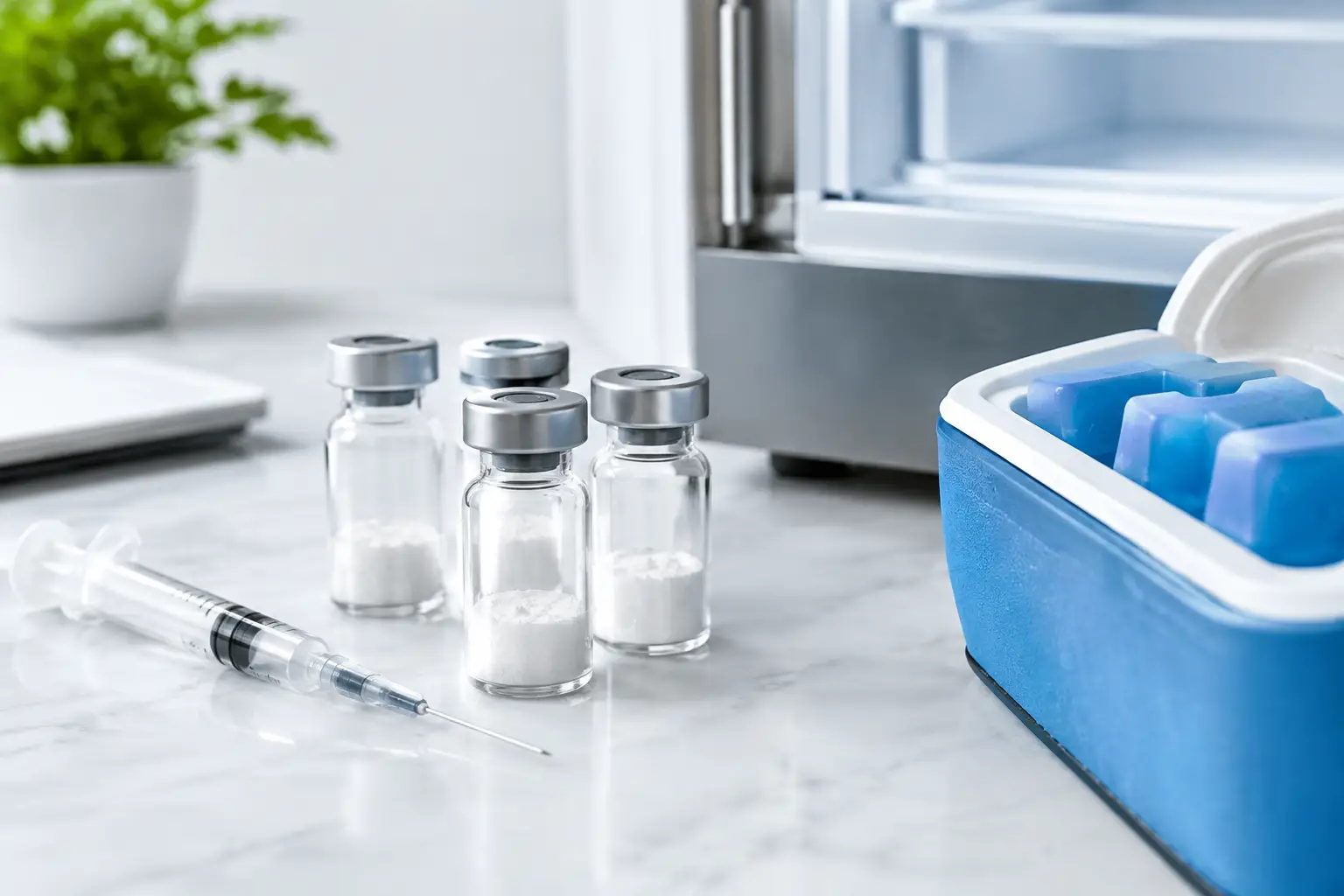
A peptide can be part of a highly personalized plan for metabolic health, recovery, sleep, vitality, or healthy aging. But even a carefully selected protocol depends on proper handling after it reaches your home. This peptide storage guide helps you protect your prescribed treatment between deliveries, doses, and follow-up visits.
Storage is not a minor detail. Temperature swings, direct light, accidental freezing, and using a product past its labeled date can affect medication quality. The most reliable rule is simple: your prescription label and pharmacy instructions come first. Different peptides, concentrations, pharmacies, and formulations can have different requirements.
Table of Contents
Peptide Storage Guide: Start With Your Label
Your dispensing pharmacy provides the instructions that apply to your specific medication. Read the label as soon as your shipment arrives, then keep the medication in its original packaging whenever possible. The carton, vial label, and pharmacy paperwork may contain key details about refrigeration, beyond-use dates, handling after first use, and what to do during travel.
Many injectable peptide medications are stored in a refrigerator, commonly within a range of 36°F to 46°F. That does not mean every product follows the same rule, and it does not mean colder is better. Freezing can damage some medications, while leaving a refrigerated product at room temperature for too long may reduce its stability. If the label says refrigerate, treat that instruction as part of the prescription.
The same principle applies to medications that arrive as a powder, a prefilled syringe, or a liquid vial. A lyophilized, or freeze-dried, product may have different storage guidance before and after reconstitution. Once a product has been mixed, its usable timeframe and handling requirements can change. Do not assume a storage rule from one peptide applies to another.
Why formulation changes the answer
Terms such as peptide therapy cover a wide range of treatments. A metabolic medication, a recovery-focused peptide, NAD+, or a therapy designed to support sexual wellness may all come with different preparation and storage directions. Some products are commercially manufactured, while others are prepared by a licensed compounding pharmacy under a prescriber’s plan.
That is why online advice, a friend’s routine, or a social-media video should never override the instructions attached to your own prescription. Provider-guided care gives you a clear point of contact when a question arises, rather than asking you to make a high-stakes call alone.
Refrigeration, Light, and Daily Handling
If your medication requires refrigeration, choose a stable location in the main body of the refrigerator. The door is convenient, but it experiences more temperature changes every time it opens. Avoid placing medication near the freezer vent, against the back wall, or in any spot where it could accidentally freeze.
Keep the vial or pen protected from direct light. Original cartons are useful for more than organization: they can help shield light-sensitive medications. A clean, designated bin can also prevent your treatment from being crowded by food containers, knocked over, or mistaken for something else.
Before preparing a dose, wash your hands and use only the supplies your provider or pharmacy recommends. Do not share pens, syringes, needles, or medication vials. If your instructions do not specifically tell you to shake a vial, avoid shaking it. Rough agitation can create bubbles and may not be appropriate for certain preparations. Gentle handling is the better default.
Keep track of the date you first use or reconstitute a medication if your pharmacy provides a beyond-use timeframe. A small note on the carton or a reminder in your phone can prevent confusion later. Do not use a medication beyond the date on its label simply because there appears to be product left in the vial.
What to look for before a dose
Appearance alone cannot prove that a medication is safe or potent, but it can alert you to a problem. Check for a cracked vial, damaged pen, leaking cap, broken seal, unexpected particles, unusual cloudiness, or a marked change in color. Some products may naturally have a slight tint or look different from others, so compare what you see with the pharmacy’s description rather than guessing.
If anything looks unusual, pause before using it. Take a photo if helpful and contact your pharmacy or prescribing team. Replacing a questionable dose is far safer than proceeding with uncertainty.
Protecting Peptides During Travel
Travel is where storage mistakes are most likely to happen. A medication should not spend hours in a hot car, checked luggage, or direct sunlight by a pool window. Plan ahead, especially during summer heat or winter cold, when outdoor temperatures can become extreme quickly.
For a refrigerated medication, use an insulated travel case with a cold source that does not directly touch the vial or pen. Direct contact with frozen gel packs can cause accidental freezing. Place a barrier, such as a cloth or protective sleeve, between the medication and the cold pack. Keep the case with you rather than leaving it in a vehicle.
For air travel, carry the medication in your personal item along with its labeled box and prescription information. The original label helps identify what the medication is and confirms that it was dispensed for you. If a delay, lost bag, or security question occurs, having everything together makes the process easier.
The amount of time a medication can safely remain out of refrigeration varies by product. Some medications have defined room-temperature allowances, while others should be returned to refrigeration as soon as practical. Check the pharmacy instructions before you leave, not after you arrive at the airport. For longer trips, ask your care team for product-specific travel guidance.
What to Do After a Storage Mistake
Mistakes happen. A refrigerator door may be left open, a package may sit outside longer than expected, or a vial may be discovered near a freezer vent. The right response is not automatically to throw the medication away, but it is also not to assume it is fine.
Write down what happened: the estimated temperature, how long the medication was exposed, whether it froze, and whether it remained in its carton. Then contact the dispensing pharmacy or your prescribing team. They can evaluate the product against the manufacturer’s or compounder’s stability guidance and tell you whether it can still be used.
Do not try to fix a frozen medication by thawing it and continuing as normal unless you have been explicitly told to do so. Likewise, do not compensate for a questionable dose by taking more at the next scheduled time. Storage problems are a reason to seek direction, not to adjust dosing on your own.
Common storage errors to avoid
The most common problems are preventable: storing medication in the refrigerator door, placing it directly against a freezer pack, leaving it in a car, removing it from its labeled carton, or using it after the pharmacy’s beyond-use date. Another frequent issue is relying on memory for dosing and first-use dates. A simple reminder system protects both your treatment plan and your peace of mind.
It is also wise to keep medication out of reach of children and pets. A dedicated refrigerator container can help, provided it does not create an overly cold environment and remains clearly labeled.
When to Contact Your Provider or Pharmacy
Contact your care team promptly if your medication has frozen, overheated, leaked, changed appearance, passed its labeled date, or was stored outside the recommended conditions for an unknown amount of time. Reach out as well if you are unsure whether your medication needs refrigeration after first use or while traveling.
Your provider should also know if storage concerns interrupt your dosing schedule. Depending on the peptide and your personalized protocol, the appropriate next step may be to resume at a certain time, wait for a replacement, or receive further guidance. Do not restart, double up, or change the schedule without medical direction.
At My Healing 365, personalized treatment is designed to make advanced wellness care more practical, not more complicated. Proper storage is one small but meaningful part of protecting that investment in your health. Keep the label close, treat your pharmacy as a resource, and ask before making assumptions – confident care starts with clear guidance.