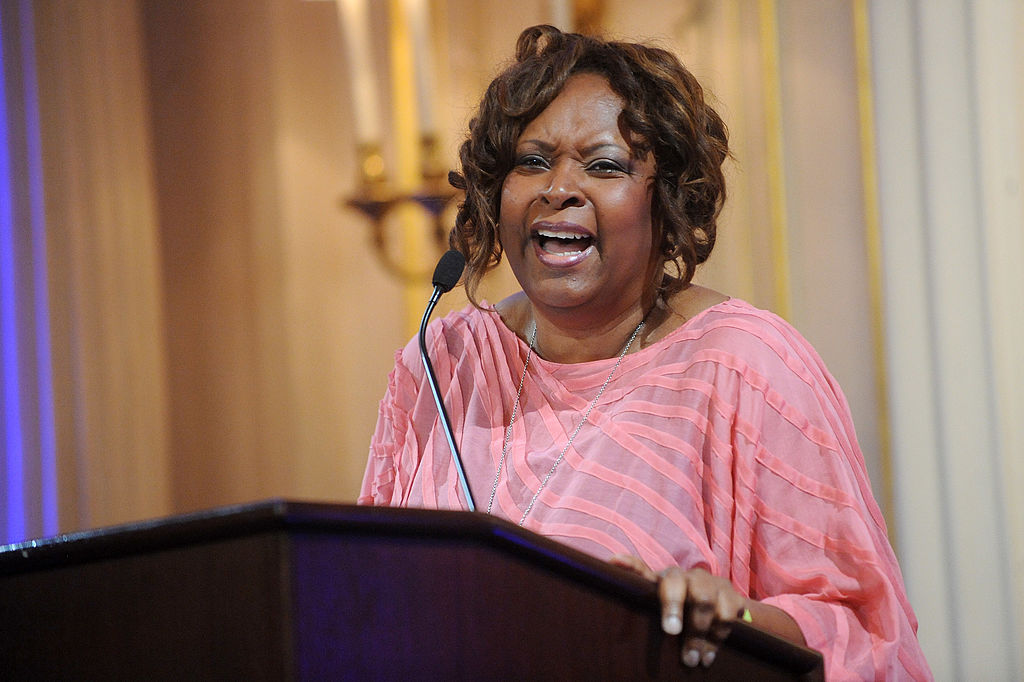
On June 1st, the start of Cancer Survivor’s Month, Robin Quivers, a longtime cohost of for The Howard Stern Show announced that she is cancer-free.
Stern celebrated the moment with her. “Fourteen years ago, when Robin was diagnosed, she took charge of her health. She did all the right things, and she never deviated,” hesaid.
“I feel like a brand-new person,” Quivers explained when Stern asked her how she reacted to the news.
Table of Contents
Quivers Was First Diagnosed with Endometrial Cancer in 2012
The 73-year-old radio personality became concerned about her health in 2012 when she began feeling off while on an out-of-town trip and she also had trouble urinating, she told People. Quivers went to the emergency room where doctors discovered a grapefruit size mass.
Upon returning home, she underwent a series of tests including a CT scan, MRI, and biopsies, which came back inconclusive. Her medical team told her the only way to find out definitively was to operate. Her surgeon discovered that the mass was resting on every organ in her pelvic area and performed a total hysterectomy.
“Then it was hours of meticulously scraping off layers of tissue and not destroying [whatever] organ it had been touching,” she told the magazine.
It was weeks before she received her official diagnosis, which was a rare form of endometrial cancer at Stage 3C.
What is Endometrial Cancer?
According to the Mayo Clinic, endometrial cancer begins as a growth of cells in the uterus. Endometrial cancer begins in the layer of cells that form the lining of the uterus, called the endometrium. It is sometimes also referred to as uterine cancer.
The American Cancer Society reports that endometrial cancer is the most common type of uterine cancer. About 68,270 new cases of endometrial cancer will be diagnosed this year and more common in post-menopausal women. The average age of diagnosis is 60.
Symptoms of endometrial cancer may include:
- Vaginal bleeding after menopause.
- Bleeding between periods.
- Pelvic pain.
Quivers Initial Treatment
When Quivers was diagnosed with a Grade 3 tumor, it meant that there was more than 50% of tumor present and she had a more aggressive form of the disease. It also had a high probability of recurrence.
The talk radio co-host initially underwent 15 months of treatment, consisting of both chemotherapy and radiation. Quivers’ cancer went into remission for three years.
In 2016 Quivers’ Cancer Returned
Quivers found out that her cancer had returned and had spread to her lymph nodes in 2016. She told People, “It’s never been a huge problem,” says Quivers. “When it’s shown some growth, then we have to manage that.”
Elevate Your Health for Just $29.99/Month
Join the Precision Wellness Subscription at My Healing 365 and get discounted services, priority coaching access, virtual care, and exclusive wellness resources to support your physical, emotional, and hormonal health.
Join for $29.99/MonthFor more than a decade, her treatment included regular immunotherapy infusions, which uses her body’s immune system to destroy cancer cells.
“When you’re in and out of treatment, you’re always recovering and trying to get back to where you were,” she said.
Getting the Good News
At the end of May, Quivers learned that there was no trace of cancer in her body.
Stern told his audience, ”We got the news… she had no cancer in her body. And I’m telling you, Robin, on behalf of this show, and you know, of course to me you’re the most important, and I love you, and I am so happy for you, and I don’t even know what you must be feeling inside.”
“I was like a person who has won the lottery and can’t believe their eyes when they’re seeing all the numbers. Is this what I think it says?” Quivers said.
She noted that undergoing treatment her life wasn’t exactly fun. However, she remained optimistic. “I never gave up hope.”
Resources

























