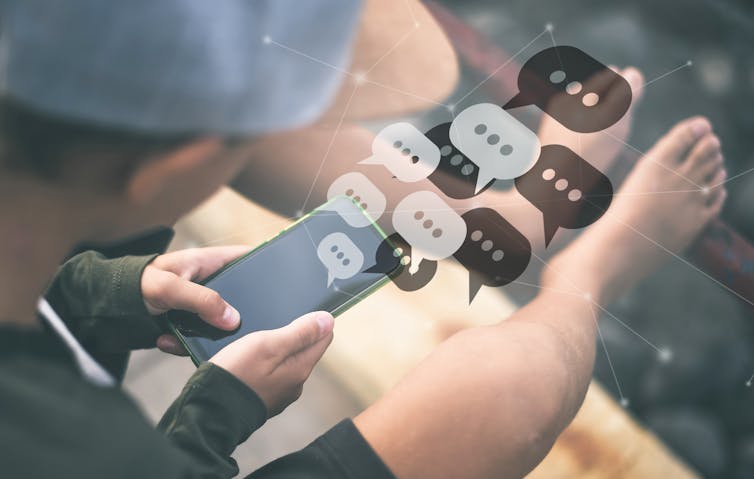
It’s 2 a.m., and a teenage girl, worrying about a friend issue, lies awake. Rather than wake her parents, she picks up her phone, opens an AI app and types, “I’m so stressed out, I can’t sleep.”
A reply arrives swiftly: “I’m sorry you’re dealing with this. Want to tell me a bit about what is stressing you?” The conversation unfolds, and 20 minutes later she is calmer and able to sleep. The supportive voice that calmed her? A large language model, or LLM, chatbot.
While this is a hypothetical scenario, it represents a very common pattern of artificial intelligence use by teens.
Many teens are turning to AI chatbots, which are designed to simulate empathy and maintain human engagement, for companionship, emotional support and mental health advice. Research shows that this is increasingly common, with 72% of teens having interacted with AI companion chatbots, and 13% to 20% having sought support through AI for emotional concerns in a two-month period in 2025.
In another recent study, 63% of the teens and young adults who used an AI chatbot for mental health advice had not disclosed it to anyone.
As clinical psychologists and a child psychiatrist who work with adolescents, we’ve seen this shift firsthand.
In 2025 we published guidelines for clinicians on how to address teen chatbot use safety, and we’re now working to help parents and other trusted adults do the same.
Table of Contents
Why teens are vulnerable
Unlike social media platforms, which connect teens with peers, AI chatbots such as ChatGPT, Claude and Gemini function as simulated conversation partners and companions, offering on-demand responses that can feel supportive and engaging. While a small number of purpose-built therapeutic chatbots have been studied in controlled settings, most teens are using general-purpose tools that were never designed or validated for mental health support. This includes stand-alone platforms such as ChatGPT and chatbots built into apps that teens already use, such as Snapchat’s My AI.
These chatbots are everywhere, highly accessible and difficult for teens to avoid. Teens often describe chatbot interactions as emotionally meaningful or supportive, sometimes even preferring chatbot conversations to talking with friends.
Teens, still forming their sense of self and often craving social validation, may be especially prone to experiencing these simulated relationships as real. This trend is happening in real time, and a pressing question is how to guide teens to use chatbots safely.
Mental health-focused chatbots vs. general ones
There is evidence that some therapeutic AI chatbots can help adults with mild symptoms when used alongside professional mental health support. Woebot, for example, a fully automated cognitive behavioral therapy-based chatbot, reduced depressive symptoms in college students after two weeks of use. Some early evidence shows potential for helpfulness for younger teens as well.
But these are specialized tools tested in research studies — not the general-purpose chatbots like ChatGPT that most teens actually use. These systems typically lack effective crisis protocols or pathways to escalate care when someone is in danger.
A November 2025 Common Sense Media report rated general-purpose chatbots as unacceptably risky for teen mental health support.
Navigating the benefits and risks
General-purpose chatbots can generate inaccurate or misleading advice that is presented with high confidence. For some users, this can create confusion or reinforce unhealthy beliefs.
Adolescents, especially those experiencing loneliness, anxiety or social-communication challenges, may form strong attachments and turn to chatbots in place of human connection. This can, in turn, distort their expectations of real relationships.
Most concerning is how these systems handle thoughts that pose real risk to teens, including thoughts of risky social behaviors, self-harm or even suicide.
Studies of chatbot performance in detecting and responding to thoughts of suicide, by both therapeutic and general-purpose chatbots, show inadequate response. Even when the chatbots offer resources like the 988 Suicide and Crisis Lifeline, a national crisis line, conversations with concerning content are often permitted to continue without a hard stop.
The safety of the interactions tends to degrade over the course of long conversations. So 2 a.m. ruminations can become even riskier interactions at 3 a.m. as chatbot responses become more chaotic and less subject to safety guardrails.
Lawsuits filed and settled in 2025-26 have alleged that interactions with language models such as ChatGPT led to teen suicidal behavior and tragic losses, highlighting that commercial chatbots lack effective guardrails and crisis protocols.
Given these concerns, some chatbot programs have instituted restrictions. Character.ai, for instance, recently banned open-ended chat for users under 18. The app now requires age verification and allows parents to opt in to receive notifications.
However, many options exist for teens to still experience open-ended chats with AI, and teens often bypass safety-oriented restrictions online.

Fabio Principe/iStock via Getty Images
Red flags to watch for
Parents and other trusted adults can be on the lookout for teens’ problematic behaviors, such as:
-
Spending increasing amounts of time chatting with AI companions.
-
Reducing time and effort in relationships with family, friends, teachers and others.
-
Showing distress or irritability when chatbot access is limited.
-
Reaching for chatbot interactions rather than human supports in moments of emotional distress or crisis.
These patterns mirror problematic social media use by teens – a trajectory that offers a cautionary lesson.
Broad acknowledgment of social media’s risk came only after harms became entrenched; in 2023 the U.S. surgeon general warned that social media poses a “profound risk of harm” to youth mental health.
In our assessment, chatbots pose a comparable risk, and early awareness is crucial.
How parents and trusted adults can help
The most powerful step is straightforward: Talk with teens about their chatbot use.
Approaching teens with curiosity and nonjudgment is helpful.
It makes sense to assume a teen is using a chatbot, because this is most likely the case. Rather than a closed-ended question like “Do you talk to chatbots?” which some teens may perceive as judgmental, adults can begin with open-ended questions like “When you use chatbots like ChatGPT, what do you talk about?”
Additional detail can be gathered from questions like “Has anything ever felt uncomfortable, confusing or surprising?” or “How do you use chatbots or AI companions when you are feeling upset or overwhelmed?”
Many teens can feel relieved that parents are willing to discuss this openly, rather than dismissing or banning it outright. Parents can use what they learn in these conversations to provide guidance.
Setting boundaries for safe use
As families set boundaries around screen time and social media, they can include chatbot use as well. Time limits, particularly late at night when teens may be more emotionally vulnerable, can be helpful. Parents and teens should come to clear agreements about when chatbots should not be used, particularly during moments of crisis or high distress.
It can be useful to review how to access human supports, such as a trusted friend, a parent, a school counselor or the 988 Suicide & Crisis Lifeline. You can also research alternative emotional-regulation techniques, such as journaling, distraction, grounding and breathing techniques.
Regular check-ins about how chatbot use is going and whether concerns are coming up can keep information flowing and improve safety. The goal isn’t necessarily to eliminate chatbot use but to set thoughtful boundaries that protect connection with real people and reduce the probability of unsafe interactions.

Lock Stock/DigitalVision via Getty Images
Key points for AI literacy
Our clinical guidelines emphasize helping teens understand what chatbots are and aren’t. Parents can reinforce this as well.
Elevate Your Health for Just $29.99/Month
Join the Precision Wellness Subscription at My Healing 365 and get discounted services, priority coaching access, virtual care, and exclusive wellness resources to support your physical, emotional, and hormonal health.
Join for $29.99/MonthImportant topics to discuss with teens include:
-
Chatbots don’t “know” people; in interactions, they are predicting responses based on patterns in the chat. Therefore, any sense of understanding, connection or empathy – however convincing – is simulated, not real.
-
Chatbots can make mistakes or entirely make things up – called “hallucinations” in the AI field – while showing great confidence in these inaccuracies.
-
Chatbots are “tuned” by their creators to be agreeable and they tend to tell people what they want to hear, which can make their outputs less trustworthy or less useful in real-life contexts.
-
Chats with chatbots are not private or privileged, and conversations may be stored, used to train future models, reviewed by humans or surfaced in a data breach.
Talking openly about these limitations helps teens engage more critically and safely.
Open lines of communication
Research is only beginning to emerge around how AI chatbot interactions specifically affect adolescent mental health, but the emerging concerns are real and important.
While chatbot interactions are increasingly difficult for teens to avoid, supporting teens toward safer use is possible. The time to talk with teens is now, and these conversations can protect their safety and deepen their human connections.
If you or someone you know is in crisis and are based in the U.S., call the 988 Suicide & Crisis Lifeline to speak with a trained listener, or text HELLO to 741741. Both services are free, available 24/7 and confidential. If you are a reader from outside the U.S., please use a helpline like the one above or speak to a healthcare professional.

























