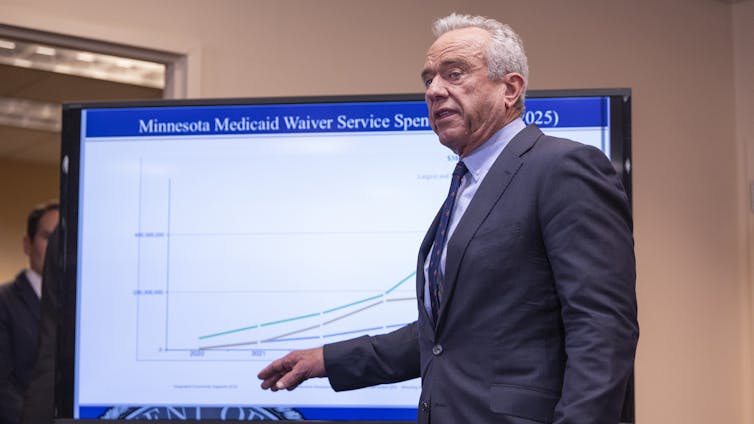
The Trump administration announced on July 21, 2026, that it’s withholding US$867 million in federal healthcare funding for California and $200 million for Minnesota – a total of more than $1 billion.
Federal officials said the two states had failed to provide sufficient evidence that a number of disputed medical claims were legitimate. These include bills for in-home care and other services covered by the two states’ Medicaid programs for low-income residents.
Medicaid administrators say the funds can be recovered if the states supply the requested documentation. But the action is highly unusual: Typically, Medicaid officials partner with states to conduct an audit when they suspect fraud, a careful process that often takes years.
It’s the second time in 2026 that the Trump administration has withheld or deferred federal Medicaid funds for several states, including California and Minnesota, because of alleged fraud and abuse. The Democratic governors of those states have called the decision a politically motivated attack on their constituents.
Elevate Your Health for Just $29.99/Month
Join the Precision Wellness Subscription at My Healing 365 and get discounted services, priority coaching access, virtual care, and exclusive wellness resources to support your physical, emotional, and hormonal health.
Join for $29.99/MonthI’m a historian of social policy who led the first comprehensive historical overview of Medi-Cal, California’s statewide Medicaid system. I’ve found that U.S. leaders have long used the language of fraud and abuse to blur the line between correcting very real failures within Medicaid and – as I believe the Trump administration is currently doing – discrediting and defunding the program itself.
Table of Contents
Slashing the safety net
The Medicaid restrictions are part of the Trump administration’s overall efforts to slash federal funding for the safety net.
The large tax-and-spending bill that Trump signed into law in July 2025 as the cornerstone of his second-term agenda pared eligibility for Medicaid by introducing work requirements for some adults. It is cutting close to $1 trillion in federal spending on the program over the next decade.
Researchers estimate that almost 12 million people, on top of the estimated 28 million without health insurance in 2025, could become uninsured by 2034 due to these changes. By mid-2026, more than 3 million people had already lost their insurance coverage due to Republican changes to the Affordable Care Act.
‘Padlocking’ the ‘cookie jar’
In February 2026, Vice President JD Vance, Health Secretary Robert F. Kennedy Jr. and Dr. Mehmet Oz, the administrator of the Centers for Medicare & Medicaid Services, or CMS, announced a new anti-fraud initiative called Comprehensive Regulations to Uncover Suspicious Healthcare.
Also known by its rather unsubtle acronym, CRUSH, this initiative is taking unprecedented steps to withhold and defer funds in response to suspected fraud. “CMS is done trying to catch fraudsters with their hands in the cookie jar,” Oz said in announcing CRUSH’s formation. “Instead, we’re padlocking the jar and letting them starve.”
To be sure, Medicaid fraud, waste and abuse – such as providers billing Medicaid for services that are unnecessary or never rendered – are very real problems that cost taxpayers billions of dollars annually. They do divert funds from the low-income and disabled Americans enrolled in the program.
But the Trump administration’s latest moves are part of a much broader history of weaponizing Medicaid fraud and abuse – both real and imagined. I see them as a politicized attempt to prove that Medicaid itself is wasteful, that state governments cannot be trusted to administer federal money, and that public benefits inevitably invite dishonesty.

Christopher Juhn/Anadolu via Getty Images
Providing little oversight at the start
Medicaid was established, along with Medicare for older adults, in 1965 as part of President Lyndon B. Johnson’s “Great Society” reforms. Despite providing millions of Americans with health insurance coverage for the first time, these programs had few centralized mechanisms for the kind of federal oversight that could prevent and catch fraud and abuse.
And the sheer scale and complexity of the Medicaid system – joint federal-state funding, varying eligibility requirements, millions of enrollees and thousands of providers – created opportunities for questionable billing practices among providers.
The 1970s saw a number of highly publicized Medicaid scandals involving nursing homes, laboratories, pharmacies and so-called “Medicaid mills” – healthcare providers that sought to bill the government for large numbers of Medicaid patients for shoddy and often fraudulent care.
A series of high-profile congressional investigations spurred demand for stronger Medicaid oversight and enforcement. That led to the Medicare-Medicaid Anti-Fraud and Abuse Amendments of 1977, which established the national Medicaid Fraud Control Units program.
The state-run Medicaid Fraud Control Units received generous federal matching funds to investigate and prosecute fraud.
The most serious Medicaid fraud was generally committed by healthcare providers and contractors, not patients. Medicaid Fraud Control Units were principally responsible for investigating providers, while also prosecuting the abuse and neglect of patients whose care was billed to Medicaid.
At the same time, however, Medicaid was becoming entangled in a broader political debate over social spending, whether many Americans were becoming too dependent on government benefits, and the alleged use of benefits by people who should not have received them. In the 1980s and 1990s, widely circulated stories about Medicaid exposed fraud and malfeasance by providers.
But disproportionately, they also highlighted the comparatively few instances of fraud by people enrolled in the program, such as cases where they submitted false receipts for covered medically related travel or sold drugs they obtained through Medicaid for free or at low cost.
Using Medicare fraud to justify spending cuts
The distinction between Medicaid and cash assistance programs, such as the Aid to Families with Dependent Children “welfare” program, frequently disappeared in political rhetoric. False or exaggerated stories that portrayed African American single mothers living extravagantly while fraudulently claiming welfare benefits became potent symbols of supposed government failure.
While campaigning as a presidential candidate, Ronald Reagan seized on this trope of the “welfare queen” in his attacks on social spending.

O’Halloran/Library of Congress via Getty Images
By the mid-1990s, opposition to welfare programs had become increasingly bipartisan. Politicians in both parties often used tales of Medicaid fraud on the part of providers and recipients to justify tighter eligibility rules and spending cuts.
Federal oversight expanded further with the Deficit Reduction Act of 2005, which created the Medicaid Integrity Program and strengthened federal oversight of state programs. The Affordable Care Act, the landmark healthcare legislation Congress passed in 2010, added new measures to screen providers and verify billing.
Concerns about Medicaid’s “integrity” became highly politicized in the debates surrounding the ACA. Critics of Medicaid expansion argued that increasing the number of people who could get health insurance through the program would increase fraud and improper enrollment. Supporters of expanding Medicaid to help more Americans gain health insurance maintained that anti-fraud rhetoric often disguised ideological opposition to the program’s expansion.
Blurring distinctions then and now
For the six decades that this program has helped millions of low-income Americans get healthcare, politicians have blurred the distinction between protecting Medicaid from abuse and using abuse to discredit Medicaid itself.
In my view, the Trump administration’s campaigns against California and Minnesota continue that pattern. It is using real weaknesses within Medicaid to advance much broader political arguments: that Democratic states cannot be trusted, that public benefits naturally invite abuse, and that withholding funds is itself a form of reform.
The result will no doubt be that fewer low-income Americans will be able to get the healthcare they need.

























