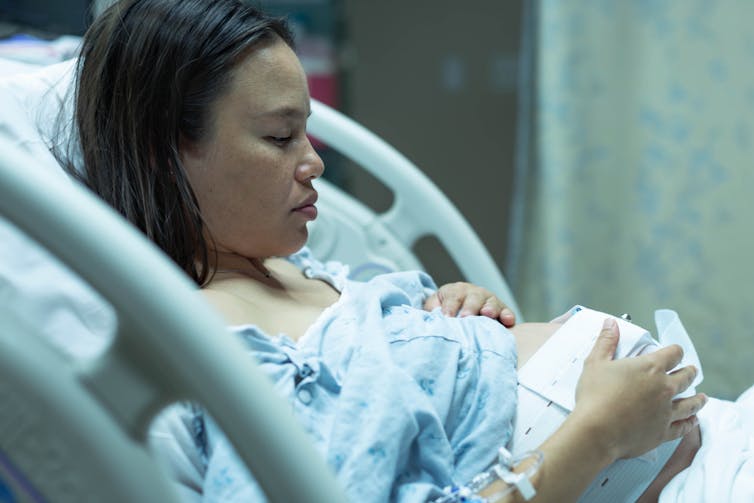
For too many women, the journey to motherhood ends in death. Maternal mortality – the death of a woman during pregnancy or within 42 days of giving birth – is not a rare tragedy. Globally, the maternal mortality rate is unacceptably high – about 260,000 women died during and following pregnancy and childbirth in 2023. In the U.S., it is also an ongoing crisis.
The U.S. has the highest maternal mortality among high-income countries.
Globally, the most common indicator used to measure maternal deaths is the maternal mortality ratio. This is the number of maternal deaths per 100,000 live births. Estimates show that the U.S has a maternal mortality ratio of 17 – compared to 1 in Norway, 2 in Poland and Australia, 3 in Spain and Japan, and 4 in Germany, Sweden and the Netherlands. The U.S. number is more in line with Bahrain and Egypt, where resources are far more limited than in America.
The maternal mortality ratio for non-Hispanic Black women in the U.S. is even higher – 50.3 per 100,000 live births compared to 14.5 among white moms.
Pennsylvania offers a useful lens for examining this crisis at the state level. Recent data shows mental health conditions accounted for nearly half of pregnancy-associated deaths in Pennsylvania, with overdose and substance use disorders as the primary causes of death. Nearly 70% of maternal deaths in Pennsylvania occurred after childbirth, including 48% between six weeks and one year postpartum.
The Pennsylvania maternal mortality review committee, a state agency established to investigate deaths occurring during or within a year of pregnancy, determined that 98% of pregnancy-related deaths in the state were preventable. This highlights a need for expanded care for pregnant and postpartum women. Poor quality of care, care discontinuity and knowledge gaps are the most frequent factors in preventable maternal deaths. This number averages about 86% in other states.

globalmoments/iStock collection via Getty Images Plus
As a nurse scientist, my research has been focused on postpartum care for the past 14 years. Postpartum care is vital in lowering maternal mortality in the U.S., however, it isn’t always prioritized in public policy.
Table of Contents
Why are mothers dying?
Mental health conditions account for about 28% of maternal mortality in America. Most deaths are caused by substance use disorders and depressive disorders.
These are followed by cardiovascular conditions, infections and hemorrhage.
One exception is that among non-Hispanic Black women, cardiovascular conditions are the most common cause of maternal mortality. These typically linger postpartum and sometimes show up later within the first year after giving birth. When a woman is discharged after birth, the burden is on her and her family to ascertain potential complications and seek timely care. Inadequate knowledge of warning signs of postpartum complications can lead to delayed care and management.
Benefits of longer postpartum care
Hospital stays after birth are growing shorter. This trend means healthcare providers have less time to educate new mothers about postpartum health complications and connect them with social services. Most postpartum education happens as new moms are being discharged a day or two after giving birth, a time when they may struggle to absorb new information.
Elevate Your Health for Just $29.99/Month
Join the Precision Wellness Subscription at My Healing 365 and get discounted services, priority coaching access, virtual care, and exclusive wellness resources to support your physical, emotional, and hormonal health.
Join for $29.99/Month
The Good Brigade/DigitalVision Collection via Getty Images
My colleague and I wanted to know how women felt about the health information they received as new mothers. We surveyed 80 Black women in St. Joseph County in Indiana about their postpartum education experiences. Most women were only somewhat satisfied.
About 46% of women did not recall receiving any education on postpartum warning signs.
The Association of Women’s Health, Obstetric and Neonatal Nurses recommends that all postpartum women should be able to recognize nine warning signs of postpartum complications, using the acronym POST-BIRTH. On average, participants in our survey could identify only two of the nine signs.
About 25% could not identify any of the signs:
- Pain in the chest.
- Obstructed breathing or shortness of breath.
- Seizures.
- Thoughts of hurting yourself or others.
- Bleeding or blood clots.
- Incision that is not healing.
- Red or swollen leg.
- Temperature of 100.4 F or higher, or 96.9 F or lower.
- Headache that doesn’t get better.
The American College of Obstetricians and Gynecologists recommends that women receive an initial visit within three weeks of birth, in addition to the traditional six-week visit and ongoing follow-up as needed.
Changing the standard of postpartum care
At the Eck Institute for Global Health at the University of Notre Dame, I created an innovative postpartum care model called Focused Postpartum Care. This model provides more frequent follow-up appointments, standardized education for the post-birth year and peer support through group sessions for 12 months after giving birth.
This treatment protocol offers women head-to-toe assessments and measures of vital signs, and it provides group education at a two- and six-week appointment. Beyond six weeks, women continue to receive measures of vital signs and group education monthly until 12 months.

Kemal Yildirim/E+ Collection via Getty Images
Blood pressure monitoring after six weeks postpartum is important, since hypertensive disorders can show up later within the post-birth year. Women are also screened for postpartum depression and social needs at multiple points throughout the year, as these needs can change over time.
In a randomized, controlled trial of this model in Ghana in 2021-23, women who received focused postpartum care showed greater knowledge of warning signs, healthy eating and family planning. They also showed significantly lower stress and depression scores at three months compared to those receiving standard care. The study sought to address shortcomings in postpartum care in sub-Saharan Africa, where health risks can continue well beyond birth and follow-up care is not always consistent.
This model of group postpartum care is being implemented in Indiana and is available upon request for use in any healthcare system.























