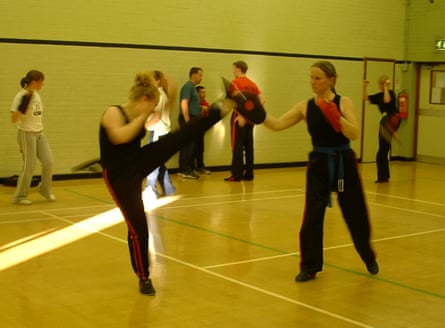
At 14, I decided to learn a martial art. I told my parents it was to defend myself on the mean streets of Congleton – a market town in Cheshire largely devoid of danger – when, in truth, it was because I wanted to be like Buffy the Vampire Slayer.
I joined a kickboxing club, and what could have been a passing phase became a thrice-weekly commitment spanning four years. I was a model student, picking up a different coloured belt every few months to mark my progression through the grades. I grew strong and flexible, swapping puppy fat for muscle. I routinely fought men without fear and found a confidence in my body I have never experienced before or since.
By the time I came to do my black belt grading in 2004, I was 19 and in the best shape of my life. Three torturous hours of punches, kicks, fitness drills and sparring pushed me to my limits and culminated in a “surprise” street-fighting section in which multiple attackers came at me with real pipes. How very Buffy.
I passed – one of the club’s first students to reach that level. Then, almost as soon as I achieved what I’d worked so hard for, I gave it up. I went travelling and to university, and swapped the kickboxing club for nightclubs. Over time, my body softened and I began to view the sport I once loved as something that belonged to a younger, stronger version of myself.
Until, in late 2024, a physio charmingly revealed I was “staring down the barrel of 40” with a cartilage tear and mild arthritis in my hip. I immediately mourned the thought of never again doing a spinning heel kick, despite barely having thought about it in 20 years. So, on a whim, I returned to my childhood club to see whether it was possible.
I expected to feel slow and out of place; instead, I came as close to time travel as is possible outside science fiction. My old instructor Alastair was still in charge; his mum, Lyn, was still a coach; and the third person to walk through the door was my old sparring partner, Amy. I had seemingly fallen through a wormhole – maybe my body would be fooled into thinking it had the fitness level of a teenager too?
I tightened the straps of my boxing gloves with my teeth, as I had hundreds of times before, and slipped back into punch combinations. Muscle memory took over: jab-cross-hook-uppercut; jab-hook-backfist. Switching to legs, I flicked through a series of front kicks and twisted my hips into side kicks. When it came to my first spinning heel kick in decades, the flat of my foot hit the pad with a satisfying slap. Too easy, I mentally scoffed.
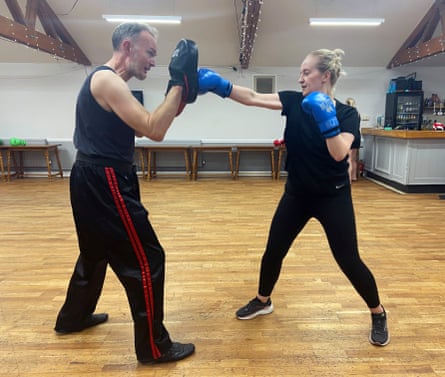
But when Alastair suggested a jump roundhouse kick, I hesitated. I hadn’t voluntarily leapt into the air since losing faith in the stability of my hypermobile ankles after one too many sprains in adulthood. I eyed the target far longer than was reasonable and performed an embarrassingly timid hop, stopping far short of the mark. My lack of self-belief was evident.
Elevate Your Health for Just $29.99/Month
Join the Precision Wellness Subscription at My Healing 365 and get discounted services, priority coaching access, virtual care, and exclusive wellness resources to support your physical, emotional, and hormonal health.
Join for $29.99/Month“It’s not because you can’t do it,” said Alastair. “It’s because you don’t believe you can.”
He was right: the real barrier wasn’t physical decline but the mental assumption I was no longer capable. I jumped a second time and cleared enough height to make contact with the pad, feeling a familiar rush of satisfaction at having landed the move.
Afterwards, I asked Alastair what he had made of my form, given my long absence. He told me that if he had to grade me right then, I’d pass with a second dan blue belt, four below black. It was a better assessment than I’d dared hope for, albeit caveated with a reality check.
The experience didn’t make me feel 19 again; in fact, I spent much of the next morning submerged in a salt bath and knocking back ibuprofen. Sure, I could execute many of the moves, but my stance was off and my breathing was all over the shop. As for press-ups and jump squats, I was in no shape to do multiple sets of 50. To get back to where I once was would take serious training.
But it did transform how I view my body. When I look back at old gym photos, I know I had zero appreciation for what it could do. Like many teenage girls, I focused only on the bits I thought needed to change, not the shapes it effortlessly slipped into, the power it had, and the ease with which it recovered. If there’s one thing I hope for, it’s that in 20 years’ time I’ll look back at photos of me training at 39 with a better appreciation of what my muscles and bones could still achieve.

























