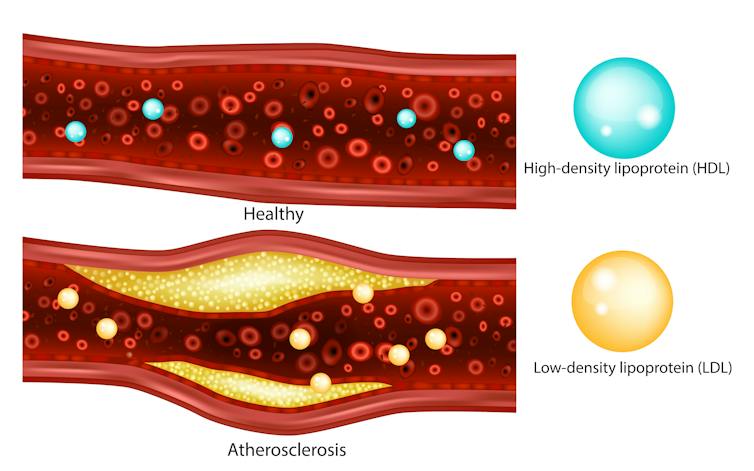
At least a quarter of Americans suffer from high levels of cholesterol or fatty acids in their bloodstream, a condition called dyslipidemia. Uncontrolled cholesterol levels increase the risk of atherosclerotic cardiovascular disease, or ASCVD: a group of diseases that result from the buildup of plaque in the blood vessels, preventing blood from traveling smoothly to vital organs. This condition can lead to heart attack and stroke.
As a cardiologist with expertise in sports and exercise science, I routinely take care of patients who are interested in making healthy lifestyle choices to control their cholesterol levels, reduce their risk of cardiovascular disease and improve overall health.
In March 2026, new guidelines were provided on how to treat dyslipidemia, by the American Heart Association and the American College of Cardiology. These guidelines, which were last updated in 2018, include findings from several new studies about how to more effectively treat – and prevent – this condition.
These new guidelines are important for both patients and doctors interested in improving heart health. Of note, these guidelines can help doctors personalize treatment to reduce each individual patient’s risk of developing cardiovascular disease.
Table of Contents
What changed in the new guidelines?
Compared to prior guidelines, the 2026 update emphasizes the need to treat high cholesterol and fatty acids earlier in life and more aggressively in order to reduce the risk of developing atherosclerotic cardiovascular disease later in life.
This push toward earlier and more aggressive treatment is based on the observation that there is a strong relationship between the duration of high cholesterol blood levels and the risk of cardiovascular disease over the span of a lifetime.
The new guidelines provide clinicians with information on how to use blood tests and imaging tools to help determine a person’s risk of developing cardiovascular disease.
Some important blood tests include standard lipid tests like levels of LDL (the “bad” cholesterol) and HDL (the “good” cholesterol), but the new guidelines also emphasize the importance of some newer blood tests like lipoprotein A (LpA) and apolipoprotein B (ApoB). The updated guidelines also recommend checking coronary artery calcium (CAC) levels, which older guidelines did not include.
Importantly, the guidelines encourage providers to use an online calculator called PREVENT-ASCVD, which uses several factors to determine whether a patient is at low, intermediate or high risk for cardiovascular disease. These factors include body mass index, blood pressure, diabetes history, kidney function and smoking status. The PREVENT-ASCVD calculator also provides an estimate of someone’s risk of cardiovascular disease over 10 years starting at age 30, as well as a risk estimate over the next 30 years.
Based on a patient’s risk level, the guidelines list several newer classes of medications that can be incorporated into a treatment plan for high cholesterol levels. Medications called statins – such as atorvastatin (Lipitor) and rosuvastatin (Crestor) – remain the standard of care for cholesterol management. Several types of additional medications are recommended if statins alone are unable to help patients achieve their cholesterol goals or if a patient experiences intolerable side effects on statins.

Sakkura/iStock via Getty Images Plus
Why were the guidelines updated?
In the mid-20th century, physiologists identified two molecules key to cardiovascular disease: LDL and HDL cholesterol. Epidemiologists observed that high LDL was tied to an increase in heart attack risk.
In the 1980s, two physiologists were awarded the Nobel Prize for discovering the LDL receptor, a protein on the surface of cells that regulates how much LDL cholesterol is brought into cells. This foundational work transformed the way doctors thought about heart health and cardiovascular disease.
Elevate Your Health for Just $29.99/Month
Join the Precision Wellness Subscription at My Healing 365 and get discounted services, priority coaching access, virtual care, and exclusive wellness resources to support your physical, emotional, and hormonal health.
Join for $29.99/MonthIn the new guidelines, LDL remains the traditional marker for determining cardiovascular disease risk. Other biomarkers like triglycerides and total cholesterol also remain important to check.
However, the guidelines include two newer markers – ApoB and LpA – that may help determine cardiovascular disease risk beyond LDL alone.
ApoB is a chemical structure that can be found on plaque-forming particles like LDL. While LDL measures the mass of plaques in the blood, ApoB measures the number of plaque particles in the blood. In some scenarios, ApoB may more accurately predict someone’s risk of cardiovascular disease than LDL cholesterol, especially for patients with diabetes or metabolic syndrome. It can also be particularly useful for patients who have normal LDL levels but elevated levels of other lab values like triglycerides.
LpA is a molecule similar to LDL cholesterol in structure, but with an extra protein attached to it called apolipoprotein A. This protein is stickier and more prone to cause plaque or blockages in arteries than LDL alone. Elevated levels of LpA may increase a person’s lifetime risk of cardiovascular disease; the higher the LpA level, the higher the risk of cardiovascular disease. The guidelines recommend checking LpA once in all adults to help determine their lifetime risk of cardiovascular disease.
Finally, the new guidelines also provide information on coronary artery calcium scores. Obtained from a CT scan, these scores directly measure the amount of calcium deposits in the arteries around the heart. The greater the amount of calcium, the greater the risk of cardiovascular disease. The guidelines provide specific recommendations for managing cholesterol levels depending on the amount of calcium in a patient’s arteries.
These patient-specific targets are representative of the broader goal of the new guidelines – namely, to personalize treatment plans based on each patient’s unique risk profile.
How do the new guidelines affect treatment?
The new guidelines shift how doctors manage cholesterol levels toward earlier screening and more personalized treatment. They emphasize the importance of lifelong prevention strategies to reduce risk of cardiovascular disease.
The guidelines recommend checking lipid levels very early in life. Children ages 9 to 11 should have their cholesterol levels checked to identify any lipid abnormalities. Starting at age 19, adults should have cholesterol levels checked every five years. Adults at an increased risk of cardiovascular disease may also consider starting medications at age 30.
The guidelines also recommend what’s called a CPR model of cholesterol management:
-
Calculate the patient’s 10-year cardiovascular disease risk.
-
Personalize their estimated risk by considering other factors like family history, blood test results and existing conditions.
-
Reclassify patients with additional imaging scans.
-
Reassess treatment recommendations based on this information.
This approach underscores the importance of personalizing treatment decisions based on each individual patient’s risk.

fcafotodigital/iStock via Getty Images
What do the guidelines say about lifestyle?
It is important to remember that healthy lifestyle choices remain the foundation for preventing cardiovascular disease.
The American Heart Association recommends specific healthy behaviors it calls Life’s Essential 8 to help reduce cardiovascular disease risk. These include getting enough sleep, quitting tobacco and managing blood pressure, among others.
The new cholesterol guidelines emphasize the importance of modifying diet, including reducing the amount of sugar, refined carbohydrates, saturated fats and alcohol a person consumes each day.
The guidelines emphasize the importance of routine exercise. Specifically, they recommend 150 minutes per week of moderate intensity exercise, or 75 minutes per week of vigorous exercise throughout adulthood. They also recommend two days per week of resistance exercise.
Lastly, the guidelines recommend weight loss of around 5% to 10% of total body weight for patients who are overweight or obese to help reduce the risk of cardiovascular disease.

























