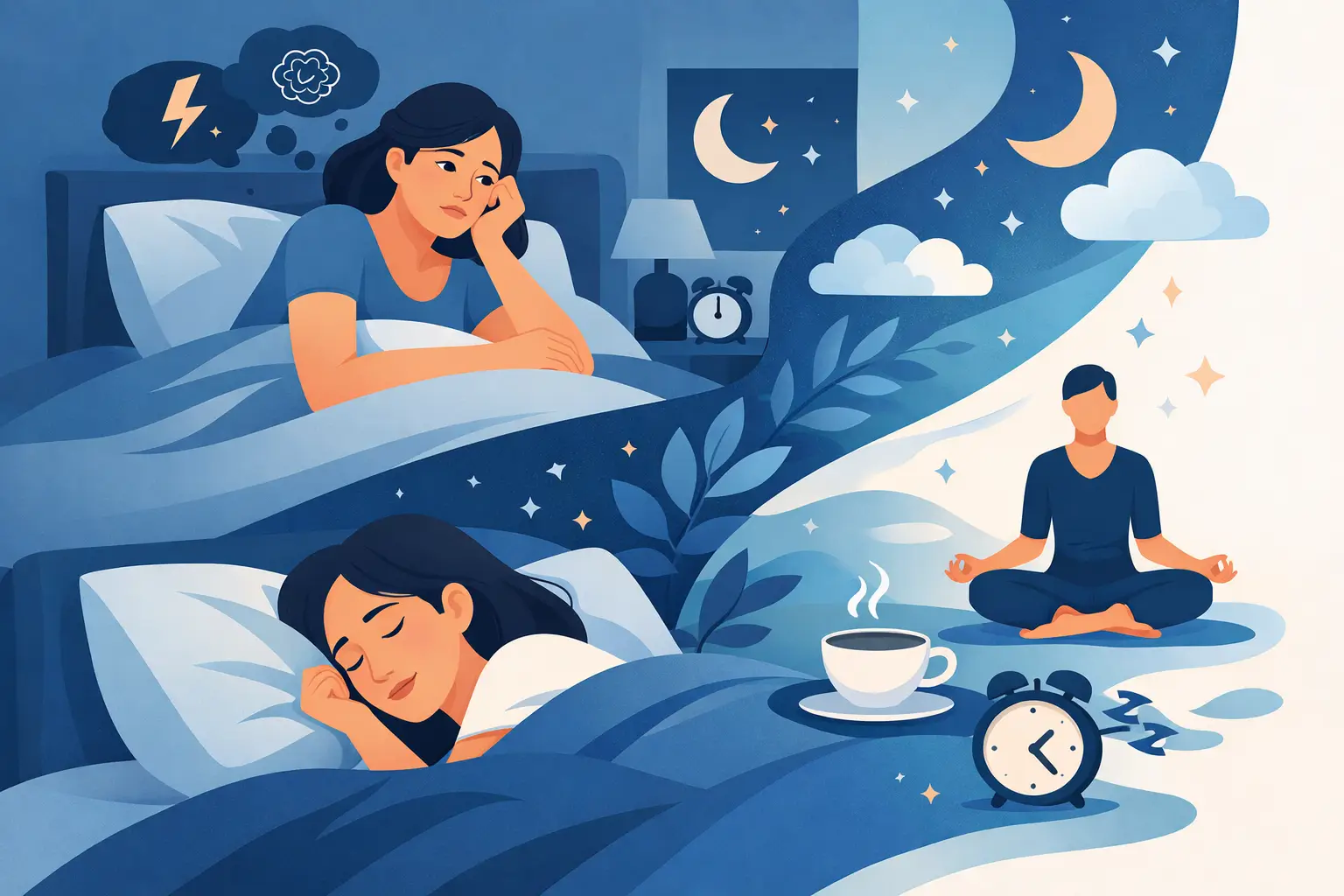
Anxiety can leave your body exhausted while your mind stays on alert. You may feel sleepy on the couch, then suddenly feel wide awake the moment your head hits the pillow. Learning how to improve sleep after anxiety starts with understanding that this is not a personal failure or a lack of discipline. It is often your nervous system trying, imperfectly, to protect you.
The goal is not to force sleep. The more pressure you put on yourself to fall asleep immediately, the more alert you may feel. A better approach is to create steady signals of safety, address the habits that keep anxiety active at night, and get support when disrupted sleep becomes a pattern.
Table of Contents
Why anxiety can make sleep so difficult
Anxiety activates the body’s stress response. Your heart rate may rise, muscles may tense, and your thoughts may scan for problems that need to be solved. Those reactions can be helpful during a real emergency. At 1:30 a.m., they can make even a quiet bedroom feel like a place where you need to stay vigilant.
Nighttime also removes many of the distractions that carry you through the day. Unfinished work, family concerns, health worries, relationship stress, or a major life change may feel louder when there is nothing else competing for your attention. For some people, poor sleep then becomes another source of anxiety: What if I am exhausted tomorrow? What if this happens again tonight?
That cycle is common, and it can be changed. Usually, it takes a few consistent adjustments rather than one perfect bedtime routine.
How to improve sleep after anxiety: start before bedtime
A calmer night often begins well before you get into bed. Your brain benefits from predictable cues that the demanding part of the day is over.
Choose a realistic wind-down period of 30 to 60 minutes. It does not need to look like a wellness commercial. You might dim the lights, shower, make caffeine-free tea, listen to something familiar, or read a few pages of a low-stakes book. The point is repetition. When you follow roughly the same pattern most nights, your brain begins to associate it with slowing down.
It also helps to create a boundary between problem-solving and sleep. Try a short “worry window” earlier in the evening. Write down what is bothering you, what you can do about it tomorrow, and what is outside your control tonight. Keep it simple. You are not trying to solve every problem on paper. You are giving your mind a place to set the thought down.
Screens are not automatically bad, especially if a phone is how you relax or connect with others. But scrolling through upsetting news, work messages, or emotionally charged content can keep your nervous system activated. If you use your phone at night, consider choosing a calmer activity and setting a clear stopping point.
Use your bed for rest, not for wrestling with thoughts
If you have been lying awake for a while and feel increasingly frustrated, get out of bed if you can. Move to a comfortable, dimly lit spot and do something quiet until you feel sleepy again. Avoid checking the clock repeatedly, starting work, or turning on bright lights.
This can feel counterintuitive when you are already tired. But staying in bed while your thoughts race may teach your brain to link the bed with tension. Stepping away briefly helps protect the association between your bed and rest.
When you return to bed, try a simple grounding exercise. Notice the pressure of the mattress beneath you. Relax your jaw and lower your shoulders. Breathe slowly, with a slightly longer exhale than inhale. You do not need to breathe perfectly. The purpose is to give your body a physical message that there is no immediate threat.
If thoughts keep returning, do not argue with them. Acknowledge them with a phrase such as, “I am having an anxious thought,” then bring your attention back to your breath, a neutral sound, or the feeling of your blanket. This takes practice, but it can reduce the struggle that keeps you awake.
Support your sleep rhythm during the day
The way you spend daylight hours has a meaningful effect on how sleepy you feel at night. A few basics can make sleep more reliable, especially after a stressful period.
Try to wake up around the same time each day, including weekends when possible. A consistent wake time is often more helpful than trying to force a perfect bedtime. Get outside or sit near bright natural light soon after waking. Morning light helps reinforce your internal clock.
Movement can also help discharge some of the physical energy anxiety creates. A walk, light strength training, stretching, or another activity you enjoy can support sleep. Intense exercise late at night works fine for some people and keeps others energized, so pay attention to your own pattern.
Caffeine deserves an honest look, too. If you are sensitive to it, an afternoon coffee, energy drink, or pre-workout supplement can linger longer than expected. Alcohol may make you drowsy at first, but it can fragment sleep later in the night and leave anxiety feeling worse the next day.
Naps are not always a problem. A short early-afternoon nap may help after a rough night. Long or late naps, however, can make it harder to build enough sleep pressure for bedtime. It depends on your schedule and how your body responds.
Be careful with quick fixes
When sleep has been difficult for several nights, it is understandable to look for anything that promises fast relief. Over-the-counter sleep aids, supplements, alcohol, and borrowed medication may seem like an easy answer. They can also create side effects, interact with other medications, or mask an anxiety problem that needs more direct care.
Melatonin can be useful in certain situations, particularly for shifting a sleep schedule, but more is not always better. It may cause grogginess or vivid dreams for some people. Prescription options may be appropriate for some adults, but the right choice depends on your symptoms, health history, current medications, and the cause of your sleep disruption.
Elevate Your Health for Just $29.99/Month
Join the Precision Wellness Subscription at My Healing 365 and get discounted services, priority coaching access, virtual care, and exclusive wellness resources to support your physical, emotional, and hormonal health.
Join for $29.99/MonthA licensed provider can help you sort through these trade-offs. The best plan may include therapy strategies, changes to an existing medication, short-term sleep support, treatment for anxiety, or a combination of approaches. Care should fit your life, not add another complicated task to it.
When anxiety-related sleep problems need professional support
Consider reaching out if poor sleep lasts more than a few weeks, interferes with work or relationships, or leaves you relying on substances or sleep aids to get through the night. Support can also be especially valuable if anxiety is showing up during the day as panic, persistent dread, irritability, low mood, or trouble concentrating.
Online mental health care can make it easier to begin when fitting in an office visit feels overwhelming. Through My Healing 365, eligible adults can connect with licensed providers online, discuss anxiety and sleep concerns privately, and receive an individualized treatment plan with ongoing messaging support.
Seek urgent help right away if you are having thoughts of harming yourself or feel unable to stay safe. In the United States, call or text 988 to reach the Suicide & Crisis Lifeline, or call 911 in an immediate emergency.
Tonight, keep the goal small: make your room a little calmer, give your worries a place to wait until morning, and let rest count even if sleep does not arrive on command. Your nervous system can learn that nighttime is safe again, and you do not have to work through that process alone.

























