The next time you call an Uber ride or order food delivery with an app, there’s a good chance that the gig worker you meet is getting government benefits.
In 2025, companies such as DoorDash, Lyft and Uber had the most workers receiving Supplemental Nutrition Assistance Program benefits among all major employers, according to a new Government Accountability Office report. This marks a major shift from 2020, when an earlier GAO survey found that Walmart and McDonald’s took the top spots for SNAP recipients.
That finding may appear surprising to most Americans, who usually see platform-based work as a side hustle to earn extra cash. In fact, these jobs are becoming more essential as a primary source of income, even as they fail to cover basic food and medical expenses for gig workers.
As a scholar of urban politics, I consider this finding an important part of the broader picture revealed in a survey of more than 1,000 Michigan residents that my institute conducted with the Michigan Metro Area Communities Study.
Roughly 22% of total respondents had engaged in gig work, and about half of those said gig work was essential or important to meeting their basic needs.
Elevate Your Health for Just $29.99/Month
Join the Precision Wellness Subscription at My Healing 365 and get discounted services, priority coaching access, virtual care, and exclusive wellness resources to support your physical, emotional, and hormonal health.
Join for $29.99/MonthAt the same time, safety net programs – paid for by taxpayers – are filling the gap when platform companies hire low-wage workers without offering traditional benefits.
Table of Contents
Flexibility as a double-edged sword
Major gig-work platforms, including Uber and Lyft, often describe their jobs as an opportunity for workers to earn income on their own terms and hours.
In this respect, they’re right. In our survey, 9 in 10 workers said they valued the flexibility, and more than two-thirds reported positive experiences overall.
But gig workers also named pressing concerns, especially about transparency, pay and benefits.
The issue, then, isn’t whether workers want flexibility, but whether flexibility allows them to get by in today’s economy.
In fact, gig work may be supplemental, but it isn’t always optional. With nearly half of all Americans saying they struggle to make ends meet, gig work is likely to increase as a source of financial survival.
At the same time, these platforms aren’t substituting for traditional employment. We found that relatively few gig workers – only 6% – reduced hours or left another job to pursue other gig work.
And when gig work becomes a necessary source of income, the lack of benefits – from health insurance to disability insurance to workers’ compensation – reflects a shift in who is turning to the safety net. If major platforms won’t pay a living wage or provide adequate benefits on the grounds that it’s the price of “flexibility,” government programs often fill the gap.
In other words, taxpayers are helping foot the bill to compensate gig workers.
Medicaid enrollment surge
The Government Accountability Office report also showed that gig platforms are collectively now the third-biggest U.S. employer with workers on Medicaid, the public health insurance program for low-income and disabled Americans. By contrast, in 2020 they didn’t make the top five.
What’s more, recent changes to Medicaid are likely to exacerbate conditions for gig workers. President Donald Trump’s sweeping tax and immigration bill passed in 2025 included provisions for the many states that had expanded Medicaid over the past 15 years. Under the new rules, Medicaid recipients face new and tougher work requirements that demand 80 hours of work or school per month to maintain coverage.
Gig work counts toward the requirement, but gig workers who work for multiple platforms may have trouble proving eligibility. For example, app interfaces have different formats for reporting hours, and gig workers don’t receive a standard pay stub with total hours worked.
They also lack a traditional employer contact or a supervisor who would allow for easy verification. And their total hours worked don’t always account for wait times, while fluctuations in user demand can make income unpredictable.
As is the case for Medicaid recipients more generally, the complexity and paperwork of the new work requirement may deny them coverage, regardless of whether they work 80 hours per month. These extra hurdles are likely to push more Medicaid recipients off the rolls and toward other social programs as medical bills surge and their overall finances become even more strapped.
This loss of coverage may also lead to even more dire consequences, such as increased hospitalizations that can result when uninsured people forgo basic or preventive care.
AP Photo/Eric Risberg
Is portability the answer?
In some states, lawmakers are starting to address the growing trend of gig platforms using government benefits to outsource benefit costs. Portable benefits offer one promising response.
Under this model, platform companies or users of gig apps contribute to worker-owned benefit accounts that follow workers across platforms. In our survey, 61% of gig workers supported this idea, as did more than half of other kinds of workers.
Two states already provide some important lessons from existing models.
In New York state, the Black Car Fund, initially established for taxi and limo drivers, has covered gig drivers since 2014. It’s a nonprofit, state-authorized benefits fund that’s managed by a board consisting of industry representatives, including drivers.
Enrollment in that program is automatic for all gig workers and taxi drivers, with benefits paid for through a passenger surcharge collected instantly via fares. It made headlines in 2023, when the state secured a US$328 million settlement after Uber and Lyft withheld pay and benefits from workers. That settlement included mandatory paid sick leave, minimum pay and other benefits.
This model has effectively shifted some of the burdens of lower-wage gig work from taxpayers to users. A centralized pool of cash gives the Black Car Fund significant purchasing power, allowing it to offer drivers full workers’ compensation as well as varying levels of health, dental and disability coverage that drivers can chose from.
Platform companies don’t contribute money at present, but if they did, they could make these benefits even more generous.
A different approach in California
As a contrasting example, California shows how much policy design matters.
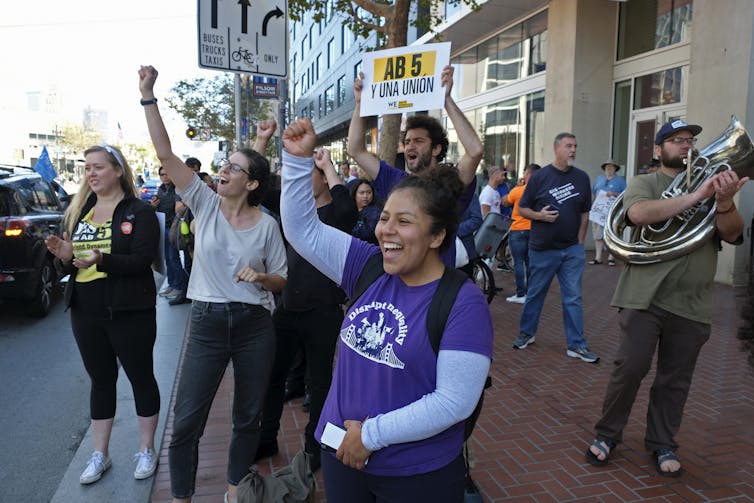
The state opted to work with tech companies when it crafted Proposition 22, which sought to provide delivery and ride-share drivers limited benefits while preserving their independent contractor status. Passed in 2020, it left implementation to the platform companies and offered a narrower set of benefits that aren’t fully portable across platforms.
The California model also has more barriers toward getting benefits. For example, tech companies only count “engaged hours” toward the minimum required to access benefits, which doesn’t account for time waiting for assignments. And because the system isn’t truly portable, gig workers who work for different platforms have more trouble qualifying.
One study found that only 10% of California drivers are receiving the healthcare stipend that the law established.
The central role of tech platforms in determining who’s eligible has become a flash point, with unions and labor rights groups reporting widespread problems with access and eligibility. In New York, on the other hand, a neutral third party determines eligibility and adjudicates payouts.
While these states have taken different approaches, I believe policymakers should remember that they don’t need to treat flexibility and worker protections as mutually incompatible. In the absence of universal federal benefits for gig workers, local and state officials can find ways to ensure that social costs aren’t shifted to the public through tax dollars and to workers through greater financial insecurity.

























