Every year, an estimated 6,000 to 24,000 people are killed by lightning across the world, and many more are injured.
Obviously, there is a wide range in these numbers, and that’s due to the fact that these estimates are built on limited and incomplete information.
I’m a lightning researcher at the University of North Dakota. I study both the physics of lightning and its impact on people. The physics is the same no matter where you are, but the impacts can be very different depending on where you live.
Research on the health effects of lightning strikes is sparse even in the U.S., but in Central Africa – one of the most lightning-active regions on Earth – researchers like me know almost nothing about who is being struck and what happens to them. That’s why I’ve spent the past 10 years working with the African Centres for Lightning and Education Network, a nonprofit organization that works to reduce deaths, injuries and property damage from lightning across Africa, to build the largest publicly available database on lightning casualties on the continent.
Table of Contents
Central Africa’s unique circumstances
Our team began collecting data for the database in January 2018, covering 46 of the 54 countries in Africa. As of June 2026, it had over 2,100 entries. I’ve been using this information to better understand when, where and why these deaths and injuries happen.
Many lightning incidents go unreported, especially in the Global South, where there may be poor internet accessibility, civil unrest or cultural beliefs that attribute lightning strikes to supernatural forces.
Then there’s the language barrier: On the African continent alone, at least 75 languages each are spoken by more than a million people, and hundreds more are spoken by smaller populations. This makes it difficult to track news reports of lightning strikes around the world even where they are available.
Africa experiences an average of 2 million to 4 million lightning strikes annually.
Near the equator, the Congo Basin, receives intense solar heating year-round. Water vapor from the Congo rainforest, the world’s second-largest rain forest after the Amazon, constantly fuels warm and moist air from the Gulf of Guinea. The Adamawa Plateau and Cameroon Highlands force that air upward, creating some of the most electrically active thunderstorms on Earth.
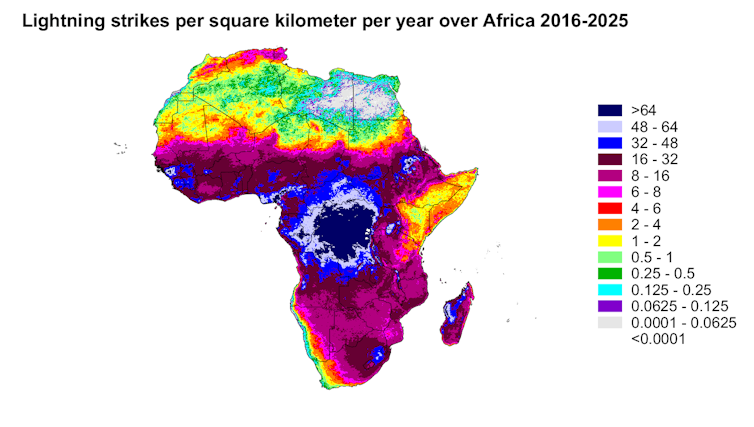
Map created using Vaisala’s GLD360 data from 2016-2025 by Daile Zhang at the University of North Dakota, CC BY
Exposure and vulnerability
But the frequency of lightning alone in this region doesn’t explain the high number of injuries and deaths from strikes in Africa. The real story is also about exposure and vulnerability.
To understand where lightning poses the greatest threat, our team created a way to measure and compare risk across countries. We assigned a score to each country based on three things: how many lightning strikes occur there, known as “hazard”; how many people are injured or killed relative to the population, or “exposure”; and how vulnerable the population is, based on gross domestic product per capita, according to the World Bank. We then calculate an overall risk score by multiplying those scores together.
Of the 15 African countries where my team and I have enough data to calculate risk, 14 fall in either high or very high lightning risk categories. The only exception is South Africa, where the lightning hazard is moderate, vulnerability is low, and a strong lightning research team has helped drive safety improvements. The higher number of reported lightning incidents in South Africa is due to the fact that the country has better reporting systems, wider media coverage and a predominantly English-speaking population, which makes incidents easier to document and share.
In soon-to-be published research from our team, we found that 87% of the lightning fatality incidents in Africa involved more than one victim, compared to fewer than 10% in developed countries. Mass casualty incidents have been consistently reported in Uganda.
This stands in sharp contrast to developed countries. In the U.S., the National Lightning Safety Council reports that 517 people died from lightning between 2006 and 2025. From historical data, it is estimated that more than 90% of those struck by lightning survived. In Canada, researchers estimate that nine to 10 people die and 92 to 164 are injured from lightning strikes each year.
These high survival numbers are likely due to the fact that most people have access to lightning-safe buildings and vehicles and can reach emergency care quickly.
But in Africa, we’ve found that about half of the lightning incidents occur indoors. The National Lightning Safety Council slogan, “When thunder roars, go indoors,” simply doesn’t apply, because most of the buildings, including schools, homes, churches and marketplaces, are not lightning safe.
Elevate Your Health for Just $29.99/Month
Join the Precision Wellness Subscription at My Healing 365 and get discounted services, priority coaching access, virtual care, and exclusive wellness resources to support your physical, emotional, and hormonal health.
Join for $29.99/MonthA lightning-safe building requires a properly designed and maintained protection system that meets international standards. Many buildings in Africa have no protection at all, while others rely on a single, often poorly maintained arrester that may not meet international standards and is not designed to protect an entire building.
Beyond statistics
In addition to gathering data about lightning strikes, our team also interviews survivors to learn more about the health effects of being struck by lightning.
One woman we spoke with, a nurse, recalls that she was vaccinating children at a primary school when she was struck by lightning with such force that she was thrown through a classroom window. Her clothes caught fire, and she lost consciousness immediately. She was in the hospital for four days and still suffers from chronic pain, partial paralysis in her legs and memory loss.
Before the strike, she was a healthy and active nurse. Now, she struggles to walk and had to leave her job. She works at a friend’s clinic when she can, but there are days the pain is too severe to go to work.
Sadly, in another incident 10 years later, 18 children were killed and 38 injured by a lightning strike in the very same classroom where she had been struck.
The building had no lightning protection system at the time of either strike. In 2016, African Centres for Lightning and Education Network installed a lightning protection system.
A challenging diagnosis
This nurse’s story is unfortunately not unique among lightning survivors, who often face major health challenges for the rest of their lives. To others, they may seem lucky. But surviving a lightning strike is often the beginning of a long and lonely medical journey.
More than two-thirds of lightning strike survivors in the U.S. do not have visible scars, according to surveys from the U.S.-based nonprofit Lightning Strike & Electric Shock Survivors International. But they often develop lasting, invisible conditions, such as brain injury, chronic pain, swelling, memory loss, tinnitus and difficulty concentrating, with symptoms varying widely from person to person.
Many face huge medical bills, disabilities that prevent them from returning to work and result in lost income, and even personality changes that strain their personal relationships. Children who are injured often develop learning disabilities as a result of brain injury caused by the lightning strike, affecting their memory, concentration and ability to keep up in school.
And yet, when they go to the doctor, they often encounter skepticism. Because there are rarely visible scars, many survivors are told their symptoms are psychological or, worse, imaginary. And survivors in both Africa and the U.S. report that even if they find a doctor who believes them, very few physicians are trained in treating lightning injury.
All of this can take a heavy toll on survivors’ mental health. After surviving a traumatic event, survivors often face a double blow: Even their own doctor doesn’t believe them or know how to help them. One lightning strike survivor founded Lightning Strike & Electric Shock Survivors International in order to offer support and resources for survivors and their families. Many survivors told me they consider the organization’s semiannual conferences to be a lifeline.
In parts of Africa where even basic medical care is hard to come by, people suffering from lightning injury also face a lack of competent care. As my colleagues and I move ahead with our research in Africa, we hope that collecting more data about survivors will inform education both for the public on lightning safety and for doctors on treating lightning injury.
It also reminds us that whether in the U.S. or in Africa, survival is not the end. Lightning only lasts a fraction of a second, but the aftermath can last a lifetime.

























