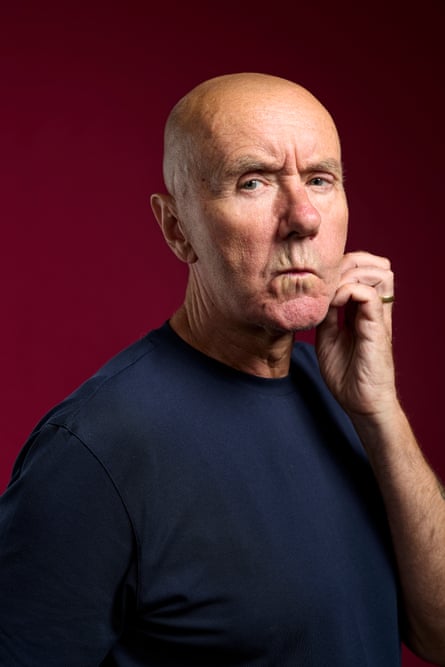
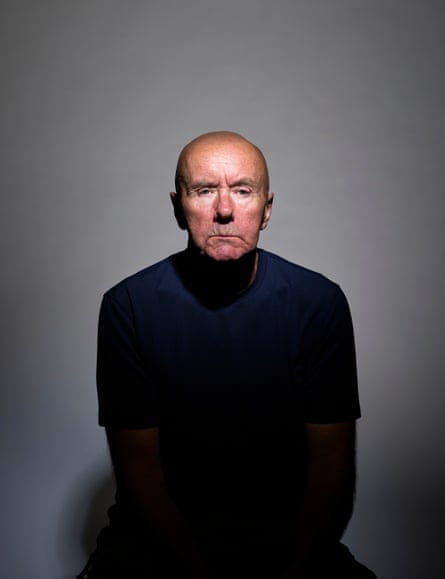
By rights, Irvine Welsh ought to be photographed somewhere gritty, looking grumpy, he says: “That’s the brand.” Beside a graffitied wall or at the docks, with a beanie pulled low, and definitely not smiling. But here he is, clear-skinned and wholesome in shorts and a T-shirt, drinking tea and – it’s hard to think of anything more off-brand – talking about the health benefits of yoga. Given his reputation for having lived in the worlds his books portray, he should or could look a lot worse. He guffaws at this, eyes a delighted blue, and repeats the phrase as if he’s found a new personal tagline: “Could look a lot worse!”
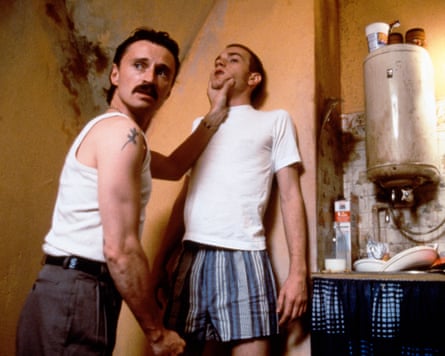
Over the three decades since his cult debut, Trainspotting, was published in 1993, Welsh’s fiction has explored with humour the darker side of life. Drugs, clubs, alcohol, violence … often alongside psychological or social deprivation. Despite being 17 novels and four short-story collections into his career, selling more than 6m books globally, he remains best known for his first. It achieved, he says, “what most writers want to achieve in a lifetime – the big zeitgeist book that goes into the culture”.
Welsh’s new book, Can Nothing Save Us?, is a big American novel and applies the same sharp-eyed realism that Trainspotting brought to working-class Edinburgh to Trump’s US. Set in the scorching heat of Las Vegas, it’s a multigenerational thriller in which, as one character puts it: “Everyone is dissatisfied. Democracy over. A confused citizenry reduced to helping rich egomaniacs build fiefdoms.” Sound familiar?
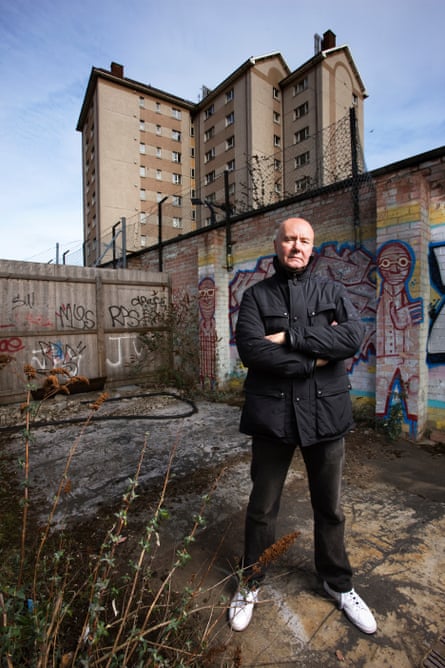
Welsh, who grew up in Muirhouse, north Edinburgh, has spent swathes of the past 20 years in the US, after marrying his second (now ex-) wife, Beth Quinn, who’s American, in 2005. He still has a home in Miami (and in London and Edinburgh). “I was there when Obama first got elected and I was there when Trump first got elected,” he says. In the run-up to Trump’s presidency, Welsh wasn’t too worried. The professional, educated women he knew barely gave him a thought, focusing instead on his rival. “Clinton,” he says. “She was the one that brought on the real seethe. She was [seen as] an enabler of the worst kind of guy – the liberal sex pest in sheep’s clothing.”
Trump remains an unarticulated presence in Welsh’s novel, an orange glow emanating from a fictional TV. Did Welsh fear litigation? “I wanted to show real people. I didn’t want to get into the politics of those wankers because they’ve got too much to say for themselves already,” Welsh says. Instead, in the midst of an affordability crisis, climate crisis, health crises and complex family relationships, all the novel’s characters are searching for the moral heart of their story.
Can Nothing Save Us? is published this month, but it has a long back story. Welsh originally thought he was collecting material for an HBO pilot on the superstar DJ – this was in 2014 – with his friend Calvin Harris. (Welsh also DJs and co-owns a record label.) From the DJ boxes of Vegas, he’d look out at “this ugly scene where middle-aged sleazy guys grind up against young women who’ve been comped for the clubs” – but the project stalled and Welsh realised he had the makings of something different: “A novel about modern America.”
He gave the draft to his editor and some writer friends. “And they all said the same thing. ‘This is shit!’”
Welsh re-read it. “Fuck, they’re right,” he thought.
Rejection must be unfamiliar to a multimillion-selling novelist. But Welsh did manage to sell the screen rights, and while he watched the writers’ room work through his pages, he became “a voyeur of my own material” and understood how to fix his novel.
By now, Welsh had seen his friend Jake Chapman’s film Accelerate or Die and he’d read the work of the accelerationists Nick Land and Sadie Plant – broadly speaking, accelerationism is the idea that technology and capitalism must speed up if humanity is to reach a better place. In Welsh’s novel, time flips forward and lurches back.
“People have got that existential crisis. Everything is going too fast for us to control,” he says.
So what can save us?
“What does save us is the inherent insanity and unworkability of the system,” Welsh says, crashing down his tea.
His proofs of “unworkability” include the decline of social media usage (“If you argue with someone on social media, you’re basically saying you haven’t got a sex life”), the dimming of the lights in Las Vegas (“You watch Vegas sneeze and the rest of America is catching cold”), “enshittification”, the climate crisis, the “radicalisation of the centre” in British and US politics, and the internet in general.
This last “was supposed to be this big zone of freedom, and now it becomes self-made manacles. It does something to us rather than for us. We’re policing each other through our bizarre politics and our nosiness …”
The novel strings a path through all this from the My Lai massacre in Vietnam in 1968 to modern mass shootings and, true to brand, climaxes in spectacular carnage.
Welsh doesn’t own a gun, but he had a transformative experience at the Lock & Load shooting range in Miami. It’s “massively seductive”, he says, “when you start shooting at things”.
He thought he’d be “skittish”. But no. “I was a stone-cold assassin. I really enjoyed it. I was feeling the power of it.”
He got to thinking: “How would it be for a dispossessed kid who’s got no money and can’t get into the system and you’re told that you’re rubbish, and suddenly you’ve got this thing in your hand …”
When Welsh left Lock & Load, “I wanted to shoot live prey,” he says. “To shoot something that’s moving. To hunt something down. I thought: ‘Fucking hell! What’s going on with me?’ This is a drug. You know? I went twice and I thought: ‘I’m liking this too much. I’ve got to stop.’”
Welsh is practised at monitoring his proclivities, drawing the line and sticking to it. His addiction to heroin in his early 20s, “living in a Velvet Underground album, basically”, is well documented (he used notes and diaries from this time to draft Trainspotting). He tried rehab but it was just a chance “to detox [to] start again with a clean slate, get some pills in”, so he went cold turkey. Was it hard?
“Not once I decided that I really wanted to,” he says. “The worst part is the psychological thing. Once [drug use] is in your emotional vocabulary as your get-out – ‘I can stop feeling crap by doing this’ – you have to reorder your thinking.”

Reordering thoughts isn’t always easy, but, for Welsh, making the decision seems tantamount to its execution. He has a sort of self-applied strictness, which implies he is his own master, but also gives the impression of having to countermand his compulsions.
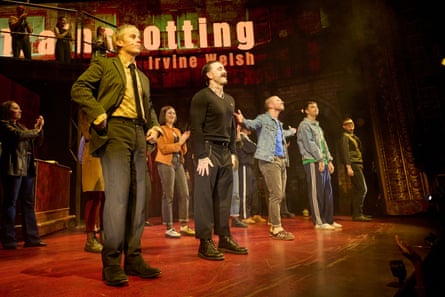
It’s not just the gun he’s recently overruled, but also sitting down. “Sitting down is the new cigarettes,” he says. As far as demonised lifestyle choices go, being sedentary is not the one typically associated with Welsh, but these days he writes at a standing desk. The other week, he took the train from Edinburgh to Guildford in Surrey for a rehearsal of Trainspotting the Musical – and the next day he was in agony.
Elevate Your Health for Just $29.99/Month
Join the Precision Wellness Subscription at My Healing 365 and get discounted services, priority coaching access, virtual care, and exclusive wellness resources to support your physical, emotional, and hormonal health.
Join for $29.99/Month“I was fucked from sitting all day,” he says. “I quite liked it.”
Liked the pain?
“The idea that it has become something that makes me feel bad, so I don’t do it any more.”
Perhaps not surprisingly, given the grim pleasure he took from the way his body registered dissent, he is geekily disciplined about wellbeing.
He takes the Zapply nutritional supplement favoured by boxers – he has boxed since childhood, when his parents sent him to toughen him up. He also attends breathing workshops – “Everything is better afterwards: your digestion, your sleeping” – and practises pilates and yoga.
Especially yin yoga – or “lazy bastards’ yoga”, as he calls it, because poses are held for several minutes. “You feel yourself opening up … Your shoulders, back, hips … It makes you calmer, basically.”
With his shiny head and straight mouth, I can’t help picturing Welsh briefly in an alternative career as a wellbeing guru or monk. Especially when he says: “I’m more Zen now than I used to be.”
Just before Christmas he was at the funeral of Mani, the bass player for Primal Scream and the Stone Roses. Once upon a time, Welsh would have been drinking with the best of them. But instead he microdosed and was “off my tits” on Guinness zero and a cup of mushroom chocolate. “Then bang! You’re sober … You go to bed feeling happy and clean … Everybody else is wrecked.”
Maybe the decisively slow yoga practice, the strict drawing of lines, is a way to counteract his own frenzy. For someone so relentlessly productive, it’s notable that his favourite bit of writing – “the best thing that I like most” – is to write “The End”. He always types the words.
It’s possible Welsh is on his own accelerationist trajectory, because this is his third novel in three years. He’s already written the next novel – a return to the Trainspotting cast – and started the one after that.
“Banging them out!” he says cheerfully, pretend-typing with hands bunched into fists, as if he’s punching the keyboard. Maybe he does. He goes to Miami each January, stays for three months, and between the gym and yoga, “easily” amasses 90,000 words.
“I’m just playing, basically,” he says. “You know when you’re a kid and you line up your soldiers on the carpet? I’m doing the same thing.” An only child, he always prized the “luxury” of his own room.
Sometimes, his wife – Emma Currie, an actor; they married four years ago – yells up. “‘You’ve got real friends down here that have come for dinner! Come and talk to them instead of your imaginary friends!’” he says. “‘You’re talking to people that don’t exist! You’re a nutter!’”
I wonder how it felt to write a multigenerational novel of complex family dynamics as an only child with no children of his own (though he is stepfather to three). Welsh was close to both parents, but his dad, a former dockworker and carpet salesman who died when Welsh was 22, “was my best mate”, and the relationship with his mother, a waitress, “more fractious”.
She was “very loving, but never into having kids”. She often told him: “You were an accident, son. A lovely accident, but an accident.” “She was quite tough, my mother,” he says. “She could be very critical of the books.
“She hated Trainspotting at first. ‘You’re hanging your dirty washing in public! Bringing shame on me again! I’m embarrassed!’” His parents “weren’t massively drug-literate” and didn’t know when Welsh was using heroin, beyond the sense that “it was more than other drugs”.
But Trainspotting grew on Welsh’s mother. “When it started to make money, she was like: ‘I want new windows, son.’ I bought her council house and got the windows double-glazed and a new door. She was all right with it after that. ‘My laddie’s written a book and it’s a bestseller!’” he says in a Scottish accent stronger than his own. “I do miss her.” She died in 2023.
“She got a bit frail in her last couple of years. I felt it put me in a strange position because she could be so cutting. We had these brilliant jousts. Then suddenly she got a bit slower and frail, and I felt I was bullying her if I tried to get involved in the cut and thrust of our jousts … But I felt I was patronising her if I didn’t.”
They did find peace. “Me and my mum, we said everything to each other. We put it all out on the table emotionally and talked about how we loved each other, and how we were friends, and how we’ve been through this and been through that together.” In a funny way, he says: “We did that too early. We were twiddling our thumbs for the last five years.”
Certainly, family love comes through in the novel as an important remedy. As to political answers, Welsh has previously said he’d like to dissolve the monarchy and the House of Lords, institutions that are “not really serving any function in the lives of most citizens”. He’d have “as much devolution as Britain and England wanted or needed”.
More personally, he believes that as people “become fed up with the system”, they will switch off. He’s noticed this switching off in himself.
“The office now posts all my stuff on X. This thing here,” he says, tapping his phone, face down on the table. “I’ve started going out without it. After about an hour, you’re anxious. Then you feel so liberated.’” He won’t touch AI, even for research.
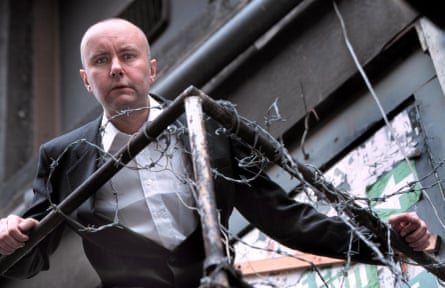
One of the problems of the internet, he says, is that it strips the context from everything – including Welsh himself. At events in college towns, “there’ll all be young people in the audience and they expect me to be young. ‘Who is this old fucker? That can’t be Irvine Welsh!’”
Yet there is something ageless about him, even if these days he gets “the young team” – friends’ and cousins’ children – to check his younger characters’ dialogue for him.
“Tell that to the mirror!” he says.
He hasn’t counted his age in years. Does he even know it?
“Sixty … eight? Sixty-nine?” he asks. (The internet says 67.) “I stopped celebrating birthdays when I got to 30. I was really depressed. I thought: ‘I’m not doing this again.’”
It sounds like ageing, measuring age – or maybe growing up – is another practice he’s drawn a line under. But he doesn’t fear what follows. He recently abandoned lifelong atheism, after a trip on the psychedelic drug DMT. “Now I just don’t know,” he says. “I’m quite excited … You do look at life in a more positive way.”
Can Nothing Save Us? by Irvine Welsh (Jonathan Cape, £20) is published on 13 August. To support the Guardian, order your copy at guardianbookshop.com. Delivery charges might apply

























