Imagine you and your partner are sitting in the waiting room of your doctor’s office, waiting for your appointment to get birth control – and instead of calculating how many other people will be called before you, or perusing old magazines, a nurse hands you a digital tablet and encourages you to play a game.
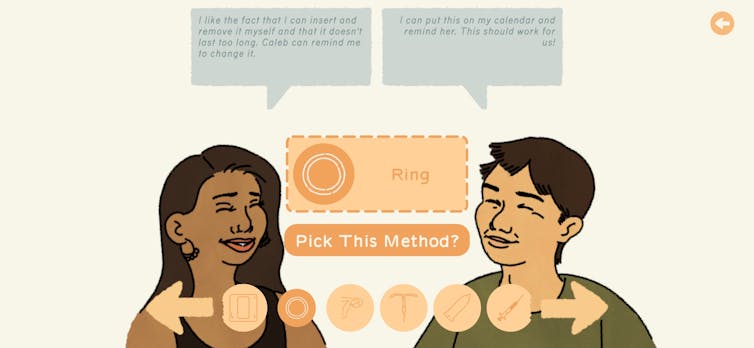
You power it on, and you find yourselves drawn into a story: Can you help Laila and Caleb figure out which contraceptive method will work best for them, given their lifestyles and Laila’s physiology? Their situation, you realize, is a bit similar to your own. Would helping them choose a form of contraception help you and your partner make an informed decision for yourselves?
As a designer and developer of games that promote positive health behavior change, I work with physicians, public health experts, artists and programmers to create games just like these. I focus on topics like vaccine hesitancy, sexuality and reproductive health – sensitive issues that people may have a hard time discussing openly.
Laila and Caleb are characters in a game that my team and I are developing called What’s My Method? We are testing whether playing it helps people choose a birth control method and makes it easier to have a fruitful discussion with their health care provider. And we are finding that this and other games for health-related education are a powerful but underused way of not just conveying information, but also providing people with an arena to learn from the outcomes of their choices.

Elena Bertozzi/SolitonZ Games, CC BY
Table of Contents
The power of play
When I tell people I make health-related video games for a living, they’re often surprised that this is a viable career choice. Many adults still see video games as trivial at best – and destructive at worst. For example, games that involve guns and shootings are widely blamed for gun violence in real life, even though there’s no causal evidence supporting the connection.
Play is how intelligent and curious beings make sense of the constantly changing world and ensure they keep learning. It is an early factor in children’s cognitive development. Peek-a-boo, for example, helps babies learn about object permanence – meaning that even if a person disappears for a short time, they aren’t gone forever. Digital play can support many types of learning. Games like Minecraft teach resource management, planning and spatial reasoning, among other skills.
The game industry is also an increasingly large part of the world economy. Given the size and reach of the international video game market – US$300 billion in 2025 – games are often the way technological innovations are introduced to a mass audience.
Take motion capture technology, which enables a device to track a person’s movement. Microsoft introduced it to the general public in 2010 through its Kinect console, in which two players can box or play tennis virtually by actually performing the movements with their bodies.
Augmented reality – the ability to use a smartphone to see a virtual world overlaid on the “real” world – entered the mainstream in 2016 when people began playing and watching others play Pokemon Go. Games are also how many people first experience virtual reality – a full immersion in an entirely virtual world – by wearing headsets like Oculus (now called Meta Quest) and Apple Vision Pro.
Gaming also has a powerful social dimension. Massively multiplayer online games like Animal Crossing, Fortnite and World of Warcraft provide a means for socialization and togetherness for billions of people worldwide. This became especially powerful during the COVID-19 pandemic when people were social-distancing – people’s use of such games soared during lockdowns, and they helped players maintain social connections.
In my own experience as the director of a university program in game design and development, I find that students who grew up playing complex digital games are better prepared to engage with technology and navigate an increasingly digital world.
Gaming for health
Early in my game design career, I realized that games don’t just provide compelling entertainment, but they can also equip players with the knowledge and the agency to solve hard problems in real life.
Elevate Your Health for Just $29.99/Month
Join the Precision Wellness Subscription at My Healing 365 and get discounted services, priority coaching access, virtual care, and exclusive wellness resources to support your physical, emotional, and hormonal health.
Join for $29.99/MonthThat’s especially valuable in health. Information for patients is usually conveyed through pamphlets or links to websites that often provide too much information in formats patients find difficult to decipher. These formats don’t effectively address gaps in health literacy. Games, on the other hand, provide targeted information in a specific context that players don’t just understand, but also, in some ways, inhabit. Such games allow players to try out different behaviors through avatars to see how they turn out. Conveying information through relatable avatars also triggers empathy, which further cements learning.
Since 2010, my team has been testing how to deploy digital games in the U.S., India, Barbados and Ghana to communicate complex health-related information through animated graphics, audio and interactive experiences.
In 2012, we worked with doctors at a hospital on Long Island, New York, to encourage families of critically ill children to get a flu vaccination. We found that family members who played a game we jointly developed called Flu Busters! were 40% more likely to get a flu vaccination than those who didn’t.
In the game, players help an avatar navigate a school filled with children sneezing and blowing their noses in order to enjoy social interactions such as sharing a cookie without getting sick. Rather than telling people how they should behave, the game allows players to experience how difficult it is to avoid being exposed to the flu virus in everyday life and how the vaccine can help children stay healthy, equipping players to make informed decisions about their own health.
In our first international project, we collaborated with public health physicians in India on a game we developed to gather data about how teenagers there make decisions about family planning. In addition to determining that a game was a very effective tool for anonymized data collection, we found that giving young people access to information about reproductive anatomy gave them the vocabulary and tools to understand and discuss their future reproductive choices..

Elena Bertozzi/SolitonZ Games, CC BY
Responding to rising vaccine hesitancy during the COVID-19 epidemic, my team developed Activate My Shield! The game demonstrates how vaccines protect against different diseases using the metaphor of armor that only works against specific types of attacks. To address misinformation that was widespread at the time – that COVID-19 vaccines contained injectable microchips – the game asks players to try putting a microchip in a vaccine needle and administering it to a person. Experiencing how impossible it is to do this helps players understand that it’s not a legitimate concern.
Reaching digital natives
Our games are available to all for free, but in order to be able to widely distribute them on the app stores, my team and I founded SolitonZ Games.
Several other research groups are developing similar games. They address an enormous range of health issues – for example, encouraging people with HIV to adhere to their treatment, helping teens avoid vaping and teaching children with asthma to manage their disease. A video game called EndeavorRx was authorized by the Food and Drug Administration in 2020 as a prescription-based therapy to improve attention in children who have attention-deficit/hyperactivity disorder.
Overall, our research and that of other groups show that digital games can be easily integrated into health care, and that play is an effective way of delivering health information. Simply put, people find the games fun and engaging.
Even as these efforts gain ground, however, health campaigns and patient education efforts have been slow to embrace game-based patient education. That’s perhaps partly because decision-makers such as hospital and clinic administrators are often unfamiliar with gaming and may be slow to buy into the idea of delivering health education through play-based technology. Plus, it’s difficult to make changes in busy environments with a lot of moving parts, like health care.
But I’m optimistic that by working together with public health experts and health care providers, game designers like me can help fit gaming into the industry and culture of health care. After all, it makes sense to try to reach digital natives on the technologies they are already holding in their hands.
























