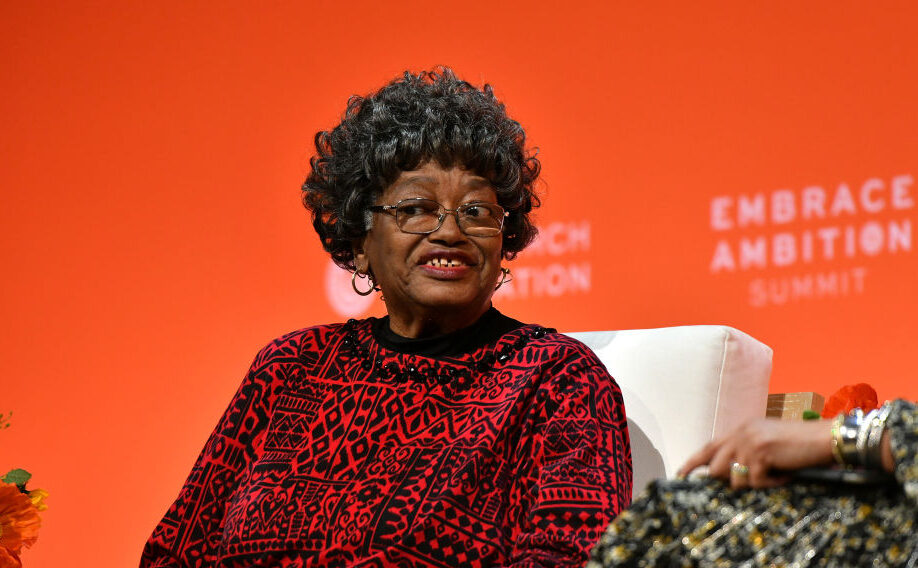
Claudette Colvin, who as a 15-year-old refused to give up her seat on a Montgomery, Alabama, bus in 1955, died on Tuesday, January 13, of natural causes. The 86-year-old had been in hospice care in an area near Houston, Texas, at the time of her passing. Her death was confirmed via Facebook from the Claudette Colvin Legacy Foundation.
“To us, she was more than a historical figure. She was the heart of our family, wise, resilient, and grounded in faith,” the Claudette Colvin Foundation said in a statement announcing her death. “We will remember her laughter, her sharp wit, and her unwavering belief in justice and human dignity.”
Table of Contents
Colvin’s Act of Resistance
On March 2, 1955, Colvin boarded a bus in Montgomery. Black passengers needed to ride in the back. However, there was a section called “No man’s land,” where bus drivers could demand that any Black passenger relinquish their seat, and the entire row, if a white rider wanted to sit there. On that day, four Black riders were asked to move; two changed sections immediately. Colvin and another passenger remained seated. When the driver called the police, the teen was the only one still refusing to move.
Colvin didn’t choose this action lightly. At the time, she was an honors student at Booker T. Washington High School. Colvin had just completed studying Black History and learning about injustices in the South. She was also active in her school’s NAACP Youth Council, and had been considering ways to protest.
“I felt as though Harriet Tubman was pushing me down on one shoulder and Sojourner Truth was pushing me down on the other,” she said. “So, therefore, history had me glued to the seat. That was the reason I could not move.”
When the police arrived, they removed her forcibly, dragging her backward off the bus as she screamed. She feared being attacked or worse by the officers. “I didn’t know if they were crazy, if they were going to take me to a Klan meeting,” she told The Guardian in 2000. “I started protecting my crotch. I was afraid they might rape me.”
The teen was charged with violating segregation laws, disturbing the peace, and assaulting an officer. She was found guilty of the assault charge, made a ward of the state, and received indefinite probation. Peers and some in the community shunned her.
Why She Didn’t Become the Face of the Montgomery Bus Boycott
Many aren’t familiar with Colvin’s actions because Rosa Parks was chosen to be the face of the Montgomery Bus Boycott. Although the NAACP and other civil rights leaders knew about her bold act of protest, they waited until Rosa Parks, nine months later, objected by giving up her seat in the same act of resistance before moving forward with any action.
Some speculate that colorism and class were involved; leaders believed getting the middle class on board with the boycott would be easier with Parks. There was also misinformation surrounding Colvin being pregnant, which occurred months after the incident.
Elevate Your Health for Just $29.99/Month
Join the Precision Wellness Subscription at My Healing 365 and get discounted services, priority coaching access, virtual care, and exclusive wellness resources to support your physical, emotional, and hormonal health.
Join for $29.99/Month“My mother told me to be quiet about what I did,” Ms. Colvin recalled. “She told me: ‘Let Rosa be the one. “White people aren’t going to bother Rosa, her skin is lighter than yours, and they like her,” she told the New York Times.
Colvin Was a Key Figure in a Landmark Case
While she wasn’t chosen as the face of the boycott, her attorney, Fred D. Gray, included Colvin as one of the four defendants—along with Aurelia Browder, Susie McDonald, and Mary Louise Smith—in a 1956 federal lawsuit, Browder v. Gayle. The lawsuit was against the City of Montgomery, the state of Alabama, centered on unfair treatment on the city buses. After winning the case, it was escalated to the Supreme Court, which affirmed the ruling. The case was instrumental in striking down bus segregation.
Her participation in the lawsuit and her act of defiance on the city bus led to her being labeled a troublemaker by both whites and Blacks. By the end of the decade, Colvin had relocated from Montgomery to the Bronx, New York. She worked as an aide in a Manhattan nursing home for 35 years.
In 2010, the street where she grew up was renamed Claudette Colvin Drive, and a mural depicting the teen and elder Colvin was added eight years later.
Why the Story is Not Widely Known
It would be decades before Colvin shared her story. She continued to follow her mother’s advice. She continued to heed her mother’s advice and worried that drawing attention to herself would cost her her job. “I wasn’t going to take that chance,” she said.
We will never forget Claudette Colvin for her strength, bravery, and act of defiance. Our condolences go out to her loved ones.

























