Faced with exploding global demand for protein and the growing environmental impact of animal farming, insects are emerging as an attractive alternative: they are rich in nutrients, resource-efficient and have already been tested by researchers, businesses and chefs.
But behind all the hype, one question remains: is eating insects really a sustainable and safe solution for feeding the planet?
Today, global meat production is putting increasing pressure on natural resources. It requires large areas of agricultural land, generates massive greenhouse gas emissions and contributes to deforestation. In fact, meat production accounts for nearly 12 per cent of global greenhouse gas emissions, according to the Food and Agriculture Organization.
It occupies around 80 per cent of agricultural land and consumes significant amounts of water and food to feed livestock.
Yet protein remains essential to human health, which means that more sustainable alternative sources must be found.
In this context, insects appear to be a promising avenue for diversifying protein sources. Raising insects requires up to 12 times less food and 2,000 times less water than beef. In addition, most of their body mass is edible: nearly 80 per cent for a cricket, compared to only 40 per cent for a cow. This efficiency makes them a promising option for reducing our ecological footprint without compromising our nutritional needs.
Read more:
2025 was the year protein ‘jumped the shark’
Table of Contents
An interesting nutritional profile
As far as nutrition goes, insects contain between 35 per cent and 70 per cent protein, depending on the species, as well as essential fatty acids, iron, zinc and B vitamins. Some even consider them to be a credible alternative to meat, particularly for combating malnutrition or optimizing nutritional intake.
However, not all species are equal. Mealworms, for example, offer a protein quality similar to legumes, but remain slightly inferior to soy or beef. Diet and breeding conditions also alter their protein content and especially their lipid content, particularly omega-3 and omega-6 fatty acids and micronutrients. In short, the nutritional composition of insects varies considerably from one species to another and from one farming method to another.
Caution is also required: some insects contain anti-nutritional substances, such as thiaminase, which can interfere with the absorption of vitamin B1. So their regular consumption requires rigorous control of the processing and the quality of the products.
Elevate Your Health for Just $29.99/Month
Join the Precision Wellness Subscription at My Healing 365 and get discounted services, priority coaching access, virtual care, and exclusive wellness resources to support your physical, emotional, and hormonal health.
Join for $29.99/MonthHealth risks that should not be ignored
Although insects have been consumed for thousands of years in several cultures — from Mexico to Congo, Thailand and Japan — their integration into larger-scale food systems is relatively recent. This raises questions about the safety and regulation of these products.
Microbiological risks are a major concern. Like any food of animal origin, insects can carry pathogenic bacteria such as Salmonella spp. or E. coli.
Nonetheless, in a report by the Canadian Food Inspection Agency that analyzed 51 samples of edible insects sold in the country, no contamination was detected. These results are encouraging, but researchers stress that caution is still needed, especially with regard to traceability and breeding conditions.
Another issue often overlooked is the risk of allergies. The proteins in certain insects, such as crickets and mealworms, are similar to those found in shellfish. This means that people who are allergic to shrimp or crab could have a similar reaction to insect-based products. For this reason, Health Canada recommends clear labelling to warn consumers.
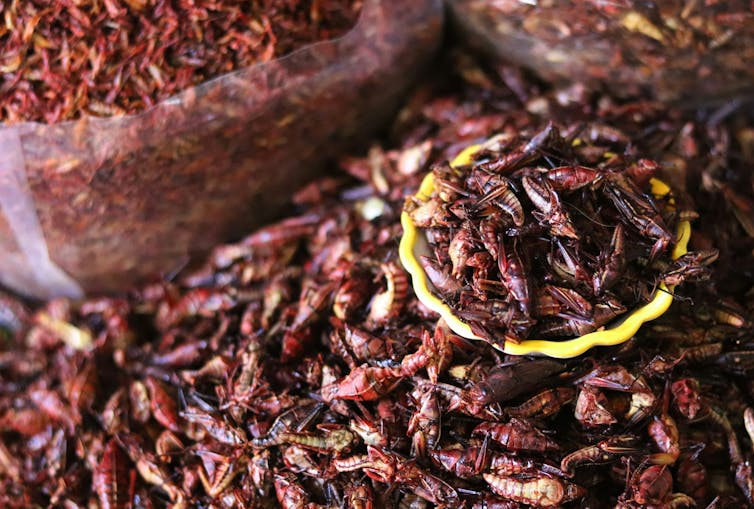
(Unsplash)
Read more:
Pourquoi apprendre à cuisiner dès l’enfance est un outil de santé publique
Production with ecological consequences
The issue of biodiversity also deserves special attention. While controlled industrial farming presents risks comparable to those of other animal production methods, large-scale collection or production could have repercussions on ecosystems.
In many parts of the world, the consumption of wild insects is already part of local food traditions. An increase in global demand could intensify this exploitation, endangering certain species and the ecological balances they depend on.
Far from being a universal solution, entomophagy is, therefore, more of a complementary option that requires rigorous supervision and sustainable resource management. Like any food innovation, its development must be carried out with careful consideration of its long-term impacts, both on biodiversity and on the communities that depend on it.
Changing our eating habits
Beyond the technical and environmental aspects, adopting insects as part of our diets poses a major cultural challenge. In many western countries, the mere thought of eating an insect provokes disgust. Several companies are attempting to normalize insect consumption by incorporating them into processed products such as protein bars, flours, burgers and pasta made from cricket powder.
Studies show that gradual exposure in familiar forms can help overcome this psychological barrier. As a result, eating insects could become commonplace within a few decades, especially if environmental concerns continue to grow.
Edible insects are not just a culinary curiosity or a simple source of alternative protein: they are at the heart of a broader debate on the sustainability of our food systems. Their potential challenges the way we produce, consume and value food. How can we feed a growing global population without exacerbating climate crises, depleting natural resources or increasing health risks?
What if, beyond simply being nutritional substitutes, insects lead us to rethink our food models, while revealing the limits of our quest for quick fixes to deeply structural problems? This reflection reminds us that the transition to sustainable diets requires more than just a new ingredient: it calls for a profound transformation of our habits, policies and collective priorities.

























