• Twenty47HealthNews
  • Health & Wellness
  • Disclaimer
    • Terms of Use
    • Privacy Policy
    • DMCA Notice
  • Twenty47HealthNews
  • Health & Wellness
  • Disclaimer
    • Terms of Use
    • Privacy Policy
    • DMCA Notice
24/7 Health News
No Result
View All Result
Home Article

How the U.S. withdrawal from WHO could affect global health powers and disease threats

January 20, 2026
in Article
How the U.S. withdrawal from WHO could affect global health powers and disease threats

Hours after Donald Trump began his second term as United States president on Jan. 20, 2024, he signed an executive order to end American membership in the World Health Organization (WHO) after one year. This restarted a process that the first Trump administration initiated in July 2020 but was reversed by Joe Biden.

The withdrawal is set to take effect this week, although WHO officials may not officially accept it because the U.S. has unpaid dues from the last two years. No matter how events play out, the rift signals the start of an uncertain new era in global public health.

In the withdrawal announcement, the Trump administration cited the WHO’s “mishandling” of the COVID-19 pandemic and its inability to remain independent from the political influence of member states. This reflected Trump’s belief that the WHO leadership favoured China in early 2020 by praising its initial COVID response while faulting the U.S. for closing its border to Chinese travellers.

Other observers acknowledged the need for reform of the WHO’s cumbersome bureaucratic structure and criticized its inability to translate scientific research about COVID into useful guidance about masking and social distancing.

Such criticisms should not obscure the WHO’s enormous contribution to global health or how U.S. interests have been intertwined with its successes. Viewed historically, its great strength lies in sustained collaboration rather than short-term emergency response.
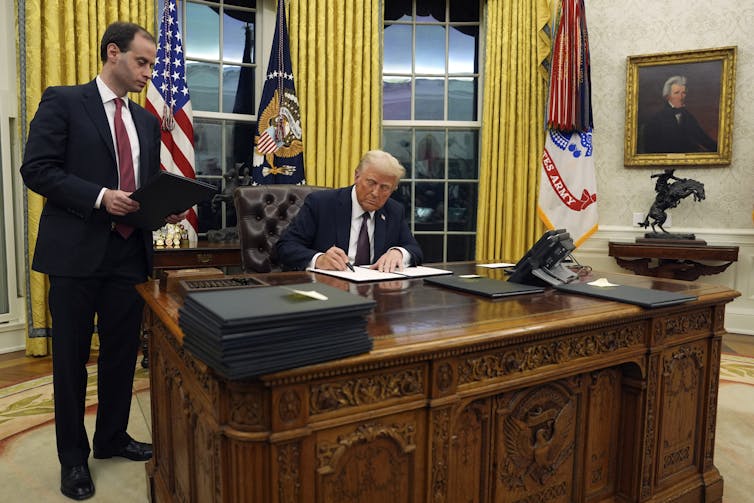
A man signing a document behind a large desk while another man watches
U.S. President Donald Trump signs an executive order withdrawing the U.S. from the World Health Organization in the Oval Office of the White House on Jan. 20, 2025, in Washington, D.C.
(AP Photo/Evan Vucci)

Table of Contents

  • Vaccine diplomacy
  • Dismantling global influence
  • Disease monitoring and global threats

Vaccine diplomacy

In my research for Epidemics and the Modern World and its forthcoming revision, I have explored how the U.S. conducted “vaccine diplomacy” in developing countries. After the Second World War, the U.S. discerned an alignment between its strategic objectives and the soft power it gained from campaigns against epidemic diseases and childhood immunization programs.

For example, in 1967, American funding and leadership encouraged the start of the WHO’s Intensified Smallpox Eradication Program (ISEP) in African countries. This work involved collaboration with global rivals such as the Soviet Union, which contributed large quantities of freeze-dried smallpox vaccine.

When the ISEP began, at least 1.5 million people worldwide died from smallpox annually. Only 13 years later, the WHO declared the disease eradicated from nature in 1980. This success encouraged efforts to eradicate polio, which accelerated after 1988 when the WHO launched the Global Polio Eradication Initiative with support from the United States Centers for Disease Control and Prevention and other partners.

Another important collaboration began in 1974 when the WHO and international partners launched the Expanded Program on Immunization to help prevent six childhood diseases (polio, diphtheria, pertussis, tuberculosis, measles and tetanus).

After 1985, the United States Agency for International Development (USAID) invested billions of dollars in the program. Global childhood immunization levels reached 80 per cent by the early 1990s and continued to pay health dividends thereafter.

An analysis published last year in the Lancet estimated that, in the last 20 years, USAID-funded programs had helped prevent over 90 million deaths globally, including 30 million deaths among children.

Dismantling global influence
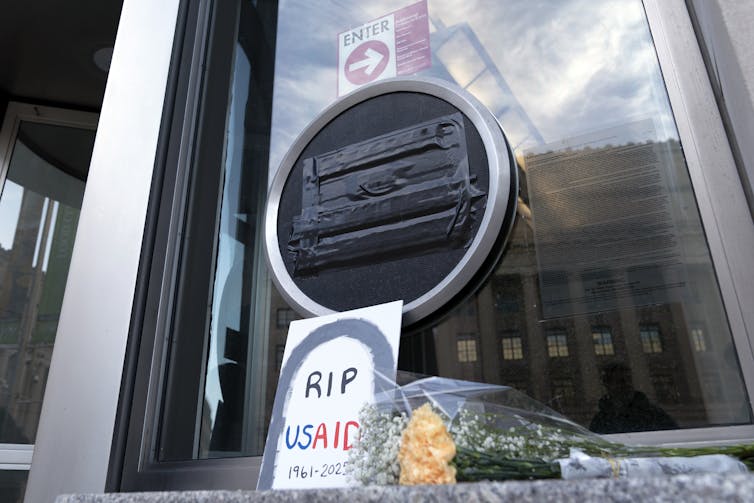
A round plaque blacked out with tape, with a hand-lettered sign reading RIP USAID and a bunch of flowers
Flowers and a sign are placed under the taped-over plaque of the U.S. Agency for International Development, or USAID, at its headquarters in Washington, D.C., on Feb. 7, 2025.
(AP Photo/Jose Luis Magana)

In public health, as in other arenas, the Trump administration has discarded participation in global alliances and instead sought bilateral agreements with other countries.

By July 2025, the Trump administration had formally dismantled USAID and cancelled funding for more than 80 per cent of its programs. Modelling conducted by Boston University epidemiologist Brooke Nichols suggests the lapsed programs have already caused roughly 750,000 deaths, mostly among children.


Read more:
International aid groups are dealing with the pain of slashed USAID funding by cutting staff, localizing and coordinating better


The U.S. has also already begun to cede influence over the objectives of global health programs. At the World Health Assembly in May 2025, the U.S. did not sign the WHO Pandemic Agreement intended to foster collaboration among governments, international agencies and philanthropies after the COVID-19 pandemic.

At that same meeting, China pledged to increase its voluntary contributions to the WHO to US$500 million over the next five years. Practically overnight, China will replace the U.S. as the WHO’s largest national contributor and undoubtedly steer priorities in global health programs towards its interests.

Disease monitoring and global threats

A more immediate concern is the disruption to surveillance for ongoing disease challenges and emergent threats.
A round logo with a globe, a caduceus and a wreath on a window
The logo of the World Health Organization is seen at the WHO headquarters in Geneva, Switzerland.
THE CANADIAN PRESS/AP, Anja Niedringhaus

Since 1952, the WHO’s Global Influenza Surveillance and Response System has provided a platform for monitoring of cases and the sharing of data and viral samples. Information from institutions in 131 countries contributes to recommendations for the composition of seasonal influenza virus vaccines. The U.S. may be left out of this global system, which will hamper efforts to match vaccines to the circulating strains of flu.

The WHO also dispatches response teams around the world for outbreaks of numerous diseases such as mpox, dengue, Ebola virus disease or Middle East respiratory syndrome. The exclusion of American scientists will hamper these efforts and diminish the nation’s capacity to protect itself.

The policy shift in the U.S. poses challenges for Canada both as its northern neighbour and as a strong financial supporter of the WHO. The recent spread of measles within Canada, which resulted in loss of the country’s elimination status, reminds us that disease outbreaks are inevitable but progress in public health is not.

Renewed support of the WHO and other multilateral efforts, although desirable, should be matched by expanded investment in programs for disease surveillance and research, vaccine procurement and public health communication. Federal and provincial governments and the Public Health Agency of Canada will all have roles to play as Canada faces disease threats in a rapidly changing world.


ShareTweetSharePin
Next Post
A moment that changed me: my client was accused of a crime he didn’t commit – and it led me to confront my past

A moment that changed me: my client was accused of a crime he didn’t commit – and it led me to confront my past

Most Read

What causes stuttering? A speech pathology researcher explains the science and the misconceptions around this speech disorder

What causes stuttering? A speech pathology researcher explains the science and the misconceptions around this speech disorder

December 15, 2022
morning back pain

Morning Again Ache Trigger Is Not the Mattress

October 11, 2021

Why Circadian Rhythms Matter for Your Health

July 30, 2024

4 steps to building a healthier relationship with your phone

January 28, 2025
lower back pain relief exercises

5 decrease again ache aid workouts

October 11, 2021
Nasal vaccines promise to stop the COVID-19 virus before it gets to the lungs – an immunologist explains how they work

Nasal vaccines promise to stop the COVID-19 virus before it gets to the lungs – an immunologist explains how they work

December 14, 2022
3 years after legalization, we have shockingly little information about how it changed cannabis use and health harms

3 years after legalization, we have shockingly little information about how it changed cannabis use and health harms

October 15, 2021
bleeding in gum

When The Bleeding in gum Is Severe ?

October 11, 2021
Good Night Sleep

6 Causes of Good Evening Sleep

October 11, 2021
Kick up your heels – ballroom dancing offers benefits to the aging brain and could help stave off dementia

Kick up your heels – ballroom dancing offers benefits to the aging brain and could help stave off dementia

January 3, 2023
Biden is getting prostate cancer treatment, but that’s not the best choice for all men − a cancer researcher describes how she helped her father decide

Biden is getting prostate cancer treatment, but that’s not the best choice for all men − a cancer researcher describes how she helped her father decide

May 20, 2025
Ten small changes you can make today to prevent weight gain

Ten small changes you can make today to prevent weight gain

October 12, 2021

COVID vaccines: how one can pace up rollout in poorer international locations

October 5, 2021

Multiple sclerosis: the link with earlier infection just got stronger – new study

October 12, 2021
Five ways to avoid pain and injury when starting a new exercise regime

Five ways to avoid pain and injury when starting a new exercise regime

December 30, 2022
Support and collaboration with health-care providers can help people make health decisions

Support and collaboration with health-care providers can help people make health decisions

December 16, 2021
Greece to make COVID vaccines mandatory for over-60s, but do vaccine mandates work?

Greece to make COVID vaccines mandatory for over-60s, but do vaccine mandates work?

December 1, 2021

This Simple Hygiene Habit Could Cut Your Risk of Stroke, New Research Reveals

February 1, 2025
woman covered with white blanket

Exploring the Impact of Sleep Patterns on Mental Health

August 4, 2024

Maximize Your Performance – Sync with Your Circadian Rhythms

August 9, 2024
Backlash to transgender health care isn’t new − but the faulty science used to justify it has changed to meet the times

Backlash to transgender health care isn’t new − but the faulty science used to justify it has changed to meet the times

January 30, 2024
How to protect your well-being, survive the stress of the holiday season and still keep your cheer

How to protect your well-being, survive the stress of the holiday season and still keep your cheer

December 21, 2025
News of war can impact your mental health — here’s how to cope

Binge-eating disorder is more common than many realise, yet it’s rarely discussed – here’s what you need to know

December 2, 2022
Nurses’ attitudes toward COVID-19 vaccination for their children are highly influenced by partisanship, a new study finds

Nurses’ attitudes toward COVID-19 vaccination for their children are highly influenced by partisanship, a new study finds

December 2, 2022
Nutrition advice is rife with misinformation − a medical education specialist explains how to tell valid health information from pseudoscience

Nutrition advice is rife with misinformation − a medical education specialist explains how to tell valid health information from pseudoscience

January 28, 2025
Four ways to avoid gaining weight over the festive period – but also why you shouldn’t fret about it too much

Four ways to avoid gaining weight over the festive period – but also why you shouldn’t fret about it too much

December 22, 2022
Why are some people faster than others? 2 exercise scientists explain the secrets of running speed

Why are some people faster than others? 2 exercise scientists explain the secrets of running speed

April 29, 2024
As viral infections skyrocket, masks are still a tried-and-true way to help keep yourself and others safe

As viral infections skyrocket, masks are still a tried-and-true way to help keep yourself and others safe

December 14, 2022
How regulatory agencies, not the courts, are imposing COVID-19 vaccine mandates

How regulatory agencies, not the courts, are imposing COVID-19 vaccine mandates

October 24, 2021
Heart disease risk from saturated fats may depend on what foods they come from – new research

Heart disease risk from saturated fats may depend on what foods they come from – new research

November 29, 2021
  • Twenty47HealthNews
  • Health & Wellness
  • Disclaimer

© 2020 DAILY HEALTH NEWS

  • Twenty47HealthNews
  • Health & Wellness
  • Disclaimer
    • Terms of Use
    • Privacy Policy
    • DMCA Notice

© 2020 DAILY HEALTH NEWS















