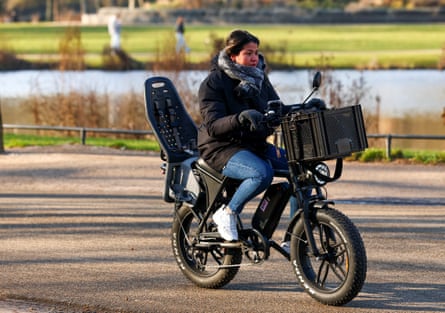
On a busy lunchtime, thick-tyred electric bikes zoom through the leafy lanes of the Vondelpark in Amsterdam. But after a marked rise in accidents – particularly involving children – these vehicles the Dutch call “fatbikes” are to be banned in some parts of the Netherlands.
“It’s nonsense!” said Henk Hendrik Wolthers, 69, from the saddle of his wide-tyred, electric Mate bike. “I drive a car, I ride a motorbike, I’ve had a moped and now I ride a fatbike. This is the quickest means of transport in the city and you should be able to use it.”
An increasing number of road safety experts, doctors and politicians in the Netherlands disagree. Although motor assistance on e-bikes is limited to just over 15mph, many fatbike riders modify the factory settings to reach speeds of 25mph in this busy park.
Elevate Your Health for Just $29.99/Month
Join the Precision Wellness Subscription at My Healing 365 and get discounted services, priority coaching access, virtual care, and exclusive wellness resources to support your physical, emotional, and hormonal health.
Join for $29.99/MonthThe safety organisation VeiligheidNL estimates that 5,000 fatbike riders are treated in A&E departments each year, on the basis of a recent sample of hospitals. “And we also see that especially these young people aged from 12 to 15 have the most accidents,” said the spokesperson Tom de Beus.
Now Amsterdam’s head of transport, Melanie van der Horst, has said “unorthodox measures” are needed and has announced that she will ban these heavy electric bikes from city parks, starting in the Vondelpark. Like the city of Enschede, which is also drawing up a city centre ban, she is acting on a stream of requests “begging me to ban the fatbikes”.
In the park, her plans stirred mixed reactions. While four in five fatbike riders who whizzed past said they were “too busy” to talk, 31-year-old Joost was sceptical. “It will be senseless,” he said. “Normal bicycles use the park, city vehicles use it. It’s all about having the appropriate speed.”
But Muriel Winkel, 33, running with her dog, Joop, was enthusiastic. “They are all souped-up, which people don’t do with evil intentions, but they often ride carelessly, without watching out,” she said. “Sometimes, my dog really gets a fright.”
Some point out that the tensions around electric bikes will soon reach other countries, especially with more political interest in stimulating active mobility.
In this land of early adopters, 48% of bicycles sold in 2024 were electric and another 13% were fatbikes, according to figures from RAI Vereniging and BOVAG motoring associations. In Amsterdam, a third of journeys are made by cycling.
The roadside assistance organisation ANWB said that the problem was not necessarily with the wide-tyred bike model – but the ease with which people could speed it up to use like a moped, “combined with risky behaviour”.
Florrie de Pater, the chair of the Fietsersbond Amsterdam cycling association, said that the rise of illegal bikes, plus a lack of enforcement, was scaring old people and children off the roads. “Because of the dangers of those who are cycling fast, especially older people over 55 or 60 simply leave their bikes at home,” she said. “We also hear that parents no longer dare to let their children cycle to school.”
The brain injury specialist Marcel Aries, a consultant at Maastricht University Medical Center, said more authorities needed to consider controversial bans, alongside the helmet requirement for children on electric bikes from 2027. “It is reasonable for governments and municipalities to consider measures that may be unpopular,” he said. “They are public health responses to increasingly congested streets and widening speed gaps between cars, cyclists and pedestrians.”
His view is shared by Marlies Schijven, a professor of surgery at the Amsterdam University Medical Center, whose frustrated LinkedIn post on dangerous riders in 2024 has been viewed 2.9m times. “It is a good step, but a baby step, only in one Amsterdam park,” she said. “The problem is much larger. We still see pain, misery and death every day at our morning meeting in the hospital.”
Wolthers, the fatbike owner, agreed that the problem was in letting children ride these powerful vehicles. “Children go through red, they don’t signal and they also can’t assess the traffic,” he said. “Hospitals have a chilling term for them: potential donors.”

























