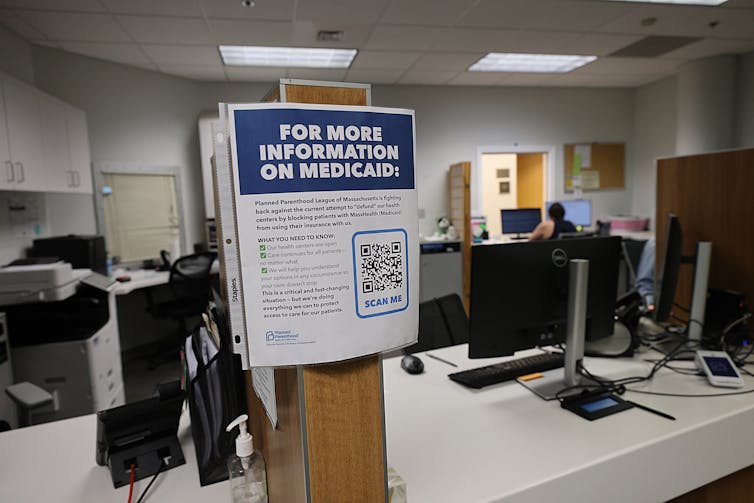
Anti-abortion conservatives have long sought to force Planned Parenthood’s clinics to close their doors and to make it harder, if not impossible, to get abortion pills as part of a two-pronged approach to limit access to abortion.
First, undermine Planned Parenthood and other abortion providers by questioning their credibility and block their funding. Second, try to ban mifepristone – a drug used in more than half of all abortions – in part by saying it’s unsafe.
As law professors who teach courses about health, poverty and reproductive rights law, we’re closely watching what’s happening with both strategies. We are particularly interested in how they will affect women’s health care, now that each state can write its own abortion laws.
Table of Contents
Attacking Planned Parenthood
Opponents of abortion rights are attacking Planned Parenthood because its clinics perform hundreds of thousands of abortions, in addition to more than 9 million other procedures, every year.
For example, it screens patients for cancer, provides contraceptive care, tests people for sexually transmitted infections, conducts pregnancy tests and offers prenatal services. Abortions account for only 4% of all of Planned Parenthood’s services.
Conservative-led states are taking aim at the nonprofit with both litigation and legislation.
For example, the attorneys general of Missouri and Florida allege in 2025 lawsuits that Planned Parenthood’s website “lies” about the safety of mifepristone.
Planned Parenthood is not the only nonprofit that is accused of deceiving the public that way. In December 2025, the South Dakota attorney general sued Mayday Health, a reproductive health education nonprofit, alleging that its advertising in South Dakota violated a state law that bans “deceptive practices.”
In late January, after Mayday countersued in a federal court in New York, that court temporarily blocked South Dakota’s actions.
Other states are taking similar steps. Kentucky, which, like South Dakota, has a nearly complete ban on abortion, is investigating the legality of ads that Mayday Health posts at gas stations. The ads tell women how they can get help obtaining an abortion.
Undermining funding
Meanwhile, state and federal efforts to reduce Planned Parenthood’s funding are making headway.
In June 2025, the U.S. Supreme Court ruled in Medina v. Planned Parenthood South Atlantic in favor of South Carolina’s attempt to bar its Medicaid program from reimbursing Planned Parenthood for health care services. That decision made it clear that any state may deny Medicaid funding for care provided by organizations, such as Planned Parenthood, that perform abortions.
Medicaid, the U.S. government’s health insurance program that primarily covers low-income people, is jointly funded by federal and state governments. About 1 in 10 women of reproductive age who received family planning services and are enrolled in Medicaid relied on Planned Parenthood’s services in 2021.
EG: Is it more accurate to say “… who in 2021 received family planning services and WERE enrolled in Medicaid relied on Planned Parenthood’s services”?
Under what’s known as the Hyde Amendment, federal Medicaid dollars may not be used to pay for abortions except in cases of life endangerment, rape or incest. States are free to use their own Medicaid dollars to pay for abortions, and some do so.
Shortly after the Supreme Court ruling, Congress passed a measure prohibiting federal Medicaid dollars from going to any clinics that perform abortions – such as Planned Parenthood.

Suzanne Kreiter/The Boston Globe via Getty Images
The provision, which bars reimbursement for all services, including those unrelated to abortion, was in the big tax-and-spending package that President Donald Trump signed into law on July 4, 2025. The defunding measure went into effect immediately, for one year, and applies to the whole country.
The provision is supposed to end in July 2026.
Due in part to the financial pressure that measure caused, Planned Parenthood says that dozens of its clinics around the country closed in 2025.
Planned Parenthood, as well as 22 states and Washington, D.C., challenged this provision in two lawsuits in a Massachusetts federal court.
The court granted Planned Parenthood’s request to dismiss its case in January 2026. The other case, brought by the states and Washington, D.C.’s local government, is still pending.
Trying to discredit mifepristone’s safety
Efforts to designate mifepristone as a dangerous drug began before the Food and Drug Administration approved its use in 2000. Abortion opponents have stepped up that campaign since the Supreme Court overturned Roe v. Wade with its Dobbs v. Jackson Women’s Health Organization ruling in 2022.
That same year, a group of doctors and medical associations opposed to abortion challenged the FDA’s approval of mifepristone and the guidelines governing its prescription.
In essence, they claimed that there was insufficient evidence demonstrating the drug’s safety, although it has been used by millions of people for more than 20 years. Several prominent medical associations, citing hundreds of peer-reviewed clinical studies and decades of evidence-based research, assert that the drug is “conclusively safe.”
Many studies have found that mifepristone is as safe as ibuprofen and safer than Viagra.
Ultimately, the Supreme Court rejected the lawsuit because the doctors did not have standing. That is, the physicians couldn’t show that they faced any clear and concrete harms from the FDA’s actions making mifepristone more widely available.

Anna Moneymaker/Getty Images
Arguing that the FDA made a mistake
But in 2024, the Missouri, Kansas and Idaho state governments were allowed to join the lawsuit, after they argued that they had standing.
The three states similarly claimed that the FDA acted improperly in 2016 as well as later, when it loosened the regulations around mifepristone, including allowing it to be prescribed via telehealth or mailed to patients.
While their case works its way through the courts, other states are questioning the FDA’s treatment of the drug.
Elevate Your Health for Just $29.99/Month
Join the Precision Wellness Subscription at My Healing 365 and get discounted services, priority coaching access, virtual care, and exclusive wellness resources to support your physical, emotional, and hormonal health.
Join for $29.99/MonthIn late 2024, Louisiana classified abortion pills as controlled substances, restricting their use more tightly than the FDA. In October 2025, the state went further, challenging the FDA’s loosened regulations, including its elimination of requirements that the pill be dispensed in person.
And in early December, Florida and Texas sued the FDA. Those states argue that its approval and regulation of mifepristone violated several federal laws, including one that gives the FDA authority to regulate drugs.
Revisiting safety findings
There are also regulatory threats to mifepristone’s availability because the Trump administration is reconsidering evidence regarding the drug’s safety.
In September 2025, Health and Human Services Secretary Robert F. Kennedy Jr. said the FDA would conduct “its own review of the evidence,” including the drug’s “real-world outcomes and evidence, relating to the safety and efficacy.”
Kennedy referenced a report cited by 22 Republican state attorneys general that, according to Kennedy, indicates “potential dangers that may attend offering mifepristone without sufficient medical support or supervision.”
The report has not been peer-reviewed or published in a medical journal. Many experts describe it as “junk science.”
If the FDA were to find mifepristone unsafe or to further restrict how it’s prescribed, this could make it harder to get an abortion. While misoprostol, which is commonly prescribed for ulcer prevention, can be used alone for abortions, it is less effective and less safe than when it’s used in combination with mifepristone.
What happens next might take a while. Some efforts to end access to mifepristone appear to be on hold – for political rather than legal reasons.
FDA Commissioner Marty Makary told the officials working in his agency in December 2025 to delay their review of data concerning the safety of mifepristone “until after the midterm elections” in November 2026.

























