Eating is a social event. Whether it’s a night out with friends or an evening at home enjoying family dinner, conversation goes well with food. But what if, in the middle of laughter and big bites, someone suddenly began to choke? Would you know what to do?
Choking is a life-threatening emergency that requires immediate recognition and action to prevent rapid loss of consciousness, respiratory arrest and death. The actions of bystanders are often a major factor in the outcome of a choking incident. If the airway obstruction is not cleared before paramedics arrive, the risk of death is 42 per cent higher than if bystanders successfully remove it.
While choking can happen to anyone at any time, certain people are at higher risk, including people with neurological conditions that affect swallowing or chewing (such as dementia, stroke or Parkinson’s disease), people intoxicated by alcohol, drugs or medications or young children with small objects.
Despite choking being an emergency, until recently there has been limited high-quality evidence to guide bystanders on the most effective way to help. Techniques like abdominal thrusts (formerly known as the Heimlich maneuver), back blows and chest compressions or thrusts have existed since the mid-1900s but, until recently, recommendations were largely based on case reports rather than rigorous scientific data. This evidence gap is dangerous.
Elevate Your Health for Just $29.99/Month
Join the Precision Wellness Subscription at My Healing 365 and get discounted services, priority coaching access, virtual care, and exclusive wellness resources to support your physical, emotional, and hormonal health.
Join for $29.99/MonthBystander response is the primary driver of a choking person’s outcome, so ensuring people know the safest and most effective way to care for a choking person can save lives.
Table of Contents
Back blows outperform abdominal thrusts and chest thrusts
Our research team — a collaboration of Canadian researchers, physicians and paramedics — investigated a large cohort of choking patients in the province of Alberta and looked at the effectiveness and safety of different choking techniques.
We found that back blows cleared the obstruction in 72 per cent of cases, superior to both abdominal thrusts (59 per cent) and chest thrusts (27 per cent). Survival to hospital discharge was also highest among those who initially received back blows (97.8 per cent) even after accounting for other important factors such as the patient’s age, sex and the type of obstruction.
Further, back blows caused no injuries, unlike abdominal thrusts and chest thrusts, which resulted in injury to the lungs, heart, liver, and ribs.
New American Heart Association guidelines
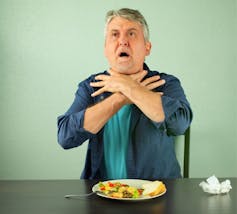
(Mokee81/Getty Images via Canva)
For the first time since 2010, the American Heart Association (AHA) updated its guidelines on how people should care for someone who is choking. Due to the AHA closely collaborating with the Heart and Stroke Foundation of Canada, these changes will impact first aid training across North America.
In the updated guidelines, our Canadian study was cited to inform this critical change, and was the only study directly comparing different choking techniques.
Previously, abdominal thrusts were recommended largely because they were reported more often in case descriptions, despite a known risk of serious injury. The updated guidelines now reflect the best available evidence.
So, how should you respond when you see a choking person?
If an adult or child can still cough, cry or speak clearly, then they are still able to clear the obstruction themselves. Get them to lean forward while encouraging them to cough forcefully.
If the person goes quiet, cannot speak or cry, or can only weakly cough, you want to start with five strong back blows first. With the person bent forward at their hips, deliver firm glancing blows between their shoulder blades using the heel of your hand up to five times.
If the obstruction does not clear, switch to abdominal thrusts. Continue alternating five back blows and five abdominal thrusts until the obstruction is cleared or the person becomes unconscious. Our study, along with others, showed that between 11 per cent and 49 per cent of choking persons will need more than one technique to successfully clear the obstruction.
Special circumstances to consider
Call 9-1-1 early. Get a bystander to call while you do back blows or place your phone on speaker if you are by yourself.
For children, kneel to their height to deliver back blows and abdominal thrusts effectively.
For infants who cannot stand, you can hold them in your arms. If the infant is still crying or coughing loudly, hold them with their head down supported by your arms. Then, if the obstruction doesn’t clear and they become quiet, you should begin with back blows followed by chest compressions, alternating until the obstruction clears.
If the person becomes unresponsive, assist them to the ground and start CPR with chest compressions. Each time you attempt to give rescue breaths, look for the object by opening the mouth and remove the object only if clearly visible.
Suction-based device
Recently, suction-based devices, such as LifeVac©, have been marketed as an alternative when other choking treatments fail, gaining attention on social media platforms like Facebook and TikTok. These devices create negative pressure in the upper airway to suction out an obstruction, in contrast to traditional techniques like back blows and abdominal thrusts that generate pressure from below.
Our research team has documented a considerable number of successful cases using these devices, with few injuries associated. Two trials in mannequins also found LifeVac© to be more effective at relieving simulation airway obstructions compared to abdominal thrusts.
While this early data is promising, major resuscitation organizations, like the AHA, have yet to make a conclusive recommendation on these devices yet – concerned that a bystander obtaining and using these devices may delay other lifesaving techniques. Still, this is an exciting field of research and larger, comparative studies will hopefully be conducted soon.
Time to get trained
People who know how to respond to choking emergencies can save a life in highly time-sensitive situations. Over the past two decades, simplified public CPR training has played a significant role in dramatically reducing deaths from cardiac arrest. Choking response has not benefited from similar public education campaigns.
Given immediate bystander response is the best chance the choking person has for survival, prioritization of mass public training in simple, evidence-based techniques such as back blows, may significantly improve choking survival.

























