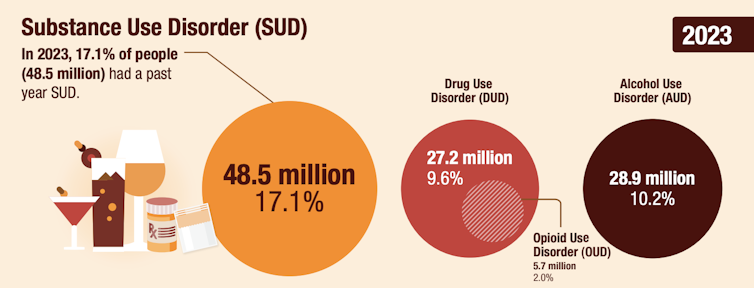
Addiction is one of the most common and consequential chronic medical conditions in the United States. Nationwide, more than 46 million people met the criteria for a substance abuse disorder as of 2021, the most recent data available.
Decades of evidence show that addiction is a chronic, relapsing disease of the brain. Nonetheless, there’s still widespread public misunderstanding of what constitutes “treatment” for addiction, not to mention heavy stigma associated with it.
Many patients, families and even health care systems view entering a detoxification or medically managed withdrawal unit as the primary step in recovery. Sometimes, this first step is considered all that is needed. As a physician and fellow in addiction medicine, I know firsthand that this common perception is wrong, and that it perpetuates misinformation about evidence-based treatment.
Centers that provide medically managed withdrawal are designed to stabilize patients in crisis, safely manage acute withdrawal and interrupt dangerous use patterns. However, the idea that “getting through detox” equates to recovery has taken hold over the past several years. This belief appears to be rooted in outdated models of addiction, public misunderstanding and media portrayals that frame addiction as solely a problem of physical dependence.
Table of Contents
Detox is a starting point, not a treatment plan
It is not uncommon for patients to show up for medically managed withdrawal, more commonly known as “detox,” without a post-discharge plan. “I haven’t thought that far,” “I just want to get through this,” or “I am getting treatment now, aren’t I?” are some of the responses I frequently hear.
However, this first step is only the start of recovery. Detoxification from alcohol or benzodiazapines – drugs commonly known as “benzos,” such as Xanax, Ativan or Valium – can be dangerous or even deadly if it’s not managed in a medical setting. While detox is often necessary to safely get someone through withdrawal, it only addresses short-term physical symptoms, not the underlying addiction – nor does it address the factors that drive people to use alcohol and drugs problematically.
Addiction has causes that are neurobiological, psychological and structural. Treating these drivers is as important as managing the initial withdrawal. Medically managed withdrawal does not restore neurochemical imbalances, provide long-term relapse prevention strategies or help patients manage ongoing life stressors or triggers as they arise.
In a 2023 study of adults with opioid use disorder, relapse rates six months after treatment were highest among individuals who received only short-term inpatient treatment, with 77% of these patients returning to use. Relapse rates were significantly lower among those who remained in inpatient care for a longer duration or who transitioned to outpatient treatment following short-term inpatient treatment.
When people were also treated with a long-acting form of an opioid-blocking medication called naltrexone, relapse rates dropped across all settings — to 59% after short-term inpatient care, 46% after long-term inpatient care and 38% for those treated as outpatients. These results highlight that brief detoxification without ongoing care is often not enough to support lasting recovery.
However, many centers that provide medically managed withdrawal face clinical, regulatory and financial constraints. As a result, they often have limited resources and can only admit patients for as few as three to five days. In these circumstances, the centers work mainly to stabilize acute withdrawal symptoms rather than to home in on underlying factors that may drive substance use and possible return to use.

US Substance Abuse and Mental Health Services Administration
Why addiction doesn’t end after withdrawal
Addiction is a chronic, occasionally relapsing condition. It disrupts three interconnected systems in the brain:
– the reward pathway, in which dopamine, a neurotransmitter, works on pleasure centers of the brain;
– stress centers in the amygdala, the part of the brain that processes emotions such as fear, aggression and anxiety; and
– motivation and control systems in the prefrontal cortex, which manage higher-level executive functions like planning and problem-solving.
When individuals repeatedly use substances like alcohol or drugs, they may discover that things they once found rewarding or joyful no longer can compete on the same scale. This often leads to increased stress and impaired self-control. Their body reduces the number of dopamine receptors – sites in the brain that bind dopamine – as a result, causing previously motivating and joyous activities to seem bleak.
Elevate Your Health for Just $29.99/Month
Join the Precision Wellness Subscription at My Healing 365 and get discounted services, priority coaching access, virtual care, and exclusive wellness resources to support your physical, emotional, and hormonal health.
Join for $29.99/MonthThis was what had happened to a patient who told me: “After meth, everything was messed up and nothing brought me joy.” At first, using methamphetamine creates a “high,” or euphoria; over time, though, individuals use it simply to avoid being sick. The substance that once was euphoric becomes a proverbial ball and chain.
These neurobiological changes do not happen overnight, and neither does recovery. It is unrealistic to expect that a typical admission for medically managed withdrawal, which may only span three to five days, will heal patients’ damaged circuits.
Furthermore, some symptoms, such as anxiety, mood changes, trouble sleeping and overall discontentment with life, can persist for three to six months or more following the initial withdrawal period. Cravings, which are intense psychological urges, often arise without warning. When this happens, having recovery support systems in place, such as a sponsor, mental health professional or relapse prevention plan, can be crucial.
Addiction often is rooted in exacerbating factors like anxiety, depression, trauma, chronic stress and pain. For example, chronic pain from a past injury can often lead to misuse of prescription opioids, which later may evolve into using other substances like heroin or fentanyl.
Patients with substance use disorders have often relied on substances as their escape lever from these deeper problems, rather than developing healthier coping mechanisms. All they have known in times of suffering is their drug of choice.
It often requires months or years to develop new ways of thinking, emotional regulation, habits and trauma responses after leaving a history of substance use behind. Learning to live substance-free and unaltered can be a new and terrifying concept.
Treatment after detox
If medically managed withdrawal is just the first step, what should come next? Patients may confer with their doctors and choose to start medication-assisted therapy, which helps prevent cravings and withdrawal as they address deeper issues through mental health treatments such as cognitive behavioral therapy. Opioid use disorder is treated with medications like buprenorphine or methadone, while alcohol use disorder medications include naltrexone, acamprosate or disulfiram.
These medications are at least as effective as many standard treatments in medicine, and I believe they should be considered when appropriate. Medications for alcohol use disorder have proved to be effective at reducing risk of death and hospitalizations, but these medications are often underutilized.
Treating substance use disorders is like managing diabetes, high blood pressure or other chronic health conditions. Even after patients are out of imminent crisis, the work is ongoing.

























