I’m still processing the devastating mass school shooting in Tumbler Ridge, B.C. Like many people across the country, I’m thinking about the families and communities directly impacted while trying to anticipate next steps.
As an academic who researches surveillance technology in Canadian schools,
I am also watching the media landscape for developments in coverage and shifts in discourse.
This is because my preliminary research suggests – based on analysis of news media reports between 2010 and 2025 – a single, tragic story can impact expanded visible security measures and significant investments.
When violence and tragedy erupt, governments and school leaders face intense pressure to act quickly, and urgency can produce policy responses that signal control without a plan to evaluate their impact.
Table of Contents
Focus on securing schools
Market research from the United States estimates that billions of dollars a year are invested in “securing” schools, often in response to school shootings.
These measures can feel reassuring in the short term, but decades of U.S. experience following the 1999 Columbine shooting suggest that expanding visible security measures shows limited or mixed evidence of reducing serious violent incidents, and does not provide causal support for the claim that these measures prevent rare violent incidents.
CBC reports that the tragedy in Tumbler Ridge “and other intruder incidents at schools” are “reviving conversations across Canada about school safety.” Since the Tumbler Ridge school shooting, there have been calls to examine emergency procedures not just in Tumbler Ridge and B.C., but also in Manitoba and Alberta.
Premier Danielle Smith suggested the Alberta Ministry of Education may expand school resource officers after upcoming safety audits.
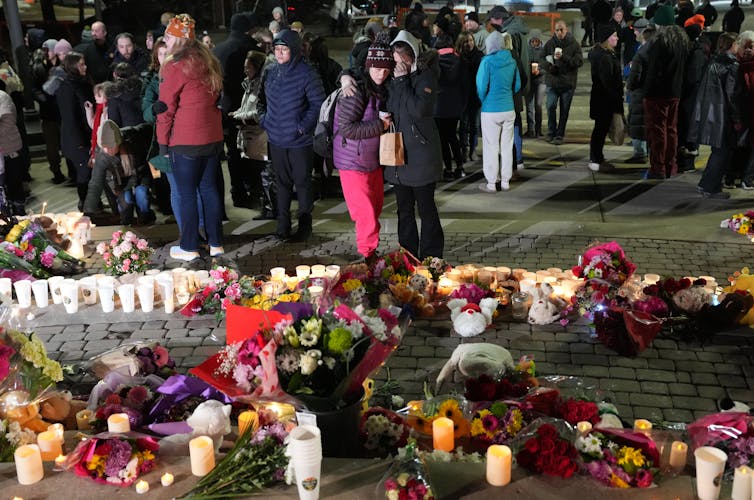
THE CANADIAN PRESS/Christinne Muschi
Expanded police presence to address violence
This recent event follows a growing movement in Canadian jurisdictions to expand police presence to address violence in schools.
The British Columbia Ministry of Education fired the Victoria School Board for banning police in schools. In Ontario, Bill 33 is set to expand policing in schools and erode democratic oversight of school boards.
Read more:
Ontario’s Bill 33 expands policing in schools and will erode democratic oversight
Scholarly evidence on school policing depends on how studies are designed and findings interpreted. A 2018 evaluation of Ontario’s Peel Region estimated school policing had positive social value based on surveys and stakeholder reports. However, it did not compare schools with and without officers or test whether police presence reduces serious violent incidents.
In contrast, a 2020 U.S.-wide study comparing similar schools before and after increases in police funding did find reductions in non-weapon physical fights. However, it found no reduction in gun-related incidents. It also documented increases in suspensions, expulsions and police referrals for Black students and students with disabilities.
Human rights commissions from both Ontario and British Columbia have cautioned that police programs in schools must meet a high legal threshold and have raised concerns about disproportionate impacts on Black, Indigenous, racialized, disabled and 2SLGBTQ+ students. They highlight that any policy that risks discrimination must be necessary, proportionate and supported by evidence.
This raises an important question: if police integration in schools increases the likelihood that already marginalized students will be criminalized through suspensions, expulsions and arrests — all of which fortify the school-to-prison pipeline — what kind of safety are we building and for whom?
Read more:
Preventing and addressing violence in schools: 4 priorities as educators plan for next year
Threat assessment and AI
Another common way schools are expanding security measures is through threat assessment models that embed digital monitoring tools and law enforcement deeper into schooling. This raises important questions about proportionality and democratic oversight, especially when students and their families may not understand how their information is being collected, used or retained.
Elevate Your Health for Just $29.99/Month
Join the Precision Wellness Subscription at My Healing 365 and get discounted services, priority coaching access, virtual care, and exclusive wellness resources to support your physical, emotional, and hormonal health.
Join for $29.99/MonthThese models are presented as preventative rather than disciplinary, focused on identifying suspicious behaviour early and intervening before harm takes place.
Evidence supporting threat assessment emphasizes early identification and co-ordinated intervention, not a permanent police presence, routine intelligence gathering or digitally monitoring students.
Expanded digital threat assessment, in particular, is connected to the development of artificial intelligence tools that are marketed to schools as preventative solutions. These solutions include scanning social media, flagging keywords, mapping digital networks and generating “risk scores” based on behavioural data.
In practice, this means that a student’s online activity can be captured and shared across school and law enforcement systems in ways that were not possible a decade ago.
These early intervention tools subject students to continuous monitoring, with private actors mediating the flow of information from students through schools to police.
Relational breakdowns
Research on mass school shootings underscores
how rare and context-specific they are.
While visible security measures may signal action, they do not address the social disconnection and relational breakdowns that often precipitate youth violence in cases where youth are current students at a targeted school, or where they are not (as in the case of Tumbler Ridge).
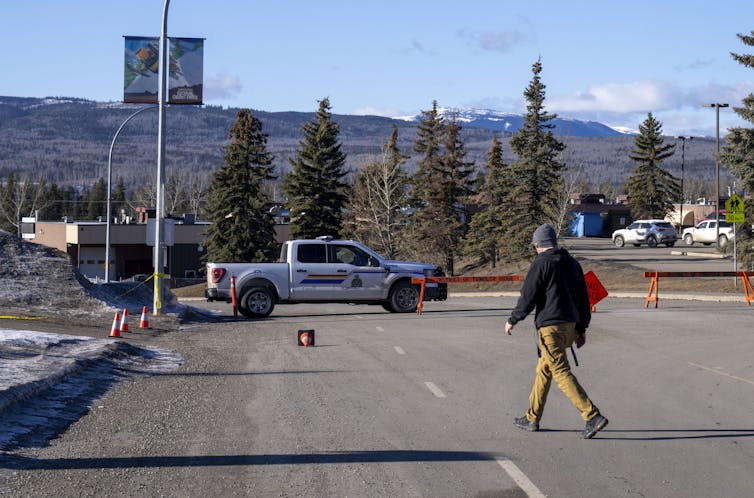
THE CANADIAN PRESS/Christinne Muschi
Students who are marginalized are most likely to experience negative school climates. In schools, these vulnerabilities call for support and trust-building, while in policing contexts, these vulnerabilities are a risk to surveil and detect relative to behavioural baselines.
When police presence expands in schools, the students most in need of care may also be the most likely to be watched. Students who feel watched are less likely to feel trusting of their school community.
Protective social connections
Decades of research on youth violence consistently identify protective social connections not only between students, but also among families, staff and the broader community. Early identification and intervention through multidisciplinary teams that include educators, administrators and mental health professionals are central to prevention efforts.
This does not require engaging in surveillance activities that risk the human rights of students or subject them to criminalization. It does require that we put resources toward educating and supporting youth rather than policing them.
In times of collective grief, the choices leaders make can shape school policy for years. If safety is the goal, relational infrastructure matters.
In this way, prevention depends not only on identifying threats, but on making environments in schools where students and youth feel supported, comfortable seeking help and willing to speak up when a peer needs support.

























