More than 128,000 Floridians are living with HIV. The state has the second-highest rate of new HIV diagnoses after Georgia, with approximately 4,500 new diagnoses in 2023, the most recent year for which data is available.
But access to treatment could be in jeopardy if potential budget cuts, announced in January 2026 by the Florida Department of Health, are enacted.
These changes, set to go into effect on March 1, would cut funding for the state’s AIDS Drug Assistance Program, which helps more than 31,000 Floridians with HIV/AIDS afford care.
I am an emeritus professor of medicine and a practicing clinician in the Tallahassee area who specializes in HIV/AIDS treatment. Many of my patients have been treated through this state program over the past 17 years, so I am deeply concerned about threats to its funding.
Table of Contents
Funding access to care
Since its creation in 1996, the Florida AIDS Drug Assistance Program has been funded through the Ryan White CARE Act, which Congress passed into law in 1990. The law ensures people with HIV have access to clinical care, housing support, nutrition, case management, and behavioral and substance use care. Most importantly, it guarantees access to medications to treat HIV and its complications.
More than half of those served by the Florida AIDS Drug Assistance Program earn less than US$22,024 per year, which is 138% of the federal poverty level. While researchers can’t say exactly how many lives have been saved by this program, modeling studies have determined that AIDS drug assistance programs across the U.S. are cost-effective.
But the Florida Department of Health says that it is facing a $120 million budget shortfall, and that the federal Ryan White funds are no longer enough to keep the program going without major cuts to services.
Loss of care and insurance
Currently, the program provides access to medication for low-income, HIV-positive Floridians either by directly giving them prescription medications or by paying for insurance coverage for them that includes HIV medications.
The proposed cuts would stiffen the eligibility requirement for the program from earning 400% of the federal poverty level or below, about $88,000 per year, down to 130% or below, about $21,000 per year. This would immediately remove financial support used by about 16,000 patients to access lifesaving medications.
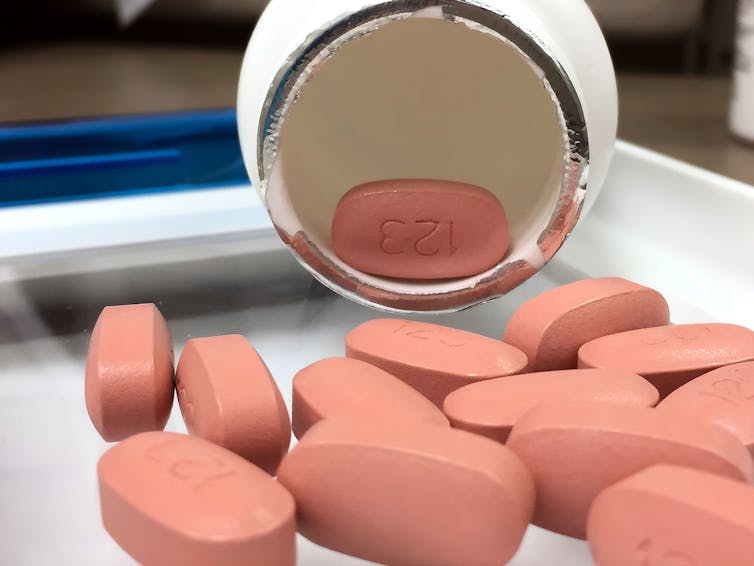
The cuts would also stop program funds from being used to purchase health insurance for eligible patients. The Department of Health has also proposed changing which drugs the program can cover, removing the recommended and most commonly prescribed drug for treating HIV, Biktarvy.
Without access to insurance coverage and medication, these patients face worse health outcomes, and HIV transmission is likely to increase. Ultimately, this would lead to higher health care costs in Florida and more deaths from HIV/AIDS.

BSIP/Universal Images Group via Getty Images
Pushing back
AIDS Healthcare Foundation, a national HIV advocacy and provider network, is suing the Florida Department of Health to require that it go through the normal rulemaking process to make changes to the program. Florida statute requires that substantive changes to a program undergo a process of public announcement, followed by a public comment period, before the change is enacted, which did not happen in this case.
An administrative judge has approved an expedited hearing for the lawsuit and will issue a ruling before March 1.
The foundation has also filed a second suit to determine the cause of the Department of Health’s $120 million budget shortfall.
Elevate Your Health for Just $29.99/Month
Join the Precision Wellness Subscription at My Healing 365 and get discounted services, priority coaching access, virtual care, and exclusive wellness resources to support your physical, emotional, and hormonal health.
Join for $29.99/MonthMeanwhile, in the state legislature, both the Florida Senate and House have attempted to include additional funding for the program in their respective budget proposals. But the final budget won’t be voted on until later this March, and Gov. Ron DeSantis has line-item veto authority.
For now, I, along with other health care providers, am scrambling to ensure that patients do not lose access to their medications. We worry that if the drug assistance program is cut, Florida could see a return to the days of increasing HIV-related complications, hospitalizations and deaths.
Read more stories from The Conversation about Florida.

























