It’s a familiar experience for many Americans: You’re watching your favorite show and suddenly you’re ambushed by an ad for a drug whose name sounds like a Wi-Fi password, before a relentlessly cheerful voice tells you to “Ask your doctor” and then blasts through a side-effect list that’s laughably long.
But that might soon change. After nearly 30 years of giving pharmaceutical companies free rein to advertise prescription drugs directly to consumers, U.S. officials are now seeking to curb this practice.
Soon after his appointment in 2025, Health and Human Services Secretary Robert F. Kennedy Jr. stated that he believes direct-to-consumer advertising of prescription drugs has contributed to overmedication and inflated health care costs, and that stronger oversight is long overdue. Meanwhile, politicians on both sides of the aisle have called for banning direct-to-consumer drug ads outright – though the Food and Drug Administration has so far focused on restricting “digital” loopholes and enforcing the laws about advertisement.
As a health economist who studies how health care policies shape decisions made by doctors and patients, I agree that the practice can steer patients toward heavily marketed brands instead of the most appropriate treatment.
But the research on how such advertising affects patients is more nuanced. Many rigorous studies show that these ads can benefit patients’ health by encouraging them to seek lifesaving treatment for conditions such as depression and heart disease and sparking conversations with their doctors. In my view, within the realities of the U.S. health care system, getting rid of direct-to-consumer drug advertising may do more harm than good.
Table of Contents
The origins of US prescription drug advertising
Only two countries – the U.S. and New Zealand – allow drug companies to advertise prescription medications directly to the public. Elsewhere, this practice is banned out of concern that short ads cannot adequately explain medical risks and that prescribing decisions should remain under physicians’ control.
And for good reason: Research on risk statements in drug ads on television shows they are often dense, fast-paced and paired with distracting visuals, making them difficult for consumers to understand.
In the European Union, Canada and Japan, for example, manufacturers may run disease awareness campaigns but cannot name specific products.
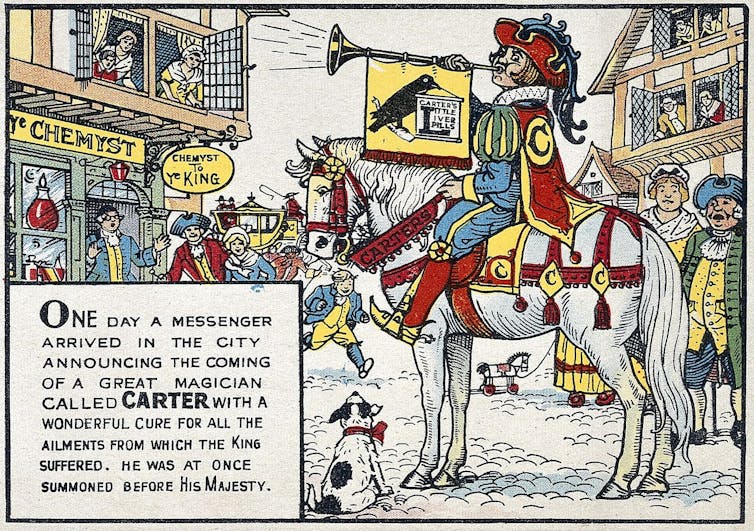
The U.S. approach to regulating drug advertising evolved gradually over more than a century. Congress’ 1906 Pure Food and Drugs Act was the first major federal step in drug oversight. It required manufacturers to label their products accurately and to disclose the presence of key ingredients.

Wellcome Collection, CC BY
For decades, pharmaceutical marketing focused on physicians by advertising in medical journals, visits by sales representatives and providing free samples. Drug companies still market heavily to physicians, but FDA policies and television changed the calculus.
By the 1960s and ’70s, the reach of mass media prompted companies to communicate complex medical information in brief commercial formats. The 1962 Kefauver–Harris Amendments, which required drugmakers to prove their products were both safe and effective to receive FDA approval, also gave the FDA explicit authority over prescription drug advertising. This allowed the agency to police exaggerated claims and require that promotional materials present a fair balance of benefits and risks, including clear disclosure of known side effects.
In the 1980s, several pharmaceutical companies experimented with marketing drugs directly to consumers in magazines and newspapers. The FDA paused these efforts in 1985 to study their effects but later allowed them to resume.
An opening for television ads
The pivotal change came in 1997, when the agency issued draft guidance that television ads needed to present only major risk information and could direct viewers elsewhere – via phone lines, print materials or websites – for the full details.
Reliable, up-to-date figures are hard to come by, but according to a widely cited estimate, the U.S. pharmaceutical industry now spends more than US$6 billion on direct-to-consumer advertising, roughly twice the amount spent in 2012.
In September 2025, the FDA announced it would revoke this change, restoring pre-1997 standards for fuller disclosure, and would more aggressively enforce currently existing rules for direct-to-consumer drug advertising. Despite growing interest from policymakers and Congress to ban them outright, a total ban likely would not survive a Supreme Court challenge.
How direct-to-consumer ads affect patients
Studies show direct-to-consumer drug advertising increases demand for medications and prompts more doctor visits and diagnoses. Policymakers and the FDA specifically have raised concerns that these ads mislead patients, encouraging them to overuse or inappropriately use drugs and choose more expensive treatments over less costly alternatives. This, in addition, could raise drug prices and result in wasteful spending. But research convincingly demonstrating this has been difficult to come by.
Elevate Your Health for Just $29.99/Month
Join the Precision Wellness Subscription at My Healing 365 and get discounted services, priority coaching access, virtual care, and exclusive wellness resources to support your physical, emotional, and hormonal health.
Join for $29.99/MonthFor example, a 2023 analysis showed that drug companies spend more on advertising drugs that have been rated as having relatively lower clinical benefit than on drugs that offer higher clinical benefit. This may imply, according to the authors, that drug companies are trying to steer patients to drugs that physicians would be less likely to prescribe.
Interestingly, though, rigorous research showed that direct-to-consumer advertising increases prescribing of both advertised and nonadvertised drugs – suggesting that overall this increase is serving patients.
Demonstrated benefits
For all the criticism that these ads are deceptive, the evidence indicates they can generate substantial clinical benefits for patients.
Research finds that ads bring patients into care, while leaving prescribing decisions largely in physicians’ hands, resulting in more patients being diagnosed and treated. For example, according to a 2022 study on antidepressants, advertising encouraged more people to start treatment and expanded overall use, especially for underdiagnosed conditions.
During the 2008 election season, political ads displaced drug commercials, providing a natural experiment on the effects of direct-to-consumer drug advertising. One study probed that period to examine ads for cholesterol-lowering medications known as statins, which are some of the most widely prescribed medications in the U.S. It found that removing drug ads reduced sales.
That study also ran a simulation banning drug ads entirely to show that doing so would have reduced new statin users by about 600,000 in 2008. Combining their estimates with clinical evidence on the drug’s benefits, the researchers found that health gains from additional treatment outweighed the costs of advertising.
Another study took advantage of the rollout of Medicare Part D, which helps cover the cost of prescription drugs, as a natural experiment. After Part D expanded drug coverage, pharmaceutical advertising increased more in areas with larger Medicare populations. In those areas, researchers found that more patients began treatment and stuck with it.
Importantly, the number of prescriptions also rose for nonadvertised drugs, including lower-cost generics, suggesting that advertising expanded overall treatment rather than simply shifting patients to heavily promoted brands.
It’s easy to single out pharmaceutical ads aimed at patients, but they are only one piece of a complex health care system – one in which drug manufacturers, providers, insurers and pharmacies all have financial incentives that shape which medications patients can access.
For example, drug company marketing directly to physicians does skew prescribing, increasing drug costs, with little evidence that patients receive better or more appropriate treatment as a result. Yet in the absence of direct-to-consumer advertising, patients’ choices of medications would be more heavily controlled by that dynamic.
The challenge for policymakers will be to curb misleading promotion without cutting off patients’ access to reliable information or undermining their role in directing their own care – and that will likely require addressing broader issues in the health care system.

























