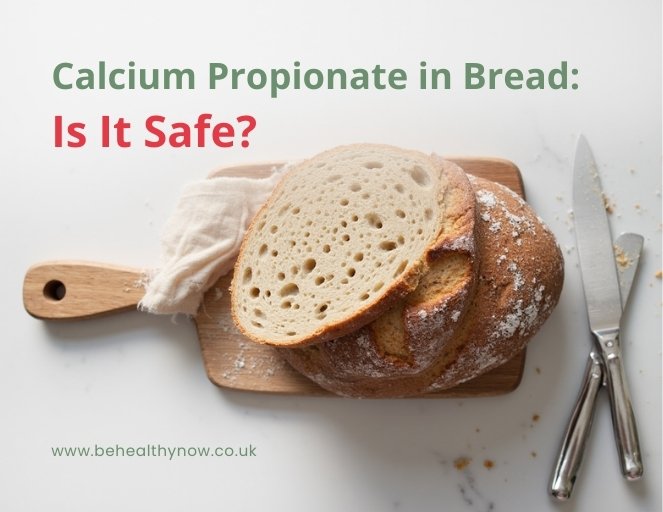
Every time I check the label of a packaged loaf of bread, I find calcium propionate on it. A quick search tells me it’s a preservative. But when I read a bit more, I start seeing claims linking it to ADHD, blood sugar problems, and even cancer. It sounds quite shocking.
So what’s the truth? Can it really be that harmful? Or is this another ingredient that looks scary but isn’t as bad as it seems? I decided to properly look into the research and see what we actually know.
Table of Contents
What exactly is calcium propionate doing in your loaf?
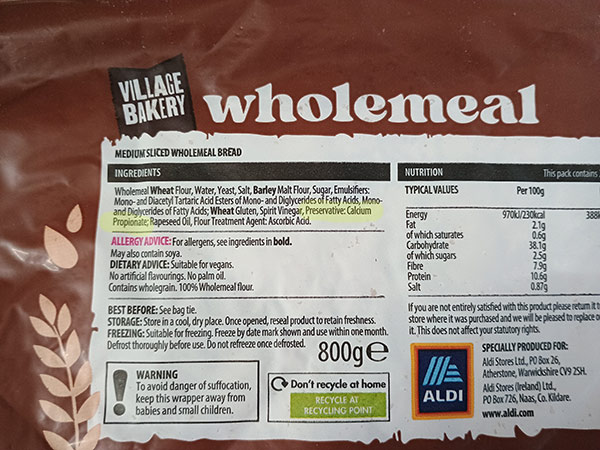
Calcium propionate is added to bread to prevent mould. Bread contains moisture, which makes it prone to mould growth, especially once it’s sliced and packaged. This preservative slows that process down and helps extend shelf life.
That’s why you’ll mostly find it in packaged, sliced supermarket bread rather than in fresh bakery loaves meant to be eaten quickly.
Is it natural or synthetic?
Calcium propionate is a manufactured food additive. It isn’t a natural ingredient like flour, salt, or yeast.
It’s made for food use in a controlled way, then added to products to do a specific job, which is slowing down mould. Propionate can exist naturally in the body too because our gut bacteria produce it when we digest fibre, but the calcium propionate you see on labels is still something that’s produced for food manufacturing and added on purpose.
Is Calcium Propionate Safe?
Calcium propionate is approved for use in many parts of the world and is not banned in major food-regulating countries.
In the European Union it is listed as E282 and authorised as a food additive under EU food law.
In the United States it is considered GRAS, which stands for “generally recognised as safe,” when used according to good manufacturing practice.
It is also permitted in Australia and New Zealand under their food standards system.
That approval is based on safety evaluations and acceptable intake levels set by regulatory bodies. In simple terms, experts have looked at the available evidence and decided that, at the amounts used in food, it is not considered unsafe.
However, approved does not mean there is zero debate or zero ongoing research. It simply means that, based on current evidence, regulators do not consider calcium propionate harmful at permitted levels in food.
Why Has It Been Linked to Cancer?
If calcium propionate is approved and considered safe at permitted levels, why do some people link it to cancer?
The concern mainly comes from laboratory studies where researchers exposed human cells to calcium propionate to see how those cells reacted. In some of these studies, they looked at whether the ingredient caused stress or damage inside the cells.
One of the things they measured was something called oxidative stress.
Oxidative stress is a term used when cells are under strain from unstable molecules called free radicals. When oxidative stress increases, it can sometimes lead to damage inside cells, including damage to DNA. Because long-term DNA damage can play a role in cancer development, this is where the worry begins.
🔬 What have lab studies found?
A 2024 laboratory study exposed human white blood cells to calcium propionate and reported increased oxidative stress and signs of DNA damage at higher concentrations.
This kind of research is useful because it helps scientists understand how substances behave at the cellular level. But it is important to remember what type of study this was.
The cells were tested in a laboratory dish and directly exposed to measured amounts of the preservative for a set period of time.
⚖️ What does this actually mean for real life?
The study was done in isolated cells in a laboratory dish. That is very different from eating bread that contains small amounts of a preservative.
When you eat food, it goes through digestion. It is broken down, absorbed, processed by the liver, and regulated by the body’s natural defence systems. Lab studies do not fully copy that complex process.
So these findings are best seen as an early warning sign that scientists may want to explore further, rather than proof of harm from eating normal amounts in food.
So, what do human studies say about cancer risk?
At the moment, we don’t have much solid human research that looks at calcium propionate intake over many years and links it to cancer risk. Most of the worry comes from lab studies, not long-term real-life evidence.
There is a large French study that looked at preservatives and cancer risk, but calcium propionate couldn’t really be properly assessed because very few people in the study were consuming it.
At this stage, there is no strong human evidence showing that eating bread containing calcium propionate increases cancer risk.
Lab studies can raise important scientific questions, but they do not prove that normal consumption of calcium propionate causes cancer.
Can Calcium Propionate Make ADHD Worse?
This is probably one of the biggest concerns parents have.
There is one study that often gets mentioned when people talk about calcium propionate and behaviour in children.
In 2002, researchers carried out a double-blind, placebo-controlled study where children were given bread containing calcium propionate and, at another time, similar bread without it. The children had previously improved on a diet that removed certain food additives.
The important detail here is that this was a small group of children who were already suspected to be sensitive to additives.
During the calcium propionate challenge, some of the children showed worsening behaviour, including increased irritability, restlessness, inattention, and sleep disturbance. Not all children reacted, but a noticeable proportion did.
What does that actually tell us?
This study suggests that calcium propionate may affect a subset of sensitive children.
It does not show that calcium propionate causes ADHD.
It does not show that all children will react to it.
And it does not mean that removing it will improve behaviour in every child with ADHD.
It simply shows that in a small, selected group of children who were already sensitive to additives, behaviour worsened when calcium propionate was reintroduced.
That is very different from saying it causes ADHD.
What should parents take from this?
If a child has known sensitivity to food additives, or if behaviour seems to worsen consistently after eating certain processed foods, it may be worth discussing a short elimination trial with a healthcare professional.
But for most children, there is no strong evidence that calcium propionate alone is a universal trigger for ADHD symptoms.
Could Calcium Propionate Affect Blood Sugar or Metabolism?
Another concern people raise is whether calcium propionate could affect blood sugar or increase the risk of diabetes. This is one of the newer areas being discussed when it comes to this preservative.
What have studies found?
In one study, researchers found that propionate (the compound released from calcium propionate during digestion) can nudge the body to release hormones that raise blood sugar.
The concern is that if something repeatedly pushes blood sugar up, the body may need to produce more insulin over time to keep things stable. And in the long run, that pattern can contribute to insulin resistance.
This doesn’t prove that bread with calcium propionate causes diabetes. But it helps explain why some researchers are paying attention to propionate and blood sugar regulation.
What about long-term risk?
A more recent large French study followed people over time and looked at preservative intake and the risk of developing type 2 diabetes. Several preservatives were associated with a higher risk of diabetes in the observational data.
Importantly, calcium propionate was one of the preservatives linked to higher diabetes incidence in that study.
It’s important to keep this in context. This was an observational study. That means it shows an association, not proof that calcium propionate directly caused diabetes. People who consume more preservatives often eat more ultra-processed foods overall, so it is difficult to separate one ingredient from the bigger dietary pattern.
So what does this mean?
At this stage, there is no clear proof that eating bread containing calcium propionate directly causes blood sugar problems.
However, because it has been linked to higher diabetes risk in large human data, this is an area worth paying attention to.
This area is still being studied, but it’s one of the more interesting modern concerns around food additives.
Does Calcium Propionate Have Any Side Effects?
For most people, calcium propionate does not appear to cause noticeable side effects at normal intake levels. However, a few possible effects have been reported or studied:
- Behaviour changes in some children
A small controlled study found that a group of children who were already sensitive to food additives showed increased irritability and restlessness when given bread containing calcium propionate. - Possible link to blood sugar issues
A large observational study found that higher intake of certain preservatives, including calcium propionate, was associated with a higher risk of type 2 diabetes. This does not prove it causes diabetes, but it raises questions. - Cell stress in lab studies
Laboratory research has shown signs of cellular stress when human cells were exposed to high concentrations. These were lab conditions, not normal dietary intake.
At this stage, serious side effects appear to be uncommon, and most concerns come from limited or early-stage research rather than strong long-term human evidence.
Which Breads Usually Contain Calcium Propionate
In the UK, calcium propionate is most commonly found in long-shelf-life, soft, plastic-packaged sliced loaves. This includes many standard white, wholemeal and “50/50” sandwich breads from big brands and supermarket own ranges. It doesn’t usually matter if the loaf is labelled wholemeal, low sugar, or high fibre – many still contain E282.
In the US, it can show up in packaged bread too, but many loaves use ingredients like fermented wheat flour or vinegar instead, so the label really is the best guide.
Elevate Your Health for Just $29.99/Month
Join the Precision Wellness Subscription at My Healing 365 and get discounted services, priority coaching access, virtual care, and exclusive wellness resources to support your physical, emotional, and hormonal health.
Join for $29.99/Month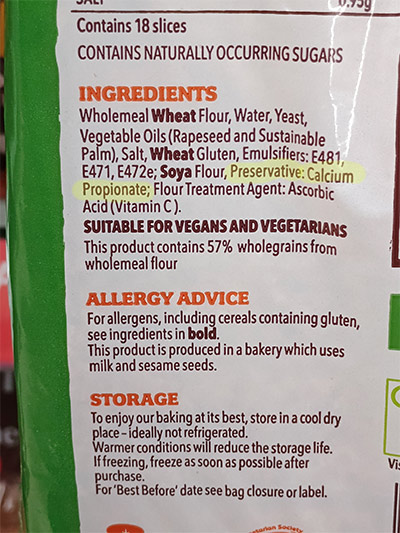
🛒 Breads that commonly contain calcium propionate (E282)
- Warburtons standard sliced loaves (white, wholemeal, 50/50 varieties in plastic packaging)
- Hovis Soft White and similar standard sliced loaves
- Kingsmill Soft White Medium Sliced Loaf
- Many supermarket own-brand soft sandwich loaves
- Many packaged pitta breads
These are typically very soft, designed to last several days, and sold in sealed plastic packaging.
Breads That Do Not Contain Calcium Propionate
Most of the breads above seem to rely on sourdough or fermented wheat flour, or they simply have a shorter ingredient list. Fermentation naturally creates acids that can slow down mould, so some loaves don’t need extra preservatives like calcium propionate.
Just keep in mind, “no calcium propionate” doesn’t automatically mean “perfect bread.” Some still contain added sugar, vegetable oils, or other extras.
And because recipes change, it’s always worth checking the label again. If you want to avoid it, look for calcium propionate or E282.
So, Should You Avoid Calcium Propionate?
Calcium propionate is considered safe in the small amounts used in bread. And right now, there’s no strong human evidence that it increases cancer risk from normal intake.
That said, a small study suggests some children may get more restless or irritable after eating it. And newer research has raised questions about how preservatives like this might affect blood sugar. One large study found an association between calcium propionate intake and a higher risk of type 2 diabetes, but it doesn’t prove it causes it.
Personally, I try to avoid breads with added preservatives when I can. But if you eat bread with calcium propionate now and then, it’s unlikely to be a big deal, especially if most of the time you choose simpler, less processed options.

























