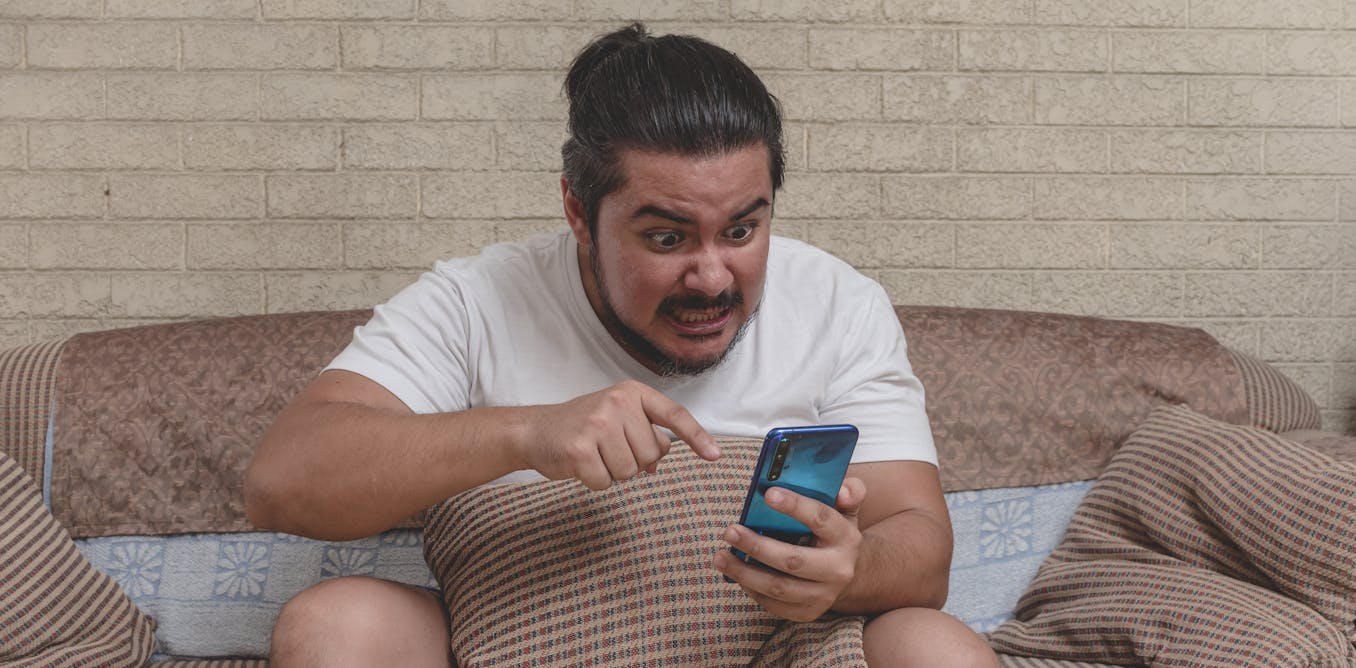
Does politics stress you out? Did the last election cause you to lose sleep, lose your temper or lose a friend? If so, you weren’t alone.
For the better part of two decades, the American Psychological Association has documented a steady increase in the phenomenon of “political stress” among American voters. However, research and reporting during that same period have focused primarily on the political consequences of increasing polarization and division rather than the psychological consequences of the modern political climate.
As a political scientist studying how the public engages with politics and media, I wondered: What does it mean to live in a political environment that is highly confrontational, emotionally charged and difficult to escape? And how does that environment affect people over time?
During the 2024 presidential election, I teamed up with three colleagues to answer those questions. Our book, The Anxious State: Stress Polarization, and Elections in America, published in January 2026, summarizes what we learned.
While several features of the modern political landscape contribute to political stress, one culprit in particular is alarmingly efficient at converting politics into chronic stress – social media.
Table of Contents
Political stress builds fast
We conducted four large, nationally representative surveys tracking Americans’ political attitudes and well-being, one every three months over the course of 2024. Across our election year surveys, roughly 4 in 10 American adults consistently reported that politics had caused them to experience at least one significant stress reaction in the past month. These included nontrivial conflicts with friends and family, sleep disruptions, lost tempers and being unable to mentally or emotionally disengage from politics.
In a country of roughly 260 million adults, that amounts to well over 100 million people experiencing measurable political stress in any given month.
In just one example, at each point in 2024, around 17% of American adults reported losing sleep over politics. This translates to roughly 44 million people nationwide. Sleep loss is not a trivial inconvenience. Extensive research shows that insufficient sleep is associated with impaired cognitive function, chronic health problems, diminished productivity and an increase in traffic accidents, just to name a few.
Our findings point to similar trends from the effects of lost tempers, fractured social networks and excessive political rumination. And while some degree of political stress might be expected in the lead-up to a highly consequential election, what surprised us most was how little these numbers changed over time. Despite a year filled with dramatic political events, reported levels of political stress rarely budged.
This stability suggests that political stress is no longer driven primarily by isolated moments of breaking news or electoral upheaval. Instead, it appears to be sustained by the environment in which people now encounter politics – and that environment is increasingly shaped by social media.
Why social media is different
Social media differs from earlier forms of political communication in a crucial way: Content is not presented chronologically or editorially; it is presented algorithmically. Platforms such as Facebook, X and TikTok are designed to maximize attention and engagement, which means they privilege content that provokes strong emotional reactions.
In other words, content that causes outrage, fear, moral condemnation and conflict is simply more likely to keep users scrolling, clicking, commenting and sharing.
As a result, political information on social media is more likely to reach people through a sensationalized and emotionally charged lens than information encountered through traditional news sources. And given the architecture of social networks, this content tends to reach users whether they seek it out or not.
Elevate Your Health for Just $29.99/Month
Join the Precision Wellness Subscription at My Healing 365 and get discounted services, priority coaching access, virtual care, and exclusive wellness resources to support your physical, emotional, and hormonal health.
Join for $29.99/MonthTime spent online is stressful, but engagement makes it worse
Our findings show that even passive exposure to political content on social media is linked to elevated political stress. But active engagement – such as likes, reposts and comments – makes the problem substantially worse.
People who reported frequently encountering, commenting on or sharing political content online consistently exhibited the highest overall levels of political stress in our survey. Compared with those who primarily consumed political information passively and without engaging, active participants were far more likely to report losing sleep, losing their temper and feeling unable to disengage from politics.
In other words, the more that social media turns users from observers into participants in political conflict, the greater the psychological toll appears to be.
A generational divide
These effects, while substantial, were not distributed evenly across the population.
Younger Americans, particularly members of Gen Z, reported higher levels of political stress associated with social media use than older cohorts. This is not especially surprising. Younger adults are more likely to rely on social media as a primary source of political information.
For a generation that has never known a political environment without algorithmically curated feeds, the boundary between politics and everyday life is especially thin. Politics does not arrive at scheduled times, through discrete channels. Rather, it is interspersed with expressions of social identity, entertainment and peer interaction. And this constant exposure comes with a psychological cost.
Social media alone certainly isn’t to blame for the anxious and divisive state of America’s political climate. In our research, we identified a number of factors that contribute to Americans’ current levels of exhaustion with politics, including sharp increases in partisan hostility and negative – often uncivil – campaign tactics.
But social media nonetheless stands out for how efficiently it amplifies this stress – and that is unlikely to change unless and until voters become more aware that their emotions and well-being are being negatively influenced by the very platforms they turn to for information and connection.























