Ever wonder why there are 26 medications for male sexual disorders and only one drug for women who experience low libido? Perhaps it’s because this glaring example of medical sexism has not been widely discussed in popular media. Not until now, that is.
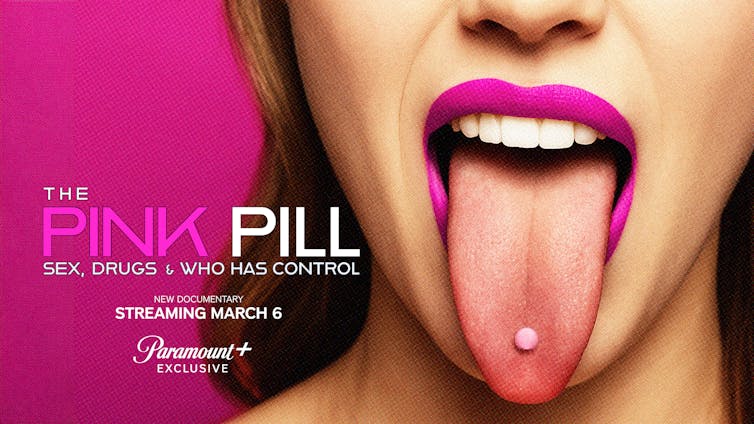
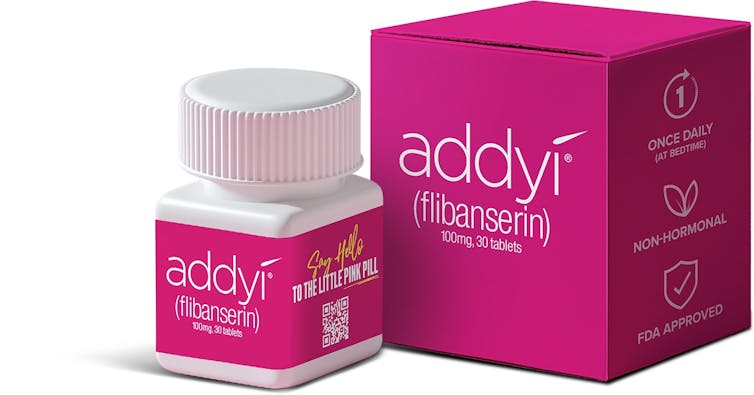
The Pink Pill: Sex, Drugs & Who Has Control, a gripping new documentary film, blends archival footage, interviews with physicians and advocates and intimate reflections from women to reveal the uphill battle getting the drug Addyi (flibanserin) to market. This so-called “pink pill” is a prescription medication for treating low libido or hypoactive sexual desire disorder (HSDD) in women.
Directed by award-winning Canadian filmmaker Aisling Chin-Yee, the film follows Cindy Eckert, the trailblazing founder of Sprout Pharmaceuticals who developed Addyi. Habitually dressed in pink, a symbol of her unwavering determination to champion women’s health, she is a force to be reckoned with.
(Paramount +)
As a sexual wellness researcher and women’s health advocate knowledgeable about gender and sexual inequities, I was deeply moved by this film. Women’s bodies and reproductive rights have not — at least not in my lifetime — been more threatened than they are today.
Addyi’s story is a vital testament to what smart and determined women in science can do for other women. Well-researched and inclusive of multiple perspectives, it shows us the collective change required to keep moving the medical needle toward a place where women’s health receives the same funding, marketing and support as men’s.
We’re not there yet, but The Pink Pill provides a road map for how to successfully advocate for women’s health and sexual autonomy.
Table of Contents
The overlooked science of women’s desire
Low sexual desire impacts 13 to 40 per cent — or between 536 million and 1.65 billion — of women globally.
Despite these numbers and many negative effects — including relationship strain, shame, depression and body image issues — the film reveals an alarming gap in medical knowledge and training. Medical students are still not trained in women’s sexual health; not even at the top schools in the United States, as one physician in the documentary adds. The clitoris was excluded from instructional materials, another shares.
The medical and moral disdain surrounding female pleasure directly impacts how women with low libido are treated by their doctors, many of whom engage in medical gaslighting. The “oh, it’s just in your head” trope has haunted women for centuries, and doctors routinely advised patients with low sexual desire to take baths, plan date nights or submit to “duty sex.”
As Eckert says, after disclosing her own struggles with HSDD:
“We’re conditioned to not fight for it.”
This was echoed in her first meeting with the U.S. Food and Drug Administration (FDA) to develop and market flibanserin in early 2010, when a male board member asked: “What do we need a bunch of horny women running around for?”

(Sharon Suh)
The research behind the “pink pill”
Later that year, German pharmaceutical giant Boehringer Ingelheim released very promising results from a flibanserin clinical trial involving women affected by HSDD.
However, in October 2010, the company halted the pursuit of FDA approval because, as Eckert said: “They didn’t want to take on women and sex.” That’s when she bought the rights to the drug and stepped up to be its champion.
Elevate Your Health for Just $29.99/Month
Join the Precision Wellness Subscription at My Healing 365 and get discounted services, priority coaching access, virtual care, and exclusive wellness resources to support your physical, emotional, and hormonal health.
Join for $29.99/MonthEckert began by naming it Addyi after the Grey’s Anatomy character Addison Montgomery, who is widely admired for her staunch support of other women and for living life on her own terms.
After reviewing the brain scans of women with and without HSDD, Eckert discovered a scientific smoking gun. There were striking differences in the hypothalamus — the brain’s “sex centre” — between the samples, with the low-libido women exhibiting far less activity.
This was evidence that low desire isn’t in women’s heads, it’s biological.
Eckert’s team went ahead and launched the largest clinical trial in women’s health history for an FDA filing — involving more than 13,000 participants. However, as revealed in the documentary, despite the data clearly demonstrating Addyi’s positive impact on women’s sexual desire, in 2013 the FDA turned down the application to take the drug to market.
Moderate success and dangerous side effects were cited, including the patronizing notion that “a woman might take Addyi the night before and fall asleep the next morning while driving her kids to school.”
When a drug became a movement
Undeterred, Eckert and her team spent over US$1 million conducting a driving study that revealed enhanced reaction times among women taking Addyi. Eckert also created the Even the Score campaign that brought Sprout’s mission of sexual health equity for women into public conversations in a new and powerful way.
Influential physicians came on board for medical credibility, and so did women who’d taken Addyi. They protested, they supported Sprout and their local women’s health agencies, and they provided testimony when Eckert applied for FDA approval again.
Their heartbreaking stories of divorce, self-doubt and soul-numbing frustration with being ignored or told their sexual lives are irrelevant are difficult to watch. But they were also incredibly inspiring.
As Eckert said:
“When we fought, other women fought.”
In August 2015, Sprout Pharmaceuticals won by a vote of 18-6. Two days later, Eckert sold Addyi to Valeant Pharmaceuticals for mass distribution for $1 billion. Valeant, however, then raised the price and imposed restrictions on the drug’s sale, placing it beyond the reach of most women financially, and many physicians refused to prescribe it.
Spurred into action once again, Sprout Pharmaceuticals filed a lawsuit against Valeant. The case was dropped and Eckert bought Addyi back for $0 — a remarkable turnaround.
Why the Addyi story matters
The Pink Pill is a galvanizing film that exposes how medical sexism contributes to the dismissal of women’s sexuality. Low desire, especially in midlife, is a real condition worthy of scientific research and pharmaceutical development.
Using a documentary film as the medium to tell this story is, as producer Julie Bristow said in an interview, “a very powerful way of getting people to engage.” It’s an emotionally compelling film, but it’s also educational.
This is a central goal for Bristow, who said: “What I hope women take away from this, and men, is that men and women’s sexual health is dealt with completely differently and in the wider health-care system as well.”
By combining scientific debate, personal testimony and political activism, The Pink Pill makes a persuasive case that women’s sexual health has long been treated as a medical afterthought — that changing this truth requires cultural progress too.

























