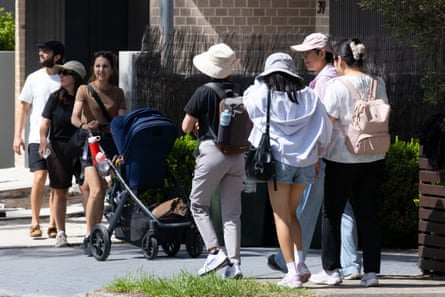
On a sunny Saturday morning, halfway along Sydney’s newly opened inner west GreenWay, a dozen frustrated residents gather with notebooks and pens. “I’m angry,” one says. “I’m really angry.”
The group is holding a snap meeting with one of the local councillors to voice their concerns about the GreenWay, the pedestrian and cycling corridor that runs for 6km from Iron Cove to the Cooks River, almost entirely off-road.
It’s the “almost” part that bothers the residents of Weston Street in Dulwich Hill.
Their modest street with narrow footpaths forms a link between the northern and southern sections of the $57m trail where there is no straightforward option to take it off-road.
Since the GreenWay opened in mid-December, it has become a cycling, running and walking utopia, attracting thousands of visitors, especially at weekends. But as those visitors pass about 80 homes along Weston Street, the residents have become increasingly disturbed, to the point where some say they face a “Herculean tsunami of a community-wide mental health crisis”.
The broad consensus of the participants in the meeting is that, without urgent action, someone is going to get seriously injured or killed by a vehicle. Secondary to that is the noise disruption and impact of a sudden swarm of people on their once-quiet residential street.
They say dog poo is getting put in their bins. Cyclists are flipping the bird when told by residents to get out of the way. Joggers are loudly talking to each other in the early morning. Garden beds on nature strips and in front yards are being trampled. They can’t leave their homes without feeling like they’re crossing a highway.
As the meeting kicks off, cyclists, strollers, joggers and dogs gleefully pass by. Children mill about on scooters. Women in athletic wear grip coffees.
The Inner West mayor, Darcy Byrne, says the GreenWay is going “gangbusters”.
It has become a hotspot for run clubs and tour groups, who bus in by the dozens. The day the residents hold their meeting in early March, Byrne reveals that plans for a GreenWay half-marathon are in the works, part of a series of six events a year he hopes will attract more and more people.
There has already been a Sydney bike rave down the route – attended by about 200 people, including rollerbladers – featuring upbeat rave music blasted through speakers.
“The GreenWay is going gangbusters UP MY STREET,” one user comments on Byrne’s social media post. “You can’t be serious.”
Another wrote: “Weston Street is no longer the safe, quiet residential street it once was. It feels like only a matter of time before a serious accident occurs.”
Table of Contents
‘Death corner’
The GreenWay has been a wild success in its first three months.
A spokesperson for Inner West council says use of the corridor has been “performing above expectation” and proving “incredibly popular” with locals and visitors.
But the more popular it gets, the more trouble brews on Weston Street.
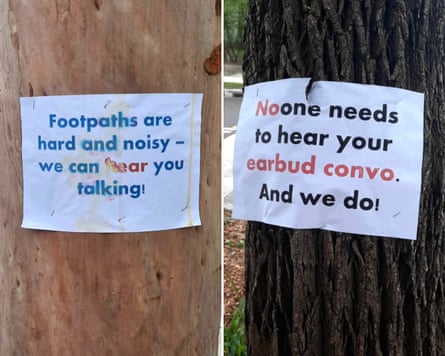
In the street’s WhatsApp group, locals voice their angst in lengthy messages, share pictures and videos of poor behaviour from visitors and discuss the best united path forward.
Angry signs have been erected, torn down and erected again. “FINISH THE GREENWAY,” one reads, alluding to calls to find a different route that avoids Weston Street.
Anther signs states: “REMOVING OUR SIGNS SIMPLY CONFIRMS THE LEGITIMACY OF OUR ARGUMENT!” and “RESIDENTS WILL NOT BE TREATED AS 2ND CLASS CITIZENS BY 2ND RATE POLITICIANS!”
Then there are the letters sent to the council. They stress that locals support the concept of the GreenWay, including bush regeneration and new public artworks.
“The streetscape, designed to encompass the existing natural geography, mature trees, and added artwork is truly beautiful,” one reads.
Elevate Your Health for Just $29.99/Month
Join the Precision Wellness Subscription at My Healing 365 and get discounted services, priority coaching access, virtual care, and exclusive wellness resources to support your physical, emotional, and hormonal health.
Join for $29.99/MonthBut it warns that the use of a “narrow residential street” is creating “escalating safety risks”.
Another letter warns that a resident has “already been struck by a runner while undertaking a routine activity (taking out rubbish bins). The runner did not stop or check for injury”.
It continues: “Residents’ dogs frequently bark or retreat in fear as GreenWay users’ dogs congregate at residential gates.”
The letters make a number of suggestions, including implementing a shared-zone speed limit of 20km/h, installing “traffic calming measures” such as patrolling rangers or police, improving signage and redirecting traffic.
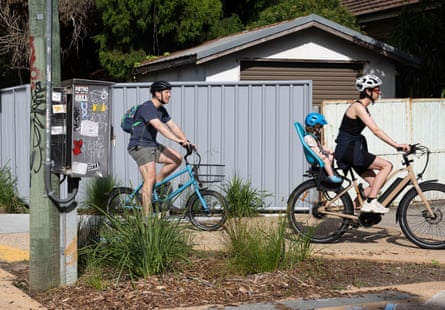
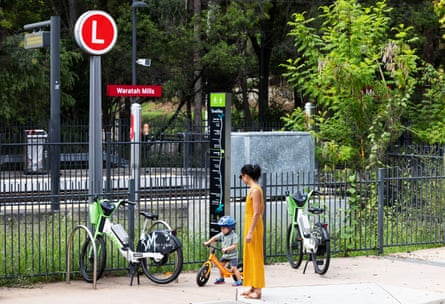
Until then, they say, the risk of serious injury is “not a matter of if – but when”. Images sent to the council refer to the exit from a tunnel on to Weston Street next to the Waratah Mills light rail stop as “death corner”.
It is on “death corner” that the first incident of the meeting occurs. A man walking a baby in a pram strolls out of the tunnel and – instead of veering on to the footpath – continues into the middle of the road. There are no cars, but the group members gesture to him in exasperated fatigue.
“You’ve got an extraordinarily tolerant street here,” one says. “This would never happen in the northern suburbs.”
The group bursts into laughter. “We need more barristers!” someone calls.
Later, they are standing on the road pointing out a segment of the street where repeated use has worn down the nature strip, when a group of cyclists approaches.
“Get out of the way,” one of them calls.
“This is our street,” a resident yells, and is promptly given the middle finger.
Troops of tourists
Mark Chinnock and Juraj Hubinsky, who are trimming their hedge at the time of Saturday’s meeting, are concerned that the social cohesion on their street is being worn away.
They have lived there for seven years and say neighbours used to gasbag about all kinds of things. But now the GreenWay dominates everything.
“With the WhatsApp group, I wake up in the morning, I clear it from the day before, and then I get home from work and there’s like 100 messages,” Chinnock says.
He says they were excited about the GreenWay, and always supported it, but the Weston Street section is “not fit for purpose”.
“We don’t agree with the passive-aggressive remarks that you might see around, because we don’t want to be labelled nimbys. We actually want it here, but it just needs to be better managed.”
Chinnock says a safer option would be to divert some traffic on to the adjacent, wider Windsor Road.
“We’re woken up every morning by joggers and people talking on their phones, and then the afternoons are the funniest when you’ve got troops of tourists coming through [by] the coach load,” he says.
Hubinsky was initially “thrilled” about the GreenWay but takes issue with its promotion as an “uninterrupted green corridor”.
“It’s actually interrupted, and it’s not so green here because it’s a road,” he says. “It’s a footpath next to where people live.”
Hubinsky says he complained to the council about walkers and joggers using the road, and was told signs could be put up to direct them on to the footpath.
“But my argument was that it’s already too busy,” he says. “People are on the road because they can’t fit on the footpath. It just doesn’t make sense.”
Chinnock says with a laugh: “When we come out of the house, I have to literally say, ‘coming out!’”
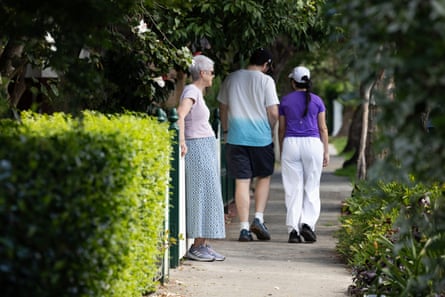
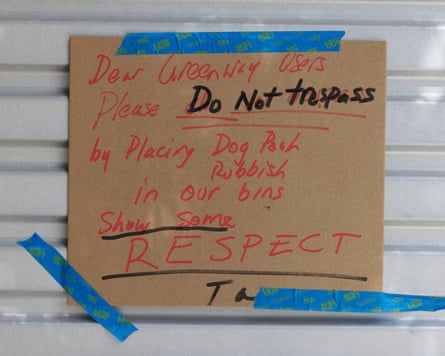
A group of residents, who say they wish to remain anonymous over fears for their safety, said in a joint statement they could “no longer safely gather outside our homes or interact casually in the street”.
The group say they face a “building, Herculean tsunami of a community-wide mental health crisis”.
“The cumulative toll on residents’ mental, physical and emotional wellbeing, with visible and clear signs of distress, are here, but have yet to be fully realised. Our little piece of suburban Australiana has gone.”
The cost of freedom
The council spokesperson says the GreenWay was “carefully designed over decades, informed by extensive community consultation”.
“We continue to work with our local community to respond to feedback. There is ongoing work to review and address safety and accessibility in the area.”
The environmental planning consultant Bruce Ashley, who has been a key advocate for the GreenWay for more than two decades, is on the route almost every day doing “guerrilla weeding”.
He says the GreenWay still needs “a lot of input”.
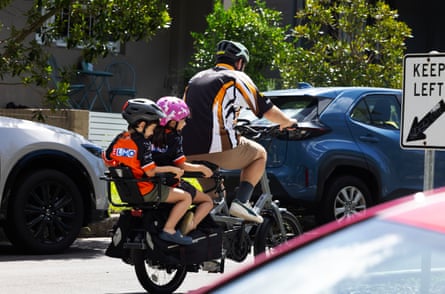
“My biggest fear is people will think the path is built so we can switch off but the whole idea was to engender a new way of looking at your own local area and being involved,” he says.
Ashley says a number of improvements could be made to the Weston Street section, including path widening, a speed limit and making a section one way. As part of the GreenWay upgrades, the street was closed at Old Canterbury Road and is now accessible only to local traffic.
“They’ve gone from a very quiet street in terms of number of people to a lot of people,” Ashley says. “But at the same time, the street is no longer a through route, it was used as a shortcut … and now it’s closed off.”
The bigger picture, Ashley says, is seeing the enjoyment people are getting out of a project that was a pipe dream for so many years.
“I was weeding the other day and saw a young girl, seven or eight, cycling with her dad down Weston Street,” he says. “She turned and said to him: ‘This is like freedom’.
“That’s what you do it for.”

























