Public health institutions are under threat by populist governments across the globe.
From Budapest to Jakarta, Indonesia, public health agencies are being stripped of funding and independence. Meanwhile, disinformation has sown distrust in scientific experts. The results are already visible through the return of diseases once thought eliminated or controlled, like measles and whooping cough.
The United States is no exception to this trend. Since Robert F. Kennedy, Jr. was confirmed as secretary of Health and Human Services in February 2025, he has fired over 10,000 staff, cut budgets and attempted to gut childhood vaccine recommendations. Though medical and public health groups have pushed back with some success, key government health institutions face a leadership vacuum, and national public health policy has fractured into “health alliances” formed by groups of states.
Doctors and scientists across the country worry about long-term damage to the country’s health system.
As a researcher studying the politics of health care, I believe it’s helpful to look to countries that have successfully managed similar threats. As my co-authors and I have argued, Brazil’s experience offers insights into how public health institutions can preserve power and authority in the face of assault.
Much like the U.S., Brazil has a fragmented and polarized Congress, it has powerful self-interested lobbies, and it has a federal system of government. And much like in the U.S., health outcomes suffer from stark race and income gaps.
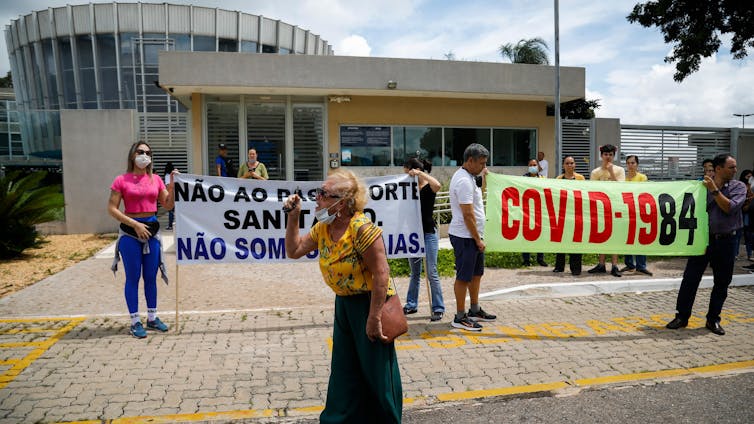
But when a populist president attacked the Brazilian health care system during COVID-19, the public successfully rallied to its defense

Sergio Lima/AFP via Getty Images
Table of Contents
A health system under attack
Brazil’s health system, established in its current form in 1990, provides free universal health care to all its citizens. Despite some significant flaws, including unequal access to care in poor and rural areas, its focus on preventive care is widely considered a model worldwide
Prior to the administration of right-wing populist Jair Bolsonaro, from 2019 to 2022, Brazilians had trust in vaccines. They had what public health experts call a vaccine culture, thanks to the hard work of health workers who had spent years promoting them and making them easily accessible. Vaccines even had a beloved national mascot in Zé Gotinha (Joe Droplet), a cartoon vaccine droplet with a Pillsbury Doughboy-like visage.
When COVID-19 hit Brazil in March 2020, Bolsonaro – dubbed by many as the “Trump of the Tropics” – launched unprecedented attacks on Brazil’s vaccine program. Among other measures, he fired the senior leadership of the health ministry and appointed as minister an active-duty military officer with no health credentials.

Vinicius Loures/Câmara dos Deputados via Wikimedia Commons, CC BY-SA
Bolsonaro’s attacks on the vaccine program – a backbone of Brazil’s preventive health efforts – were especially strong. He pressured Brazil’s drug regulatory agency to ban pediatric vaccines. He blocked resources for vaccine procurement, and he spread misinformation, notoriously suggesting the vaccine could give people AIDS.
After Bolsonaro’s initial attacks on Brazil’s COVID-19 response efforts, the entire health system appeared on the verge of collapse. However, Brazil’s public health workers then marshaled broad support to defend their vaccine program.
Opposition governors offered important but limited help by producing their own vaccine guidance and procuring their own vaccines. But political support, on its own, couldn’t overcome Bolsonaro’s attacks.
That’s because Brazil’s vaccine program depended not just on independence, but also on resources to operate. And governments with an anti-science bent have many ways to deprive even well-established agencies of resources without broad congressional approval.
Brazil’s vaccine program ultimately survived because allies outside government stepped in to defend it not only with political advocacy, but by donating money and resources and with social activism.
Business leaders to the rescue
Businesses filled gaps in government resources with donations of private-sector funding. Two business coalitions gave a total of over 270 million real (US$54 million) to help two public laboratories, the Institute of Technology in Immunobiology, known as BioManguinhos, and the Butantan Institute.
One of the largest foundations in Brazil, the Lemann Foundation, paid for AstraZeneca’s clinical trials in Brazil. Ambev, one of the largest firms in South America, lent its logistics team to help BioManguinhos acquire supplies and equipment.
Women of Brazil, a nonpartisan network of female business leaders, even built a campaign called United for the Vaccine to help towns and cities acquire the vaccine distribution equipment they needed. They provided local health officials with cheap supplies, like coolers and refrigerators, as well as costlier investments, such as boats and even planes for carrying vaccines to the isolated communities of the Amazon.
As pulmonologist Margareth Dalcolmo, who consulted for United for the Vaccine, emphasized to me in an interview: “All their requests were met, without one cent of government money being used.”
From the ground up
Another hugely important component of defending Brazil’s vaccine program was support from trusted local grassroots groups.
Elevate Your Health for Just $29.99/Month
Join the Precision Wellness Subscription at My Healing 365 and get discounted services, priority coaching access, virtual care, and exclusive wellness resources to support your physical, emotional, and hormonal health.
Join for $29.99/MonthWhen vaccines became available, community-based groups across the country jumped in to combat disinformation with their own locally produced information campaigns – especially in underserved communities.
One group I spoke to distributed 5,000 informational posters across their neighborhood. Another, Tamo Junto Rocinha, or We’re in it Together Rocinha, published a book with lessons for kids to do with their parents while school was canceled – all with vaccination information embedded. Voz das Comunidades, or Voice of the Communities, a neighborhood news service, even created a smartphone application to combat misinformation while also notifying community members of daily death tallies.

Mauro Pimentel/AFP via Getty Images
So many grassroots groups organized to counter Bolsonaro’s attacks on COVID-19 vaccines that researchers began to map the campaigns bubbling up across the country. By early 2021, one map had identified over 1,300 grassroots efforts and over 800 organized by universities.
By August 2022, despite Bolsonaro’s disinformation campaigns, 81% of Brazil’s adult population was fully vaccinated against COVID-19. These vaccination rates equaled those of New Zealand and the Netherlands and were well above that of the United States, where only 67% were fully vaccinated at the time.
This is not to say that Brazil was immune to disinformation campaigns. Vaccination rates for some diseases, such as measles, declined, as they have across the world.
But in many ways, the attacks on Brazil’s vaccine program paradoxically strengthened it. By the end of 2022, thanks to donor support, BioManguinhos had already built a new testing laboratory, and Butantan was constructing a new vaccine production facility. Brazil even had a new national health surveillance institute. By 2024, once Bolsonaro was voted out, overall spending on the health system had increased from the prior year by 27%.
Playing the long game with public health
In my view, these emergency countermeasures in Brazil worked effectively because the country had already spent years building a foundation of trust in – and ownership of – the shared goals of its public health system.
Decades ago, in the 1980s, Brazilians successfully demanded that their politicians make health care accessible to all – driving the genesis of the country’s universal public health system, known by the acronym SUS.
Brazil’s health ministry continues to invest heavily in making sure citizens take ownership of it. Cities and towns are postered with signs declaring “SUS is ours!” or “Health care is your right!”
As I found in my recent research in Brazil, this kind of advertising makes people feel their institutions are an earned right and reduces the power of partisan messaging.
Brazil also invests in integrating health workers into the communities they serve and cultivating public trust in their expertise. Government health care workers routinely set up shop in public plazas to advertise cancer screenings or give vaccinations. They regularly visit schools, where doctors or nurses talk to young people in accessible language about what the nation’s public health system offers its citizens. As one health care worker told me: “It’s like they are constantly saying, ‘Look, the doors are open. You can come. You’ll be seen and supported.’”
These long-term relationships between communities and the public health system helped lay the groundwork in Brazil for mounting a unified defense when political turbulence threatened public health agencies. Worldwide, a long-term view toward building or strengthening these relationships may help the public embrace the idea that public health institutions are worth defending.


























