It can be estimated theoretically that more unique biological interactions exist than stars in our known universe.
The biological foundations of life are built on an unimaginably vast network of interactions, where molecules, cells, systems and organisms are constantly colliding.
For centuries, scientists and doctors have relied on targeted techniques and isolated observations. Through slow, iterative, shared discovery over generations, we have developed our understanding of biology, applying fractional knowledge to enable life-changing approaches in only a subset of disease states and dysfunction.
Humanity is now entering a new era of scientific discovery, using artificial intelligence to learn and reason about complex biological challenges.
Table of Contents
Artificial intelligence
Thoughtful implementations are revealing new information to solve significant problems at the intersection of biology and medicine.
Using AI enables us to organize and perceive the complexity of biological interactions at scales greater than the human brain is innately capable.
These frameworks are backed by growing experimental data made possible by rapidly improving analytical technologies.
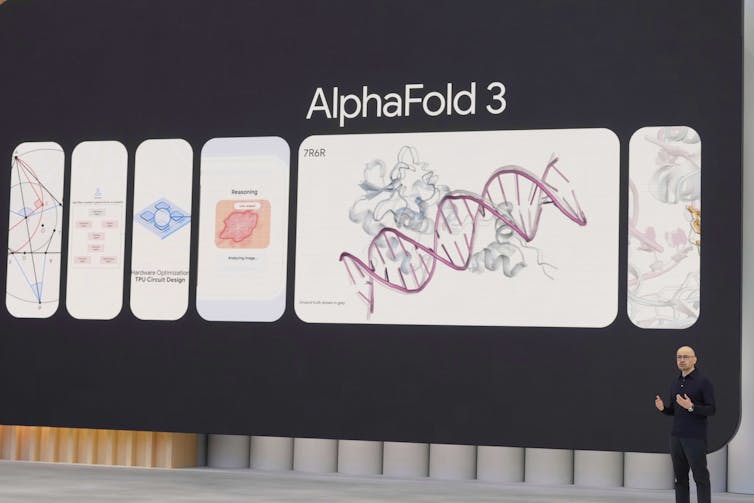
One widely reported example of AI in biology is the 2024 Nobel Prize in chemistry for AlphaFold, an AI model that predicts protein structures and interactions from statistical regularities in structural and evolutionary data.
Proteins, responsible for an immense proportion of biological interactions, can now be systematically explored virtually in hours or days. This circumvents conventional methodologies that require weeks, months or even years of effort.
(AP Photo/Jeff Chiu)
AlphaGenome, another of Google DeepMind’s AI-driven models, now allows researchers to quickly and efficiently predict how gene variants contribute to genetic landscapes that drive disease and dysfunction.
These disruptive AI approaches (and others) are already being applied broadly in cancer, Alzheimer’s disease, pandemic response and beyond.
Elevate Your Health for Just $29.99/Month
Join the Precision Wellness Subscription at My Healing 365 and get discounted services, priority coaching access, virtual care, and exclusive wellness resources to support your physical, emotional, and hormonal health.
Join for $29.99/MonthCorrelation versus cause and effect
Importantly, the AI field is presently dominated by modelling approaches that are statistical in nature; that is, these models learn correlations, rather than cause and effect.
This distinction is important. Statistical models are limited by the context within which they can be applied.
This leads us to the major overarching question in the field today: how do we capture the cause and effect of every interaction that exists within this nebulous network that we call biology?
Contemporary solutions to this question are explored through hybrid computational frameworks. These are models that combine what limited structured knowledge we have about biological systems and how they function with multi-modal datasets.
But what do I mean by knowledge? From a physical sciences perspective, established causal mechanisms or fundamental laws in physics, chemistry and biology.
From a medical perspective, established mechanisms of disease progression or aging.
And multi-modal datasets? Data obtained to observe biology and medicine from a range of perspectives. These could be:
-
Images of biology that inform spatial characteristics of healthy or diseased states.
-
Quantitative data that informs expression of metabolites, genes, proteins, epigenetics or other aspects of what makes up biological identity and function.
-
Medical data that informs the broad variables that may (or may not) play a role in disease onset and progression.
These are just a few examples. As you might imagine, this isn’t a simple task.
(Unsplash+/Aakash Dhage)
Training AI models
The Arc Institute is one of several groups tackling this by learning biological representations at the cellular level.
Arc Institute researchers train AI to understand how gene networks interact to make up cellular identity across more than 150 million cells from different organs within the body.
Researchers then perform perturbations: making informed disruptions to biology to understand the cause and effects that drive biological changes. These changes have implications for cellular function or identity.
The data obtained from these experiments inform causal mechanisms in biology.
This means informing direct cause and effect, alongside compensatory mechanisms (how biology tries to adapt in response to changes) and biological variance (how one cell may differ in its response from another).
Those results are integrated into the model architecture to optimize how well it learns to predict a statistical-causal representation of cell state. That is, a representation that is causally informed, but that also captures statistical representations of how large numbers of features (input variables) interact.
This approach and those like it are driving the fields of biology and medicine forward at an accelerated pace.
However, biology is very complex. The question remains of how we tie one aspect of biological state of being (such as genes expressed for a given cell identity or function) to the many other aspects that drive identity and function in biological contexts.
Extraordinary complexity
It is undeniable that causal-aware AI systems have the potential to accelerate drug discovery, optimize personalized treatment recommendations, and even offer novel mechanistic solutions across the breadth of biomedical science and medicine.
However, there are substantial challenges to achieving these outcomes. Biological systems are extraordinarily complex.
These systems are highly dimensional, meaning they operate at the intersection of a very large number of variables. They are also confounding, as biological variance makes it difficult to separate important information from noise.
Further, biology is rich in compensatory mechanisms that are ingrained in our evolution, as biology tries to correct or compensate itself when one variable output goes awry.
Even limited causal evidence is difficult to distinguish from correlation in biological systems, experimentally in the lab or medically in the clinic.
There are other challenges as well:
-
Insufficient data, or a lack of critical information within existing datasets.
-
Inconsistencies and bias in data collection, including but not limited to underrepresentation, and perspective biases in many contexts.
-
Ethics in AI, a topic upon which one could write books surrounding health, medicine and everything beyond.
The question yet remains: How can we reliably implement, interpret and translate these systems into solutions, in light of all these obstacles?
Regenerative competence

(AP Photo/Malin Haarala)
Our own team, the Biernaskie lab at the University of Calgary, is applying these very approaches.
We’re studying how reindeer regenerate their antlers, both seasonally and following injury. Our work is first to model, predict, then facilitate this regenerative competence in humans.
Our first goal is to regenerate healthy skin in burn survivors, or significantly improve healing outcomes.
Severe burns result in fibrotic scarring, an evolutionary mechanism that preserves life by minimizing risk of bleeding and infection. The result is dysfunctional scar tissue devoid of sweat glands, hair follicles or most of the cell types that co-ordinate healthy skin.
Burns are most common in children, and the physical, social, and psychological effects of severe burns create significant burden across survivors lifespans.
Other labs around the world are committed to using AI to solve complex problems in health and medicine, focusing on a wide range of approaches. These range from deeper integration of data across omics and imaging to improved theoretical and experimental frameworks for validating causal mechanisms, robust cyclical validation to advance predictions using pre-clinical experiments, and transparent, fair and ethical frameworks.
Professionals across the breadth of this trans-disciplinary field may together be on the precipice of a new era of solutions to some of the toughest challenges in health and medicine.

























