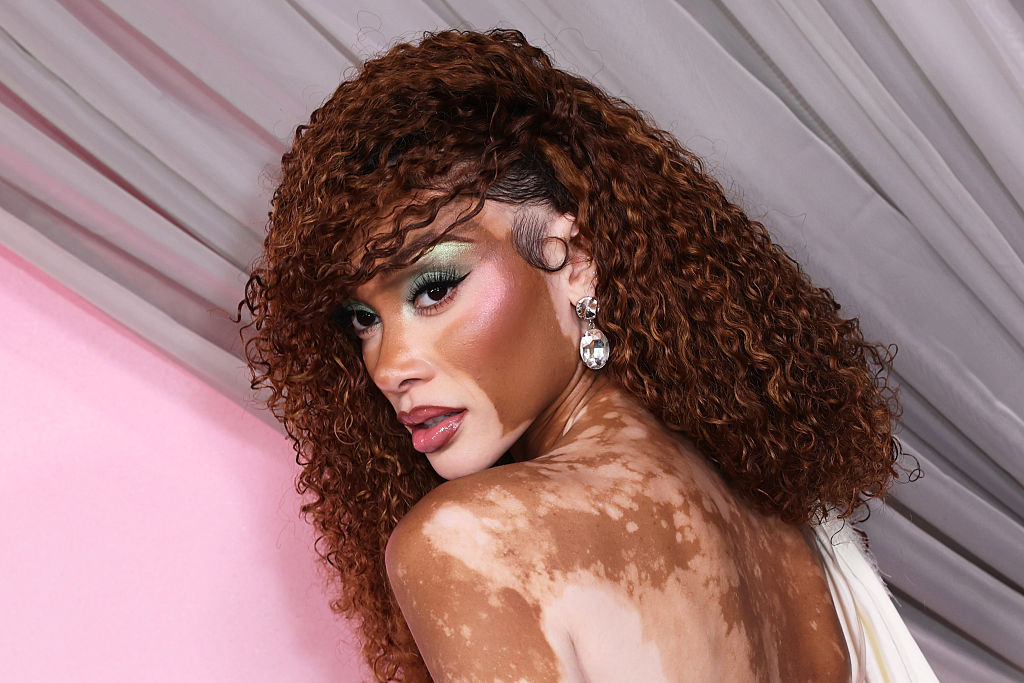
Winnie Harlow never saw herself on glossy magazine pages growing up. Now, she’s a beauty founder with vitiligo who sets the standards for who is considered beautiful. Her vision is realized through the models she hires and the creators she partners with.
Table of Contents
Redefining Beauty as A Boss
“When I was growing up, being different or looking different could never be seen as beautiful. Now, I feel when I see a little girl who looks like little Winnie, I see a different shine of confidence because she knows she’s represented in the world,” the accomplished model and Cay Skin founder tells Black Health Matters. “Vitiligo is a chronic (long-lasting) autoimmune disorder that causes patches of skin to lose pigment or color. This happens when melanocytes – skin cells that make pigment – are attacked and destroyed, causing the skin to turn a milky-white color,” according to the National Institute of Arthritis and Musculoskeletal and Skin Diseases. Sun protection is imperative for those with vitiligo. “The absence of melanin pigments makes the lesional skin increasingly sensitive to sunburn,” reports Phytomedicine Plus.
Redefining The Conversation Surrounding Vitiligo
The model and entrepreneur has partnered with Incyte on The Power of Choice, a campaign designed to empower and inform people facing vitiligo and those they turn to for support. It includes visual educational materials. “I feel like the power of choice, really, to me, has to do with confidence and choosing to be confident every single day,” says Harlow. Information helps build that confidence. The negative impacts of vitiligo don’t just show up on your skin. They crawl beneath it. The less-visible symptoms of vitiligo, including uveitis, itching, and ear inflammation, are not as widely recognized. When a teacher advised Harlow to learn more about vitiligo as a kid, she was uninterested. “I was like, why would I want to learn more about this thing that makes me insecure or, you know, gets me bullied?”
When she decided to engage, resources were few. “I tried to do research when I was younger, but there wasn’t much information,” she continues. Later, resources expanded. “Once I could learn more and once there was more information about it, it actually made me understand myself more.”
She collaborated with Incyte to help others understand what is happening to their bodies. “It’s an autoimmune disorder. And, it’s definitely something that you should educate yourself on,” she says.
Her Ora ring and other tools provide useful data, helping her be an active participant in her health care plan. “I get kind of obsessive, but in a good way, because I want to know when I’m not getting enough sleep,” she says. “If I’m not aware of it, I won’t try to fix it.”
Elevate Your Health for Just $29.99/Month
Join the Precision Wellness Subscription at My Healing 365 and get discounted services, priority coaching access, virtual care, and exclusive wellness resources to support your physical, emotional, and hormonal health.
Join for $29.99/MonthRedefining What Mental Health Looks Like
Vitiligo can impact one’s mental state. “The Journal of the American Medical Association Dermatology says, “Patients with vitiligo often have impaired quality of life (QOL) and experience substantial psychosocial burden,” and “improvement in the psychosocial health of patients should be prioritized in the management and treatment of vitiligo.” Its high contrast on Black skin can heighten mental effects.
Traditionally, marginalized communities have not made room for mental health issues. On social media, the popular refrain “depress them dishes” refers to the fact that some parents lack the tools to support their children’s emotional well-being.
Harlow’s participation in the campaign will amplify the mental toll the condition can take. “I am a Caribbean girl, and it was very much so, like, depress your books,” recalls Harlow. “I think it’s really beautiful that we are not only acknowledging mental health but also speaking about it in a positive light too, because it doesn’t have to be a negative conversation, even though it can feel heavy sometimes.”
Redefining The Arc of the Main Character
Harlow is normalizing vitiligo as part of life, not the center of it as an author. “I have a children’s book coming out. It’s called Simply Winnie (out June 2, 2026), and it’s kind of about my experiences as a kid.” I noticed in a lot of books that had to do with representation or kids with differences, it was really on the nose,” she explains. “The challenges that kids in my book go through are more related to the things inside of them rather than outside.”
She connects to all of her childhood experiences, in the book, not just the obvious ones. “Of course, I was bullied for my skin, but somebody probably didn’t like a sweater that I wore or the way my hair was styled or, you know, like I had different experiences other than just my skin. And I wanted to tap into those issues that kids do go through and how to navigate those things,” says Harlow. “The questions that I’m usually asked typically have to do with their vitiligo, but we are so much more than what’s on our skin. We are people, inside of our skin.”
Harlow didn’t only consider the representation she wanted to infuse into the industry. She considered her lived experiences. “As someone having vitiligo, SPF has always been really important for me, but it was not always an experience that I enjoyed because SPF on, especially people of color, can very much so give you that ash quality that none of us are looking for,” she said. Sephora shelves are not the only place she is sending a message.
Resources

























