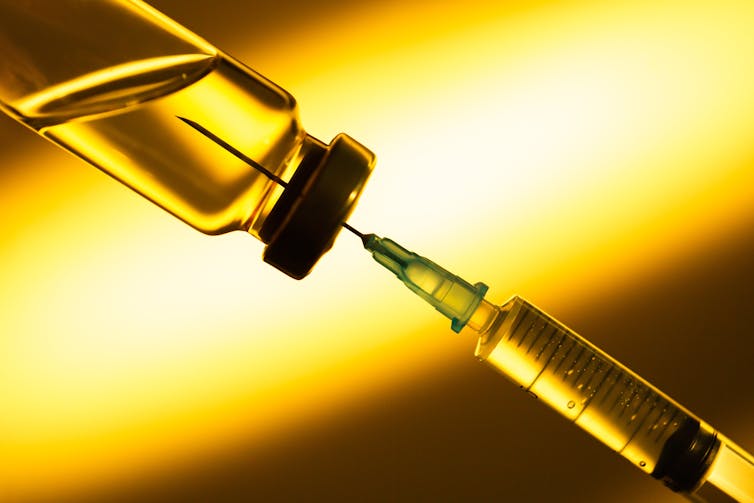
It’s tough to avoid the current hype about the health benefits of injecting peptides. Although these substances – essentially, synthetic bits of protein in solution – have long made the rounds in the fitness world, their popularity has exploded. Social media influencers, podcasters, wellness clinics and online sellers promote peptides as a quick and easy way to build muscle faster, heal injuries more quickly, reduce inflammation, lose fat, sleep better and more.
Health Secretary Robert F. Kennedy Jr. has repeatedly backed broader access to peptides. In April 2026, the Food and Drug Administration announced plans to consider allowing some of them to be made to order at specialist pharmacies after banning them in 2023.
But do these products actually work, and can people who use them be sure they are safe?
Two of the most-hyped peptides widely promoted for injury recovery are BPC-157 and TB-500, sometimes marketed together under the comic book-sounding nickname the “Wolverine stack.”
That stack is part of a much larger longevity and fitness boom in which vendors sell or promote many different peptide products, often for uses that have not been studied rigorously in people. Online, people swap dosing protocols, compare “stacks” and describe these compounds as shortcuts for everything from tendon recovery to fat loss and muscle gain.
I am a physician in physical medicine and rehabilitation who spends a lot of time thinking about how people recover from musculoskeletal injuries, including tendon problems, ligament sprains, muscle strains and joint injuries. After digging through the evidence on these compounds, I think the gap between the marketing and the science is much wider than most buyers realize.
Table of Contents
Peptides can be real medicines
A peptide is just a short chain of protein building blocks called amino acids.
Some peptide drugs are important, legitimate medicines. Insulin is one example. GLP-1 drugs are another.
The issue is not whether something is a peptide but whether it has gone through the long process that makes medicines credible: reproducible manufacturing, careful dose testing, clinical trials for a specific condition and ongoing safety monitoring.
BPC-157, TB-500 and other internet-hyped peptides have not gone through that process. Such peptides are often sold online as supplements, or as research-grade products made for laboratory use but not FDA-approved as a treatment for people.
That distinction matters, because it means that producers might prepare such peptides at different concentrations, using different solvents, stabilizers and other ingredients. In other words, one vial of what’s supposedly the same substance would not necessarily be the same as the next, even if it were made by the same producer. And there’s no requirement that manufacturers ensure that products are free of contaminants.
Different vials could thus potentially behave differently in the body and may carry different risks, such as infection. That is a big problem if people are injecting something sold online as a shortcut to recovery.
The evidence for BPC-157
BPC-157 was discovered in the early 1990s as an isolated version of a peptide fragment linked to compounds found in stomach acid.
Early research focused on benefits for the gut, but because some animal studies suggested the compound could help promote blood vessel growth, calm inflammation and support tissue repair, researchers years later began testing it in cell and animal models of tendon, ligament, muscle, bone and cartilage injury.
Some hints from those studies are promising, which is why influencers and scientists got excited about BPC-157.
But in humans, the evidence is extremely thin. In fact, for common sports and orthopedic injuries, it’s close to nonexistent, as my colleagues and I found when we reviewed the published literature on BPC-157 for musculoskeletal healing in 2025.
The one published study we found in people included only 16 participants with knee pain. It relied on their self-assessment to gauge improvement and didn’t compare the group that received the peptide to one that did not. Those flaws made it impossible to tell whether the improvement was due to placebo effects, because many injuries get better over time anyway, or from the peptides.
Other reviews uncovered similar limitations: For musculoskeletal injuries, the studies in people are too sparse and low quality to pin down whether the peptide works or what risks it poses.
Basic, practical questions remain, too – such as what dose people should use, how long the compound lasts in different tissues and whether the product in a purchased vial actually matches its label.
TB-500 claims are even harder to evaluate
TB-500 has a slightly different story. It is usually marketed as a synthetic product related to a naturally occurring peptide called thymosin beta 4, which is found in many tissues.
Thymosin beta 4 has attracted scientific interest because it appears to be involved in processes relating to tissue repair, including cell movement, how new blood vessels form and how tissues respond to injury. Animal studies suggest it may support bone healing after fractures as well as muscle repair.
Elevate Your Health for Just $29.99/Month
Join the Precision Wellness Subscription at My Healing 365 and get discounted services, priority coaching access, virtual care, and exclusive wellness resources to support your physical, emotional, and hormonal health.
Join for $29.99/MonthResearchers are beginning to study thymosin beta 4 in people – though, so far, most studies look at safety and not recovery from sports injuries.
Anna Efetova/Moment via Getty Images
Here’s the issue, though: TB-500 is a smaller piece of thymosin beta 4. This means that research on thymosin beta 4 does not necessarily show that TB-500, the version most commonly sold online, helps a person recover faster from a tendon, muscle or joint injury.
Another complication is that the biological processes thymosin beta 4 seems to promote, such as new blood vessel growth and cell migration, don’t just occur in bone or muscle healing. They also play a role in other contexts, such as scarring, abnormal tissue growth and cancer biology.
This does not prove harm, but it does mean these are not simple, risk-free recovery supplements. Human studies don’t just have to show that thymosin beta 4, TB-500 or products sold under that name help people recover from common sports injuries, but also that these products are safe for long-term use.
So far, data on safety is scant. A recent analysis of more than 12,000 Reddit posts about using BPC-157 and other peptides after musculoskeletal injuries or surgery found that users frequently raised concerns about side effects, product purity and long-term safety. For example, some users reported injection-site reactions, diarrhea and emotional numbness. Studies like this one rest on low-quality, anecdotal evidence, but it’s the only evidence available for most of these peptides.
How to think about bold peptide claims
What makes the current peptide craze so confusing is that BPC-157 and TB-500 are not miracle cures, but they are not pure nonsense either. They sit in a more uncomfortable middle ground: interesting biology, intriguing findings in animal studies and, realistically, no convincing proof that they promote musculoskeletal healing in people.
In other words, peptides on the whole can be real medicines. But that does not mean the vial being marketed online is a safe, tested treatment for an injured shoulder, Achilles tendon or knee.
When you encounter wellness influencers or online sellers promising the glamour of faster healing, better recovery or a more aesthetic body, a few mundane questions can help cut through the marketing:
-
Has this exact product been tested in people with my injury?
-
Was it studied at the same dose and by the same route being marketed online?
-
Do I know exactly what is actually in the vial?
-
Is the promised benefit strong enough to justify the risk of using a product that has not cleared the usual standards for drug quality and evidence?
For now, none of those questions yield a clear, positive answer.
























