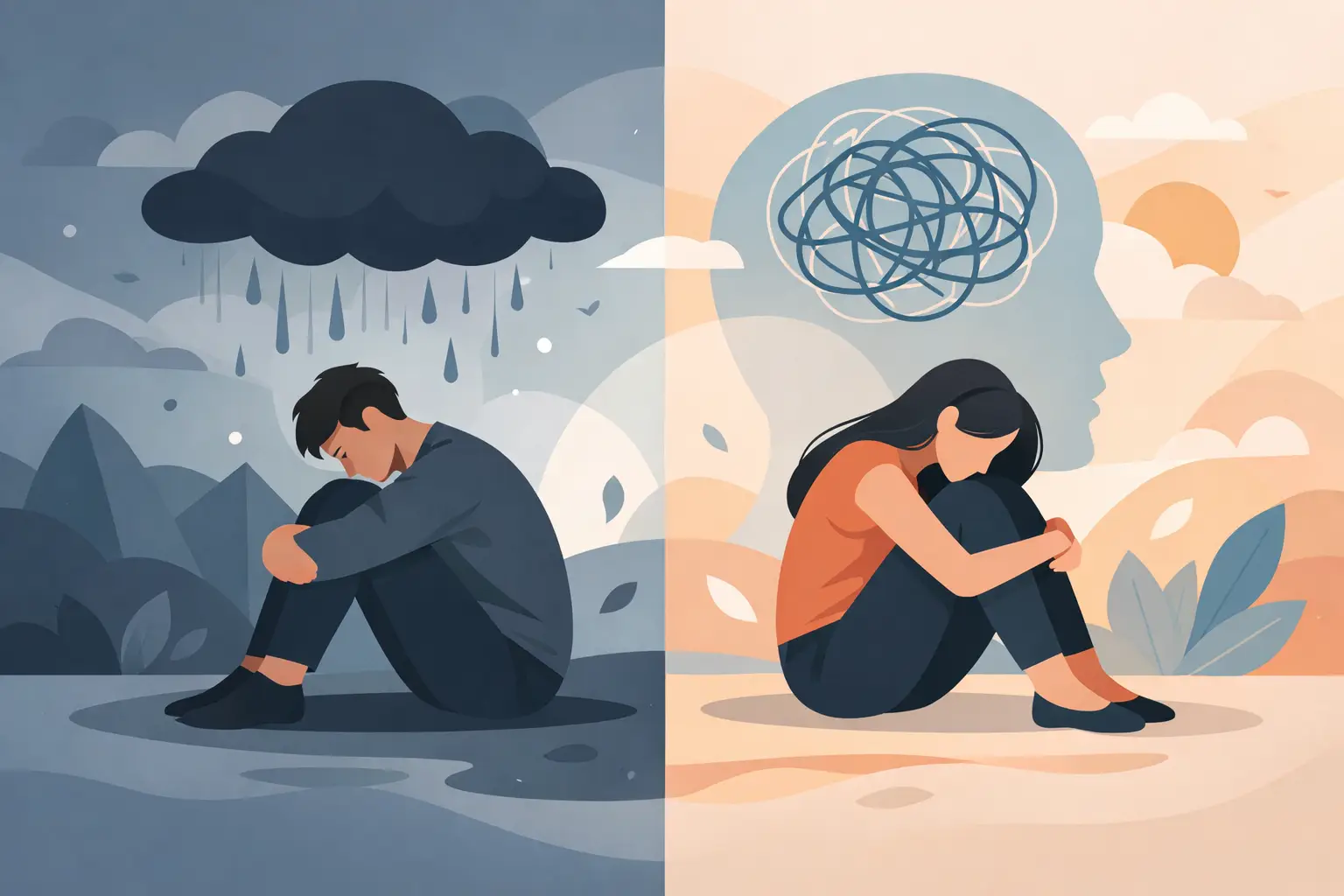
Some people feel keyed up all day and still can’t get out of bed. They worry constantly, replay every conversation, and expect the worst – yet they also feel flat, tired, and disconnected from things they used to enjoy. If you’ve ever wondered how does anxiety and depression go together, the short answer is that they often overlap in real life more than people expect.
These are different conditions, but they can show up at the same time and feed into each other. Anxiety tends to bring fear, tension, racing thoughts, and a sense of being on edge. Depression often brings low mood, hopelessness, low energy, and loss of interest. When both are present, symptoms can feel confusing. You may seem restless on the outside and shut down on the inside.
Table of Contents
How does anxiety and depression go together in real life?
The connection is not just emotional. It can affect your sleep, focus, appetite, relationships, and ability to function at work or at home. Anxiety can keep your nervous system activated for long stretches of time. That ongoing stress can wear you down, making it harder to recover emotionally, think clearly, or feel motivated. Over time, that can look a lot like depression.
The reverse can also happen. Depression can make everyday tasks feel heavier and less manageable. When you start falling behind, withdrawing from people, or losing confidence in your ability to cope, anxiety can grow around that. You may start worrying about your performance, your health, your future, or whether things will ever improve.
That is why many people do not fit neatly into one box. They may have trouble sleeping because their mind won’t slow down, then feel emotionally numb the next day. They may want relief from constant worry but also feel too drained to follow through on routines that once helped. This overlap is common, and it does not mean your experience is unusual or untreatable.
Why anxiety and depression often overlap
There is no single reason these conditions appear together, but several factors can increase the chance. Brain chemistry plays a role, especially the systems involved in mood, stress response, and motivation. Family history can matter too. If mental health conditions run in your family, your risk may be higher.
Life circumstances also matter. Ongoing work stress, parenting strain, grief, financial pressure, relationship conflict, trauma, and major transitions can all push someone toward both anxiety and depression. Sometimes it starts with one and grows into the other. Sometimes both symptoms rise at the same time after a stressful season.
Personality and coping patterns can shape the picture as well. People who are highly self-critical, prone to rumination, or used to carrying too much on their own may be especially vulnerable. When your mind is always scanning for what could go wrong, and you are also blaming yourself for struggling, the emotional load adds up fast.
What the symptom mix can look like
When anxiety and depression happen together, the experience is not always obvious. Some people picture anxiety as panic and depression as sadness, but the reality is often broader. You might feel irritable rather than sad. You might feel physically tense but emotionally shut down. You might look functional to everyone else while feeling overwhelmed inside.
A mixed symptom pattern can include constant worry, racing thoughts, poor sleep, low energy, loss of interest, difficulty concentrating, muscle tension, hopelessness, and pulling away from other people. Some people become perfectionistic and avoidant at the same time. They care deeply, fear failure, and then feel too exhausted to start.
This overlap can also make symptoms seem inconsistent. One day you may feel agitated and unable to relax. The next, you may feel slowed down and detached. That shift can be frustrating, especially if you are trying to explain what is happening to a partner, friend, or provider.
Physical symptoms are part of the picture
Mental health symptoms rarely stay only in your thoughts. Anxiety and depression can show up as headaches, stomach discomfort, tightness in the chest, appetite changes, fatigue, or body aches. If you are waking up tired, struggling to fall asleep, or feeling drained even after a quiet day, your mind and body may both be under strain.
Because these symptoms are physical too, people sometimes assume something is wrong with their character instead of recognizing they may need support. That delay is common. It is also one reason accessible care matters.
How the cycle keeps going
Anxiety and depression can reinforce each other in subtle ways. Anxiety can cause overthinking, avoidance, and sleep disruption. Those patterns can leave you isolated, worn out, and discouraged. Depression can then make it harder to take action, reach out, or use coping tools consistently. As motivation drops, anxiety often grows around everything you are not doing.
You can see this cycle in everyday situations. Maybe you feel anxious about work, lose sleep, and start dreading the next day. After weeks of that stress, you feel emotionally depleted and stop enjoying your evenings or weekends. Then you get anxious about how little energy you have and whether you are falling apart. The symptoms become connected.
This is why treatment should look at the full picture, not just one label. If someone only addresses worry but not low mood, or only low mood but not constant tension, progress can feel incomplete.
When it is time to get help
You do not need to wait until things feel severe. If symptoms are lasting more than a couple of weeks, affecting your sleep, work, relationships, or ability to function, it is reasonable to talk with a licensed provider. The same is true if you feel stuck in a loop of worry and emotional exhaustion that you cannot break on your own.
Getting help early can make treatment feel more manageable. Many people wait because they think they should be able to handle it themselves, or because finding care feels like another stressful task. If privacy, time, or long waits have kept you from reaching out, online mental health care can remove some of those barriers.
A telehealth model can make support feel more doable. Instead of arranging travel, missing work, or sitting in a waiting room, you can connect with a licensed provider from home and get a treatment plan built around your symptoms. For people balancing jobs, children, caregiving, or just limited energy, that convenience matters.
Elevate Your Health for Just $29.99/Month
Join the Precision Wellness Subscription at My Healing 365 and get discounted services, priority coaching access, virtual care, and exclusive wellness resources to support your physical, emotional, and hormonal health.
Join for $29.99/MonthWhat treatment may involve
Treatment depends on your symptoms, health history, and goals. For some people, therapy-based strategies are a strong fit. For others, medication may be part of the plan. Often, the best approach combines both, especially when anxiety and depression are happening together.
A provider may help you identify patterns that keep symptoms going, such as catastrophizing, avoidance, poor sleep habits, or all-or-nothing thinking. They may also recommend evidence-based medication when appropriate, particularly if symptoms are persistent or significantly affecting daily life. The right plan should be individualized, not one-size-fits-all.
It also helps to have ongoing support instead of a one-time conversation. Mental health symptoms can shift, and treatment may need adjustment over time. Services like My Healing 365 are built around that reality, offering online access to licensed providers, personalized plans, and a more private, flexible way to start care.
What improvement can look like
Feeling better does not always mean every anxious thought disappears or every hard day goes away. More often, it means you can sleep more regularly, think more clearly, and feel less trapped by your own mind. It means your reactions feel less intense, your mood becomes steadier, and daily tasks stop feeling impossible.
Progress is rarely perfectly linear. Some weeks feel lighter than others. What matters is that the pattern begins to shift in a healthier direction.
You are not imagining the overlap
If you have been trying to decide whether what you feel is anxiety or depression, the answer may be both. That does not make your situation more hopeless. It simply means your symptoms deserve a fuller look. Many people experience this overlap, and many respond well to care that treats the whole person instead of a single symptom.
You do not have to force yourself to power through constant worry, low mood, or the exhausting mix of both. The right support can help you feel more like yourself again, one practical step at a time.

























