As a deadly outbreak of Ebola virus spreads in the Democratic Republic of Congo and Uganda, the U.S. Centers for Disease Control and Prevention said on May 17, 2026, that it is transferring “a small number of Americans” who were in Congo and who were exposed to the virus.
Some of these exposures are classified as high-risk, and among them is an American doctor who has been evacuated to Germany, health officials said.
On May 18, the U.S. also announced a ban on people who have recently traveled to Ebola-affected countries from entering the country.
The World Health Organization declared the outbreak to be an international health emergency on May 17. However, the CDC says the risk to the United States remains low.
As an infectious disease scientist who has studied multiple epidemics around the world, I agree that this reassurance is justified. But one key aspect of this outbreak is highly concerning: There is more than one Ebola virus, and this outbreak is caused by one for which the world has no vaccine.
Table of Contents
A familiar name, an unfamiliar virus
First identified in 1976, Ebola viruses have caused dozens of outbreaks across Africa.
The group of viruses that cause the disease, called orthoebolaviruses, consists of six known species, but three cause most large outbreaks: Zaire, Sudan and Bundibugyo. The tools the world developed over the past decade – the licensed vaccine Ervebo and monoclonal antibody treatments – were designed against the Zaire species, which is by far the most common.
The current outbreak, by contrast, is caused by the Bundibugyo virus, first identified in 2007 in Uganda. It is only the third documented Bundibugyo outbreak on record – and the largest.
There are no approved vaccines or therapeutics for the Bundibugyo virus. That’s because its genetic makeup differs significantly from other orthoebolaviruses. When the Bundibugyo virus was first described, scientists warned that this divergence would complicate efforts to design diagnostics and vaccines against it. An immune response to the Zaire species, elicited by a vaccine, is unlikely to protect against Bundibugyo.
An outbreak that grew in the dark
The most worrying feature about the current outbreak is not the virus itself but how large it already was when it was recognized.
Elevate Your Health for Just $29.99/Month
Join the Precision Wellness Subscription at My Healing 365 and get discounted services, priority coaching access, virtual care, and exclusive wellness resources to support your physical, emotional, and hormonal health.
Join for $29.99/MonthIt took the WHO until May 15 to identify the Bundibugyo strain as the cause of the outbreak. By May 16, the health organization had identified 246 suspected cases and 80 deaths in the DRC’s Ituri province. Recent Zaire outbreaks were often declared with only a handful of community deaths.
One reason for the delay is technical: The rapid field tests used for screening are calibrated for the Zaire species and often miss Bundibugyo. Early samples in this outbreak tested negative for Ebola; only genomic sequencing at a reference laboratory in Kinshasa identified the species. An outbreak that spreads invisibly is far harder to contain because contact tracing is always one step behind.
Geography compounds the danger – and explains why the WHO moved so fast after identifying the cause of the outbreak to declare it an emergency. Ituri has porous borders with Uganda and South Sudan as well as a highly mobile population. It is also in the grip of a humanitarian and security crisis due to prolonged armed conflict in eastern Congo.
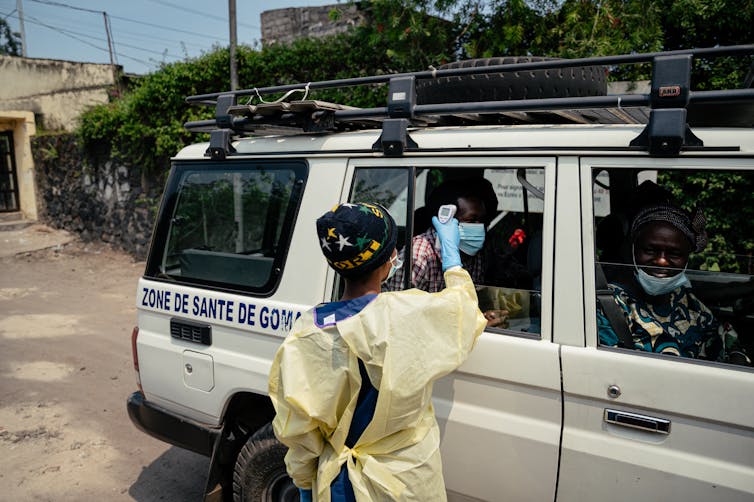
Jospin Mwisha/AFP via Getty Images
The outbreak’s hot spots include mining towns with constant worker turnover, and cases have already reached Kampala, Uganda’s capital city, where more than 1.5 million people are connected to the world by an international airport. That is the international community’s central fear: not the remote village, but the virus reaching dense, highly connected urban hubs from which it can travel along trade and air routes across borders.
An outbreak that stays rural can be contained; one that reaches the transit network – as seems to be the case now – becomes everyone’s problem.
How Ebola spreads – and why health workers’ risk is high
There is also a less intuitive route. After recovery, the virus can persist for months in sites such as the testes, eyes and central nervous system, which infectious disease experts call “immune-privileged” sites. This means they don’t tend to experience strong responses from the immune system when they are invaded by foreign substances.
For the Zaire species, this has produced documented cases of sexual transmission from male survivors whose blood had long since cleared the virus. This is why the WHO now advises male survivors to abstain from sex or use condoms until semen tests negative twice.
How far this applies to Bundibugyo is not yet established, but it is one more reason that a “contained” outbreak is rarely the end of the story.
A revealing detail of the current outbreak: Among the first identified cases were four health workers, who died within days. This points to transmission inside health facilities, a classic pattern when protective equipment and infection control fall short.
What this outbreak is really testing
With no specific vaccine or antiviral, the response depends entirely on classic public health measures: early detection, case isolation, contact tracing, safe burials, infection control and community engagement. These work, but they are labor-intensive and fragile in a conflict zone.
The encouraging news is that early supportive care – fluids and blood-pressure and oxygen management – saves lives even without a targeted drug. Experimental Bundibugyo vaccines have also shown promise in primates, though they are not yet proved in humans.
There is a final point that should resonate in the United States: Some epidemiologists have raised the question of whether cuts to global health programs contributed to the delay in this outbreak’s detection. Whatever the answer, the lesson is the same: With the existing Ebola vaccine, the world built a narrow defense against one species of a virus that comes in several.
The Americans now being flown out of Congo are a reminder that in an interconnected world, no outbreak is ever entirely someone else’s problem.
























