
Disclosure: This site contains some affiliate links. We might receive a small commission at no additional cost to you.
Medically Reviewed
Dr. Jose Rossello, MD, PhD, MHCM
Preventive Medicine & Public Health Specialist
Last Reviewed: May 19, 2026
Seeing a TSH result flagged as high or low on a lab report can feel alarming, particularly because the thyroid affects so many body systems — energy, weight, heart rate, mood, and more. But a single TSH value outside the reference range is often a starting point for a conversation rather than a definitive diagnosis. This article explains what TSH measures, how to think about the numbers, and the most useful questions to raise with your clinician.
Table of Contents
What TSH actually measures
TSH stands for thyroid-stimulating hormone. It is not produced by the thyroid itself — it is produced by the pituitary gland, a small structure at the base of the brain. The pituitary monitors how much thyroid hormone (primarily T4, or thyroxine, and T3, or triiodothyronine) is circulating in the blood. When thyroid hormone levels fall, the pituitary responds by making more TSH to signal the thyroid to produce more. When thyroid hormone levels are high, the pituitary dials TSH back down.
This feedback loop means TSH essentially works in reverse of thyroid hormone:
- A high TSH generally suggests the thyroid is not making enough hormone — the pituitary is working harder to stimulate it. This is the pattern seen in hypothyroidism (underactive thyroid).
- A low TSH generally suggests the thyroid is making too much hormone — the pituitary has backed off. This is the pattern seen in hyperthyroidism (overactive thyroid).
The American Thyroid Association (thyroid.org[1]) describes TSH as the best initial test for evaluating thyroid function because it acts as an “early warning system” — it often moves before the thyroid hormone levels themselves become clearly abnormal.
What the numbers generally mean
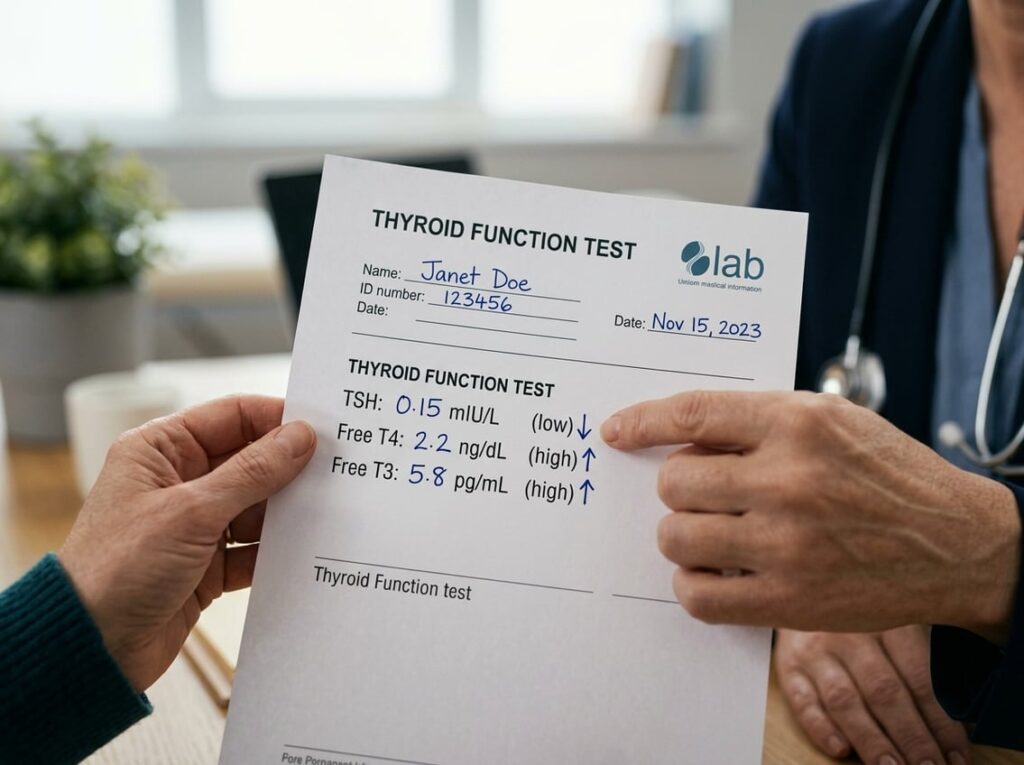
The conventional reference range for TSH in adults is approximately 0.4 to 4.0 mIU/L (milliunits per liter), though some laboratories use a slightly wider range (up to 4.5 or 5.0 mIU/L). This range represents the middle 95% of results in a population of healthy adults without known thyroid disease, as outlined in resources from NIDDK at NIH[2] and the American Thyroid Association[3].
A few important caveats:
- TSH naturally varies with age. The upper end of the normal range tends to be somewhat higher in older adults. A TSH of 5.5 mIU/L might be flagged in a 35-year-old but is closer to the age-adjusted range in an 85-year-old.
- Individual set points differ. Research suggests each person has their own natural TSH “home base,” and what is normal for one person may not be for another. This is one reason context matters.
- Mild abnormalities often warrant repeat testing. A single TSH that is slightly above or below range may normalize on its own.
- Subclinical thyroid dysfunction refers to situations where TSH is abnormal but free T4 is still within the normal range. Subclinical hypothyroidism (elevated TSH, normal T4) is very common and does not always cause symptoms or progress to overt disease.
Why guidelines pay attention
The American Thyroid Association[4] and Endocrine Society[5] have issued clinical practice guidelines on thyroid disease management. The USPSTF has not issued a recommendation for universal thyroid screening in asymptomatic adults, which reflects that the evidence for population-level benefit is still debated.
Why thyroid function matters clinically:
- Hypothyroidism (high TSH) can cause fatigue, weight gain, cold intolerance, constipation, dry skin, and mood changes. In its more severe forms, it raises cardiovascular risk — TSH above 10 mIU/L is associated with higher risk of heart disease, according to ATA research summaries[4].
- Hyperthyroidism (low TSH) can cause rapid heart rate, weight loss, anxiety, heat intolerance, and in some cases, atrial fibrillation. Untreated hyperthyroidism can also reduce bone density over time.
- Subclinical thyroid disease is a much larger gray zone. Many people with mild TSH abnormalities feel completely well and do not necessarily require treatment — the decision depends on the degree of TSH deviation, symptoms, age, and other health factors.
Thyroid dysfunction is particularly important to identify during pregnancy, as thyroid hormones are essential for fetal brain development.
Common drivers at the population level
For high TSH (hypothyroidism):
- Hashimoto’s thyroiditis. The most common cause of hypothyroidism in the U.S. is an autoimmune condition in which the immune system attacks thyroid tissue. It can be detected with a thyroid antibody test (TPO antibodies).
- Prior thyroid treatment. Radioiodine therapy or thyroid surgery for hyperthyroidism or thyroid cancer often results in long-term hypothyroidism requiring treatment.
- Medications. Lithium, amiodarone, certain immunotherapy drugs, and others can affect thyroid function.
- Iodine. Both iodine deficiency and excess can impair thyroid function.
- Age. Hypothyroidism becomes more common with advancing age, particularly in women.
For low TSH (hyperthyroidism):
- Graves’ disease. The most common cause of overt hyperthyroidism in the U.S. — an autoimmune condition that stimulates the thyroid to overproduce hormone.
- Thyroid nodules. Some nodules produce thyroid hormone autonomously (toxic nodules or multinodular goiter).
- Thyroiditis. Inflammation of the thyroid (including postpartum thyroiditis) can temporarily release excess stored hormone, producing a transient low TSH.
- Too much thyroid medication. People already on thyroid hormone replacement can have a low TSH if their dose is higher than needed.
- Subclinical hyperthyroidism. A low TSH with normal T4 and T3 is common, especially in older adults; its significance depends on severity and symptoms.
What follow-up evaluation may be considered
If TSH is outside the reference range, next steps typically include:
- Repeating the test. A single abnormal TSH, particularly if mildly abnormal, is often repeated in a few weeks to confirm it is not a transient fluctuation.
- Free T4 (thyroxine) testing. When TSH is high, free T4 helps determine whether this is subclinical (T4 still normal) or overt hypothyroidism (T4 below normal). When TSH is low, free T4 — and sometimes free T3 — helps characterize the degree of hyperthyroidism, as described by the ATA[1].
- Thyroid antibodies. TPO (thyroid peroxidase) antibodies, if elevated alongside a high TSH, support a diagnosis of Hashimoto’s thyroiditis. TSI (thyroid-stimulating immunoglobulin) is used to assess for Graves’ disease when TSH is low.
- Thyroid ultrasound. If there are nodules, goiter, or other structural concerns, ultrasound evaluates the anatomy.
- Radioiodine uptake scan. Used in some cases of hyperthyroidism to determine the cause.
- Assessment for medications or other conditions that could be driving the abnormality.
Lifestyle and prevention factors evidence supports
Thyroid function is largely determined by biology, genetics, and often autoimmune processes — which means there is no “lifestyle fix” for most thyroid conditions. That said, some evidence-supported considerations:
- Adequate iodine intake. Iodine is essential for thyroid hormone production. In the U.S., where most table salt is iodized and dairy consumption is common, severe iodine deficiency is rare — but people following highly restrictive diets without iodine sources may be at risk.
- Selenium. Selenium is required for thyroid hormone synthesis and activation. Most people get adequate amounts from food (Brazil nuts are particularly rich). Supplementation is sometimes discussed in Hashimoto’s, though evidence for clinical benefit is mixed.
- Avoiding excessive iodine. Very high iodine intake (from supplements, seaweed, or contrast dyes) can paradoxically worsen thyroid dysfunction in susceptible people.
- Monitoring if on thyroid medication. People already taking thyroid hormone replacement should maintain their follow-up schedule, as dose needs often change with weight changes, aging, pregnancy, and new medications.
- Smoking. Smoking is associated with higher risk of Graves’ disease and worsened thyroid eye disease.
Questions to bring to your appointment
- What is my TSH value, and does my clinician consider it meaningfully abnormal or in a “watch and see” zone?
- Would it be helpful to recheck TSH in a few weeks to see if this is a persistent finding?
- Should we also check free T4 — and possibly free T3 — to understand the full picture?
- Do I have any symptoms that might be connected to a thyroid problem?
- Would thyroid antibody testing help clarify whether an autoimmune process is involved?
- Are any of my current medications known to affect thyroid function?
- Is there anything about my age, pregnancy status, or other health factors that changes how we interpret this result?
- Does this result change what I should monitor or how often I should have thyroid function checked?
- What TSH level would prompt more active treatment versus continued monitoring?
- If this is subclinical hypothyroidism, what is the typical natural history? Does it often normalize, stay the same, or progress?
- Are there specialists I should see given this result?
- What symptoms should prompt me to call before my next scheduled appointment?
Red flags warranting prompter follow-up
Most TSH abnormalities can be addressed in a scheduled appointment. However, contact your clinician promptly or seek urgent care if you experience:
- Rapid or irregular heartbeat (palpitations), chest pain, or shortness of breath — especially with a low TSH
- Extreme fatigue, confusion, inability to stay warm, or swelling around the face (possible signs of severe hypothyroidism in older adults — this is rare but serious)
- Bulging or prominent eyes, or significant eye pain (associated with Graves’ disease)
- A rapidly enlarging lump or mass in the neck
- High fever with a thyroid condition — rare but can indicate thyroid storm (very high thyroid hormone levels), a medical emergency
- Any symptoms that are significantly affecting your ability to function day to day
Key takeaways
- TSH is made by the pituitary gland and acts as a thermostat for the thyroid — high TSH suggests the thyroid is underperforming; low TSH suggests it may be overproducing.
- The standard reference range is approximately 0.4–4.0 mIU/L, but interpretation depends on age, symptoms, and other clinical factors.
- A single mildly abnormal TSH often warrants repeat testing before significant action is taken.
- Free T4 (and sometimes T3) testing is typically ordered alongside TSH to characterize whether the abnormality is subclinical or overt.
- Most thyroid conditions are driven by autoimmune processes or structural changes — not primarily by lifestyle factors.
- Timing matters: thyroid screening is particularly important in pregnancy, where thyroid function affects fetal development.
Disclaimer
This content is for general educational purposes only and is not medical advice. It does not create a doctor-patient relationship. Always talk to your licensed healthcare professional about your specific situation.
Post Views: 2
Elevate Your Health for Just $29.99/Month
Join the Precision Wellness Subscription at My Healing 365 and get discounted services, priority coaching access, virtual care, and exclusive wellness resources to support your physical, emotional, and hormonal health.
Join for $29.99/MonthDisclosure: This site contains some affiliate links. We might receive a small commission at no additional cost to you.
Medically Reviewed
Dr. Jose Rossello, MD, PhD, MHCM
Preventive Medicine & Public Health Specialist
Last Reviewed: May 19, 2026
Seeing a TSH result flagged as high or low on a lab report can feel alarming, particularly because the thyroid affects so many body systems — energy, weight, heart rate, mood, and more. But a single TSH value outside the reference range is often a starting point for a conversation rather than a definitive diagnosis. This article explains what TSH measures, how to think about the numbers, and the most useful questions to raise with your clinician.
What TSH actually measures
TSH stands for thyroid-stimulating hormone. It is not produced by the thyroid itself — it is produced by the pituitary gland, a small structure at the base of the brain. The pituitary monitors how much thyroid hormone (primarily T4, or thyroxine, and T3, or triiodothyronine) is circulating in the blood. When thyroid hormone levels fall, the pituitary responds by making more TSH to signal the thyroid to produce more. When thyroid hormone levels are high, the pituitary dials TSH back down.
This feedback loop means TSH essentially works in reverse of thyroid hormone:
- A high TSH generally suggests the thyroid is not making enough hormone — the pituitary is working harder to stimulate it. This is the pattern seen in hypothyroidism (underactive thyroid).
- A low TSH generally suggests the thyroid is making too much hormone — the pituitary has backed off. This is the pattern seen in hyperthyroidism (overactive thyroid).
The American Thyroid Association (thyroid.org[1]) describes TSH as the best initial test for evaluating thyroid function because it acts as an “early warning system” — it often moves before the thyroid hormone levels themselves become clearly abnormal.
What the numbers generally mean
The conventional reference range for TSH in adults is approximately 0.4 to 4.0 mIU/L (milliunits per liter), though some laboratories use a slightly wider range (up to 4.5 or 5.0 mIU/L). This range represents the middle 95% of results in a population of healthy adults without known thyroid disease, as outlined in resources from NIDDK at NIH[2] and the American Thyroid Association[3].
A few important caveats:
- TSH naturally varies with age. The upper end of the normal range tends to be somewhat higher in older adults. A TSH of 5.5 mIU/L might be flagged in a 35-year-old but is closer to the age-adjusted range in an 85-year-old.
- Individual set points differ. Research suggests each person has their own natural TSH “home base,” and what is normal for one person may not be for another. This is one reason context matters.
- Mild abnormalities often warrant repeat testing. A single TSH that is slightly above or below range may normalize on its own.
- Subclinical thyroid dysfunction refers to situations where TSH is abnormal but free T4 is still within the normal range. Subclinical hypothyroidism (elevated TSH, normal T4) is very common and does not always cause symptoms or progress to overt disease.
Why guidelines pay attention
The American Thyroid Association[4] and Endocrine Society[5] have issued clinical practice guidelines on thyroid disease management. The USPSTF has not issued a recommendation for universal thyroid screening in asymptomatic adults, which reflects that the evidence for population-level benefit is still debated.
Why thyroid function matters clinically:
- Hypothyroidism (high TSH) can cause fatigue, weight gain, cold intolerance, constipation, dry skin, and mood changes. In its more severe forms, it raises cardiovascular risk — TSH above 10 mIU/L is associated with higher risk of heart disease, according to ATA research summaries[4].
- Hyperthyroidism (low TSH) can cause rapid heart rate, weight loss, anxiety, heat intolerance, and in some cases, atrial fibrillation. Untreated hyperthyroidism can also reduce bone density over time.
- Subclinical thyroid disease is a much larger gray zone. Many people with mild TSH abnormalities feel completely well and do not necessarily require treatment — the decision depends on the degree of TSH deviation, symptoms, age, and other health factors.
Thyroid dysfunction is particularly important to identify during pregnancy, as thyroid hormones are essential for fetal brain development.
Common drivers at the population level
For high TSH (hypothyroidism):
- Hashimoto’s thyroiditis. The most common cause of hypothyroidism in the U.S. is an autoimmune condition in which the immune system attacks thyroid tissue. It can be detected with a thyroid antibody test (TPO antibodies).
- Prior thyroid treatment. Radioiodine therapy or thyroid surgery for hyperthyroidism or thyroid cancer often results in long-term hypothyroidism requiring treatment.
- Medications. Lithium, amiodarone, certain immunotherapy drugs, and others can affect thyroid function.
- Iodine. Both iodine deficiency and excess can impair thyroid function.
- Age. Hypothyroidism becomes more common with advancing age, particularly in women.
For low TSH (hyperthyroidism):
- Graves’ disease. The most common cause of overt hyperthyroidism in the U.S. — an autoimmune condition that stimulates the thyroid to overproduce hormone.
- Thyroid nodules. Some nodules produce thyroid hormone autonomously (toxic nodules or multinodular goiter).
- Thyroiditis. Inflammation of the thyroid (including postpartum thyroiditis) can temporarily release excess stored hormone, producing a transient low TSH.
- Too much thyroid medication. People already on thyroid hormone replacement can have a low TSH if their dose is higher than needed.
- Subclinical hyperthyroidism. A low TSH with normal T4 and T3 is common, especially in older adults; its significance depends on severity and symptoms.
What follow-up evaluation may be considered
If TSH is outside the reference range, next steps typically include:
- Repeating the test. A single abnormal TSH, particularly if mildly abnormal, is often repeated in a few weeks to confirm it is not a transient fluctuation.
- Free T4 (thyroxine) testing. When TSH is high, free T4 helps determine whether this is subclinical (T4 still normal) or overt hypothyroidism (T4 below normal). When TSH is low, free T4 — and sometimes free T3 — helps characterize the degree of hyperthyroidism, as described by the ATA[1].
- Thyroid antibodies. TPO (thyroid peroxidase) antibodies, if elevated alongside a high TSH, support a diagnosis of Hashimoto’s thyroiditis. TSI (thyroid-stimulating immunoglobulin) is used to assess for Graves’ disease when TSH is low.
- Thyroid ultrasound. If there are nodules, goiter, or other structural concerns, ultrasound evaluates the anatomy.
- Radioiodine uptake scan. Used in some cases of hyperthyroidism to determine the cause.
- Assessment for medications or other conditions that could be driving the abnormality.
Lifestyle and prevention factors evidence supports
Thyroid function is largely determined by biology, genetics, and often autoimmune processes — which means there is no “lifestyle fix” for most thyroid conditions. That said, some evidence-supported considerations:
- Adequate iodine intake. Iodine is essential for thyroid hormone production. In the U.S., where most table salt is iodized and dairy consumption is common, severe iodine deficiency is rare — but people following highly restrictive diets without iodine sources may be at risk.
- Selenium. Selenium is required for thyroid hormone synthesis and activation. Most people get adequate amounts from food (Brazil nuts are particularly rich). Supplementation is sometimes discussed in Hashimoto’s, though evidence for clinical benefit is mixed.
- Avoiding excessive iodine. Very high iodine intake (from supplements, seaweed, or contrast dyes) can paradoxically worsen thyroid dysfunction in susceptible people.
- Monitoring if on thyroid medication. People already taking thyroid hormone replacement should maintain their follow-up schedule, as dose needs often change with weight changes, aging, pregnancy, and new medications.
- Smoking. Smoking is associated with higher risk of Graves’ disease and worsened thyroid eye disease.
Questions to bring to your appointment
- What is my TSH value, and does my clinician consider it meaningfully abnormal or in a “watch and see” zone?
- Would it be helpful to recheck TSH in a few weeks to see if this is a persistent finding?
- Should we also check free T4 — and possibly free T3 — to understand the full picture?
- Do I have any symptoms that might be connected to a thyroid problem?
- Would thyroid antibody testing help clarify whether an autoimmune process is involved?
- Are any of my current medications known to affect thyroid function?
- Is there anything about my age, pregnancy status, or other health factors that changes how we interpret this result?
- Does this result change what I should monitor or how often I should have thyroid function checked?
- What TSH level would prompt more active treatment versus continued monitoring?
- If this is subclinical hypothyroidism, what is the typical natural history? Does it often normalize, stay the same, or progress?
- Are there specialists I should see given this result?
- What symptoms should prompt me to call before my next scheduled appointment?
Red flags warranting prompter follow-up
Most TSH abnormalities can be addressed in a scheduled appointment. However, contact your clinician promptly or seek urgent care if you experience:
- Rapid or irregular heartbeat (palpitations), chest pain, or shortness of breath — especially with a low TSH
- Extreme fatigue, confusion, inability to stay warm, or swelling around the face (possible signs of severe hypothyroidism in older adults — this is rare but serious)
- Bulging or prominent eyes, or significant eye pain (associated with Graves’ disease)
- A rapidly enlarging lump or mass in the neck
- High fever with a thyroid condition — rare but can indicate thyroid storm (very high thyroid hormone levels), a medical emergency
- Any symptoms that are significantly affecting your ability to function day to day
Key takeaways
- TSH is made by the pituitary gland and acts as a thermostat for the thyroid — high TSH suggests the thyroid is underperforming; low TSH suggests it may be overproducing.
- The standard reference range is approximately 0.4–4.0 mIU/L, but interpretation depends on age, symptoms, and other clinical factors.
- A single mildly abnormal TSH often warrants repeat testing before significant action is taken.
- Free T4 (and sometimes T3) testing is typically ordered alongside TSH to characterize whether the abnormality is subclinical or overt.
- Most thyroid conditions are driven by autoimmune processes or structural changes — not primarily by lifestyle factors.
- Timing matters: thyroid screening is particularly important in pregnancy, where thyroid function affects fetal development.
Disclaimer
This content is for general educational purposes only and is not medical advice. It does not create a doctor-patient relationship. Always talk to your licensed healthcare professional about your specific situation.
Post Views: 2