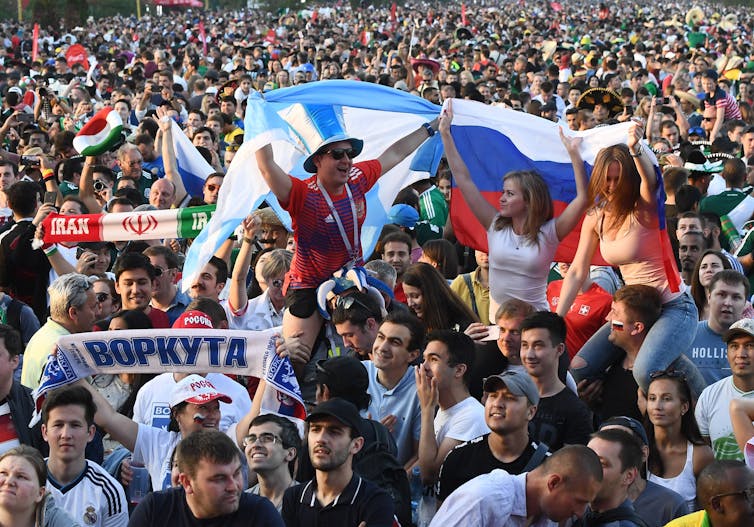
When the 2026 FIFA World Cup begins on June 11, 2026, matches will be played across 16 cities in the United States, Canada and Mexico. Millions of fans will arrive through multiple airports and will pack into stadiums, airports, hotels, bars and public transit systems over five weeks.
That makes the World Cup not just a sporting event but a weekslong experiment in global mixing that creates a perfect environment for infectious diseases to spread. Events of this scale rarely cause major outbreaks, but they do create opportunities for outbreaks and for health systems to be tested.
The possibilities range from the dramatic but unlikely (an imported Ebola case) to the much more probable (flu and measles spreading through crowded venues) and the largely overlooked (spikes in sexually transmitted infections and mosquito-borne diseases gaining footholds in new areas).
As an infectious diseases physician studying how outbreaks affect peoples’ health, and an avid soccer fan – I root for the Colombian team – I have been watching closely as public health experts prepare for the event.
Here are some of the infectious disease threats they are monitoring as the world’s largest sporting event kicks off:
Table of Contents
Ebola – scary but unlikely
In May 2026, the World Health Organization declared a global health emergency over an Ebola outbreak in the Democratic Republic of Congo and Uganda caused by a rare strain called Bundibugyo, which kills roughly 1 in 3 people it infects.
No approved vaccines, rapid diagnostic tests or treatments exist for this strain. And the global response has been complicated by deep cuts to international health aid and the U.S. withdrawal from the World Health Organization.
If a case is detected, rapid identification and isolation are critical to prevent further local transmission.
Still, the risk of Ebola reaching a World Cup stadium is very low. That’s because the virus spreads only through direct contact with bodily fluids like blood or saliva, not through the air, and infected people aren’t contagious until they show symptoms.
The U.S. has banned entry for non-U.S. citizens and green card holders who have been in the affected countries in the past 21 days and is screening all passengers traveling from affected areas. It is also urging European countries to embrace similar procedures as World Cup travel picks up. Mexico and Canada also have travel restrictions in place.

Claudio Villa – FIFA/FIFA via Getty Images
Measles, flu and COVID-19 – the bigger dangers
The more likely threats for soccer fans attending the World Cup are respiratory infections — illnesses spread by coughing, sneezing and breathing in crowded spaces.
Of special concern is measles, which is surging in the United States as well as in Canada and Mexico. As of June 4, the U.S. Centers for Disease Control and Prevention has confirmed 2,030 cases of measles in the U.S. in 2026 – close to the total count for all of 2025 and significantly higher than in previous years.
Measles is one of the most contagious infectious diseases on the planet. A single infectious traveler passing through Denver International Airport in 2025 triggered an outbreak of at least 10 cases. An infected fan in the stands, at an airport or in a bar could easily cause an outbreak.
On top of that, the 2025–2026 flu season reached a 30-year high, and COVID-19 continues to cause an estimated 290,000 to 450,000 hospitalizations per year. And big gatherings can amplify the risk of transmission.
In the background, avian influenza H5N1 — the bird flu circulating in dairy cows and poultry — has caused 70 human infections in the U.S. since 2024. No person-to-person spread has been detected, but scientists are watching closely for mutations that could change that.
Mosquito risks
Mosquito-borne diseases add another layer of risk to health authorities and travelers, especially for matches in southern U.S. and Mexican host cities during peak summer mosquito season.
Dengue – a tropical virus that causes high fever, severe body aches and sometimes life-threatening complications – set a U.S. record in 2024, with nearly 3,800 cases. That was a 359% jump over the prior 14-year average.
Elevate Your Health for Just $29.99/Month
Join the Precision Wellness Subscription at My Healing 365 and get discounted services, priority coaching access, virtual care, and exclusive wellness resources to support your physical, emotional, and hormonal health.
Join for $29.99/MonthMost cases occurred in travelers returning from the Caribbean and Central America. Still, locally acquired cases have cropped up, mainly in Los Angeles.
There’s also the risk that fans will bring infectious diseases from their home countries.
Yellow fever, a potentially deadly viral infection, is absent from the U.S. but remains a threat to fans traveling from parts of Sub-Saharan Africa and South America, where the disease is native. A 2024 yellow fever outbreak in South America outside the Amazonian jungle, where transmission generally occurs, hinted that its spread to urban areas is possible.
And Oropouche virus, a once-obscure mosquito-borne illness, exploded across Latin America in 2024 in the largest epidemic ever recorded, with over 8,000 confirmed cases in Brazil alone. Although infection is usually mild, it can have dangerous complications such as brain inflammation and bleeding disorders and can harm a developing fetus. No vaccines or treatments exist.
Travelers carrying these infections may need medical care, but familiarity with them among U.S. physicians tends to be low. There’s also a small risk that illnesses may spread locally through mosquito bites.
Sexually transmitted infections under the radar
One category of possible risk that’s getting less media attention is sexually transmitted infections.
About 1 in 5 international travelers engages in casual sex, according to one study, and nearly half of those encounters are unprotected.
Mpox, a viral infection that spreads through close physical contact, continues to circulate in the U.S and is a particular concern at large public events. Syphilis is also seeing a global resurgence.
Public health in action
Public health authorities across the U.S., Canada and Mexico have scaled up monitoring efforts amid preparations for keeping World Cup travelers safe.
In the U.S., a coalition of academic institutions, companies, nonprofits and public health organizations led by Georgetown University and nonprofit healthcare provider MedStar Health, called the Health Security Operations Center, will be keeping close tabs on disease transmission during the event. But some experts have raised concerns about U.S. resilience to public health threats at the World Cup due to significant cuts to public health infrastructure since 2025, including to the CDC.
Fans can take several steps of their own to protect themselves. They can make sure their routine vaccinations – especially measles, flu and COVID-19 – are up to date; practice safe sex; use mosquito repellent; and stay home or wear a mask if they feel sick.























