• Twenty47HealthNews
  • Health & Wellness
  • Disclaimer
    • Terms of Use
    • Privacy Policy
    • DMCA Notice
  • Twenty47HealthNews
  • Health & Wellness
  • Disclaimer
    • Terms of Use
    • Privacy Policy
    • DMCA Notice
24/7 Health News
No Result
View All Result
Struggling with energy, weight, or blood sugar?
Get personalized medical & wellness support at My Healing 365.
Book Your Wellness Strategy Session
Home Article

Unhoused people and wildlife are increasingly coming into contact. Here’s what can be done to protect them

July 14, 2026
in Article
Unhoused people and wildlife are increasingly coming into contact. Here’s what can be done to protect them

As homelessness increases around the world, more unhoused people are turning to parks and other urban green spaces to seek shelter. However, these places are also home to animals that live in and around urban areas.

This sets the stage for potentially dangerous interactions between humans and urban wildlife such as coyotes. Unhoused people face the risk of contracting disease from wild animals, while animals can be displaced by human presence.

Recent work by my colleagues and me shows that this issue contributes to human-wildlife conflict, with important ecological and social consequences. To explore conflict between homeless communities and urban wildlife, we focused on coyotes in Edmonton.

One of the most successful carnivores of the Anthropocene, coyotes thrive in cities. They have a remarkable capacity to live alongside humans, as well as an ability to get into trouble with people; conflict includes property damage, disease transmission, attacks on pets and, rarely, people.

Data we examined from the Edmonton Urban Coyote Project showed that the number of coyote conflict reports in the city is increasing. These include interactions in which coyotes intimidated, approached or attacked humans or their pets.

Key to our work were the harsh winter conditions in Edmonton. Consistent snowfall transforms the city into a canvas that records the details of coyote life, which can be read footprint by footprint, telling us what they eat and where they go to find safety.

Cold temperatures also encourage people sleeping outdoors to seek heated spaces, but unoccupied encampments remain highly visible. This combination allowed us to read the stories of human-wildlife interactions in the snow, while respecting human privacy.

Three forms of conflict

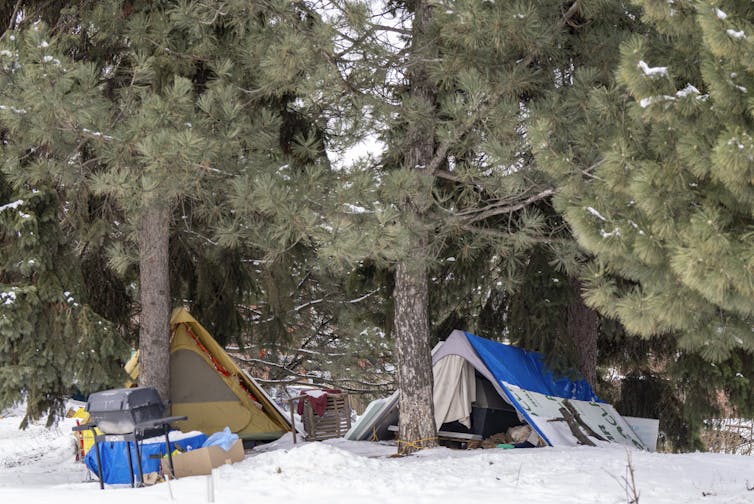
tents surrounded by trees in a snowy area

Tents belonging to unhoused people in Montréal in February 2026. Direct support to those experiencing homelessness could alleviate some imminent threats to their well-being.
THE CANADIAN PRESS/Christinne Muschi

Competition: Tracking showed that people experiencing homelessness and coyotes often used the same areas. This makes sense — both seek secure areas, far from major trails, where disturbance is less likely.

Competition between people and wildlife does not require people and animals to be in the same place at the same time. For example, in the winter, coyotes dig dens into the abandoned sleeping platforms of unhoused people. In the spring, people experiencing homelessness damage coyote dens.

Food: Those experiencing homelessness may not be able to secure their food or dispose of trash. Areas surrounding encampments are often littered with food remains. Such refuse becomes an easy meal for opportunistic coyotes.

Human food represents a considerable health risk for wildlife. Wild animals that eat human food are more often diseased and can become food conditioned — a process by which wild animals associate people with food, alongside a suite of behavioural and physiological changes that extend all the way to the gut microbiome. Across species, conflict behaviours are especially difficult to reverse among food-conditioned animals.


Read more:
Coyotes are here to stay in North American cities – here’s how to appreciate them from a distance


Disease: Wherever animals spend time, poop accumulates. This is especially true for species like coyotes, who use scat to communicate. Scat is often left on or near food items — including those found in encampments — and on visually prominent objects, such as litter. We often found coyote scat in and near abandoned encampments.

Contact with coyote scat can cause serious disease in humans. As scats break down from weather, and are even fed on by birds, it becomes part of the soil, but infectious microscopic agents persist.

In Edmonton, up to half the coyotes carry Echinococcus multilocularis — a tapeworm that causes alveolar echinococcosis in humans. This infectious disease is often fatal. By sleeping in scat-strewn green spaces, often without access to hygiene facilities and with difficulties accessing health care, the homeless community faces increased exposure to this (and other) parasites carried by wildlife.

What should we do about it?

a grocery store trolley on its side in a woodland area near a hole dug in the ground

A coyote den constructed under a discarded grocery cart, in Edmonton, Alta.
(Sage Raymond), Author provided (no reuse)

The ideal solution is to end homelessness and the factors that cause it. In North America, the single biggest predictor of homelessness is the relationship between income and housing ability; narrowing this gap would benefit both people and wildlife.

Knowing that wildlife threaten a vulnerable human community may lead some to propose wildlife eradication. Evidence from coyotes and other species shows that eradication efforts usually fail, and often after accruing a large price tag, undercutting ecosystem services, and destabilizing animal populations, leading to increased conflict behaviour.

Elevate Your Health for Just $29.99/Month

Join the Precision Wellness Subscription at My Healing 365 and get discounted services, priority coaching access, virtual care, and exclusive wellness resources to support your physical, emotional, and hormonal health.

Join for $29.99/Month


Read more:
Why killing coyotes doesn’t make livestock safer


So what are some feasible, short-term interventions that could alleviate conflict given ongoing homelessness and persisting urban wildlife?

First, there must be more research that involves ecologists, social scientists, medical professionals and people who have experienced homelessness. Diverse teams are best able to tackle challenges that lie at the interface of people and wildlife, research and practice.

Second, direct support to those experiencing homelessness could alleviate some imminent threats to their well-being. The form this support takes should depend on local context.

Finally, health-care professionals and those that work closely with homeless communities should be familiar with local diseases carried by wildlife, their symptoms and the risk factors that affect this community. Doing so represents a small step towards increased access to health care.

It is easy to overlook that cities are ecosystems where both people and wildlife live. Differing privileges, opportunities and discrimination all affect how people relate to urban nature. Our work shows that human-wildlife conflict is shaped by these inequalities.

Fostering human-wildlife co-existence in cities is bigger and more complicated than wildlife management in isolation. If we want to build cities that are healthier for both people and wildlife, we must recognize social inequality as an ecological force and create systems that prevent the circumstances that foster conflict.


ShareTweetSharePin
Next Post
My rookie era: I signed up for over-40s football – it’s liberating to spend hours focusing solely on a game

My rookie era: I signed up for over-40s football – it’s liberating to spend hours focusing solely on a game

Most Read

What causes stuttering? A speech pathology researcher explains the science and the misconceptions around this speech disorder

What causes stuttering? A speech pathology researcher explains the science and the misconceptions around this speech disorder

December 15, 2022
In war-torn Iran, air pollution from burning oil depots and bombed buildings unleashes invisible health threats

In war-torn cities, air pollution from burning oil depots and bombed buildings unleashes invisible health threats

March 25, 2026
3 women stroke prevention

Silent Stroke Symptoms in Women: What You Might Be Overlooking

February 27, 2026
morning back pain

Morning Again Ache Trigger Is Not the Mattress

October 11, 2021
lower back pain relief exercises

5 decrease again ache aid workouts

October 11, 2021

4 steps to building a healthier relationship with your phone

January 28, 2025

Why Circadian Rhythms Matter for Your Health

July 30, 2024
bleeding in gum

When The Bleeding in gum Is Severe ?

October 11, 2021
Good Night Sleep

6 Causes of Good Evening Sleep

October 11, 2021
3 years after legalization, we have shockingly little information about how it changed cannabis use and health harms

3 years after legalization, we have shockingly little information about how it changed cannabis use and health harms

October 15, 2021
Nasal vaccines promise to stop the COVID-19 virus before it gets to the lungs – an immunologist explains how they work

Nasal vaccines promise to stop the COVID-19 virus before it gets to the lungs – an immunologist explains how they work

December 14, 2022
Kick up your heels – ballroom dancing offers benefits to the aging brain and could help stave off dementia

Kick up your heels – ballroom dancing offers benefits to the aging brain and could help stave off dementia

January 3, 2023
Socialising, work, exercise: what makes a good day and is there a ‘formula’ for making it better?

Socialising, work, exercise: what makes a good day and is there a ‘formula’ for making it better?

April 12, 2026
Biden is getting prostate cancer treatment, but that’s not the best choice for all men − a cancer researcher describes how she helped her father decide

Biden is getting prostate cancer treatment, but that’s not the best choice for all men − a cancer researcher describes how she helped her father decide

May 20, 2025
Ten small changes you can make today to prevent weight gain

Ten small changes you can make today to prevent weight gain

October 12, 2021

COVID vaccines: how one can pace up rollout in poorer international locations

October 5, 2021
GLP-1 drugs may fight addiction across every major substance, according to a study of 600,000 people

GLP-1 drugs may fight addiction across every major substance, according to a study of 600,000 people

March 6, 2026

Multiple sclerosis: the link with earlier infection just got stronger – new study

October 12, 2021
Support and collaboration with health-care providers can help people make health decisions

Support and collaboration with health-care providers can help people make health decisions

December 16, 2021
Greece to make COVID vaccines mandatory for over-60s, but do vaccine mandates work?

Greece to make COVID vaccines mandatory for over-60s, but do vaccine mandates work?

December 1, 2021
Five ways to avoid pain and injury when starting a new exercise regime

Five ways to avoid pain and injury when starting a new exercise regime

December 30, 2022

This Simple Hygiene Habit Could Cut Your Risk of Stroke, New Research Reveals

February 1, 2025

Maximize Your Performance – Sync with Your Circadian Rhythms

August 9, 2024
woman covered with white blanket

Exploring the Impact of Sleep Patterns on Mental Health

August 4, 2024
Six ways to improve your cat’s one wild and precious life

Six ways to improve your cat’s one wild and precious life

June 6, 2026
Four ways to avoid gaining weight over the festive period – but also why you shouldn’t fret about it too much

Four ways to avoid gaining weight over the festive period – but also why you shouldn’t fret about it too much

December 22, 2022
GPs don’t give useful weight-loss advice – new study

GPs don’t give useful weight-loss advice – new study

December 16, 2022
As viral infections skyrocket, masks are still a tried-and-true way to help keep yourself and others safe

As viral infections skyrocket, masks are still a tried-and-true way to help keep yourself and others safe

December 14, 2022
You’ve reached your weight loss goal on GLP-1 medications – what now?

You’ve reached your weight loss goal on GLP-1 medications – what now?

February 5, 2026
How to protect your well-being, survive the stress of the holiday season and still keep your cheer

How to protect your well-being, survive the stress of the holiday season and still keep your cheer

December 21, 2025

Ready to take control of your health?

Get a personalized plan for your weight, energy, hormones, and blood sugar with My Healing 365.

Book Your Session Now – Limited Weekly Spots
  • Twenty47HealthNews
  • Health & Wellness
  • Disclaimer

© 2020 DAILY HEALTH NEWS

  • Twenty47HealthNews
  • Health & Wellness
  • Disclaimer
    • Terms of Use
    • Privacy Policy
    • DMCA Notice

© 2020 DAILY HEALTH NEWS















