The World Health Organization estimates that in 2026 nearly 11 million people will contract the virus that causes measles. Most of these cases will occur in Africa and Asia, but many countries in the Americas and Europe are reporting outbreaks affecting hundreds or thousands of people.
There is no treatment for measles, but vaccines have been proven to be safe and effective at preventing the disease. Unvaccinated people who get sick with measles are at risk of serious complications that can lead to deafness, blindness and death. The risk of a bad outcome is higher for people who are undernourished and unable to access supportive medical care.
As an infectious disease epidemiologist, I study the reasons for changes in population health risks around the world. The specific factors leading to measles epidemics vary by country, but the underlying cause everywhere is decreased vaccination rates.
Table of Contents
Zero-dose children in low-income countries
The vast majority of parents around the world want to protect their children from preventable infectious diseases through vaccination. In many lower-income countries, the supply of vaccines remains insufficient to meet the demand for them.
Elevate Your Health for Just $29.99/Month
Join the Precision Wellness Subscription at My Healing 365 and get discounted services, priority coaching access, virtual care, and exclusive wellness resources to support your physical, emotional, and hormonal health.
Join for $29.99/MonthBecause measles is highly contagious, the vaccination rate needs to be above 95% to protect a community from outbreaks, creating what is known as “herd immunity.” One dose of measles vaccine protects most people from the disease, but two doses are recommended to improve effectiveness.
Most high-income countries have measles vaccine rates near the 95% target. In Europe, the average one-dose vaccination rate is about 94%, and the two-dose rate is about 88%. In the U.S., more than 90% of 2-year-olds have received at least one dose of measles vaccine and more than 92% of kindergartners have received two doses. The vaccine coverage rate is above 95% in many communities, though it is much lower in some school districts.
In contrast, only about 80% of young children in low- and middle-income countries have received at least one dose of measles vaccine, and only about 70% have received two doses.
Almost every country had reduced access to vaccines during the early months of the COVID-19 pandemic, when supply chains and clinic access were severely disrupted. Most young children in high-income countries were able to catch up on missed doses before they reached school age. But in lower-income countries, millions of kids who missed routine vaccinations during the pandemic are still classified as “zero-dose children” who have not received any of the vaccines their countries recommend.
Only a tiny fraction of the cases of measles diagnosed in lower-income countries are confirmed with laboratory tests and reported to public health authorities, so it’s impossible to get an exact case count. But healthcare workers have reported observing higher than typical numbers of cases in many countries during the past year.
In 2026, measles epidemics have been reported in countries experiencing armed conflict or housing refugees displaced by war, such as Burundi, Democratic Republic of Congo, Somalia, Sudan and Yemen.
Outbreaks have also been reported in peaceful countries, including Maldives and Zambia, and cases are surging in India. Dozens of other countries are also experiencing epidemics. All of these situations are linked to undervaccination.
Vaccine shortages in Bangladesh
Bangladesh has reported more measles cases this year than any other country, and more than 900 people have died from the infection.
While Bangladesh faces many of the same challenges as other low- and middle-income countries, the past few years have presented some unique difficulties.
In 2024, the country’s longtime government collapsed and an interim government was installed. During this time of political instability the government ordered too few vaccine doses.
In 2025 vaccine shortages worsened when the interim government decided to stop procuring its vaccines through UNICEF and instead tried to purchase them through a competitive bidding process before new supply chains had been established.
Bangladesh has now resumed working with UNICEF to acquire vaccines. Unfortunately, it has returned to UNICEF at a time when its partner organization Gavi, the Vaccine Alliance, is facing funding cuts.
Under Gavi’s cofinancing model, low- and middle-income countries’ initial vaccine purchases are subsidized by contributions from high-income countries and other investors. Over time, countries pay an increasing portion of their own vaccine costs.
Because Gavi pools orders from all over the world, it is able to shape markets and negotiate with vaccine manufacturers for lower costs per dose. The major limitation of this system is that reduced funding for global health shrinks the budget for subsidizing vaccine purchases.
But since 2025, France, Germany, the U.K., the U.S. and several other high-income countries have significantly reduced their budgets for development assistance, leaving Gavi with a substantial budget shortfall.
As Bangladesh has grown its economy, it is paying a greater share of the costs of the vaccines it purchases through Gavi. However, it does not yet have the means to fully self-finance its vaccine program. For now, if Gavi’s budget is not fully replenished, countries like Bangladesh will not have enough money to buy all of the vaccines they need.
Even though a mass vaccination campaign in early 2026 saw more than 1 million Bangladeshi children vaccinated against measles, the percentage of children who have been vaccinated remains far below the 95% threshold required to prevent widespread epidemics.

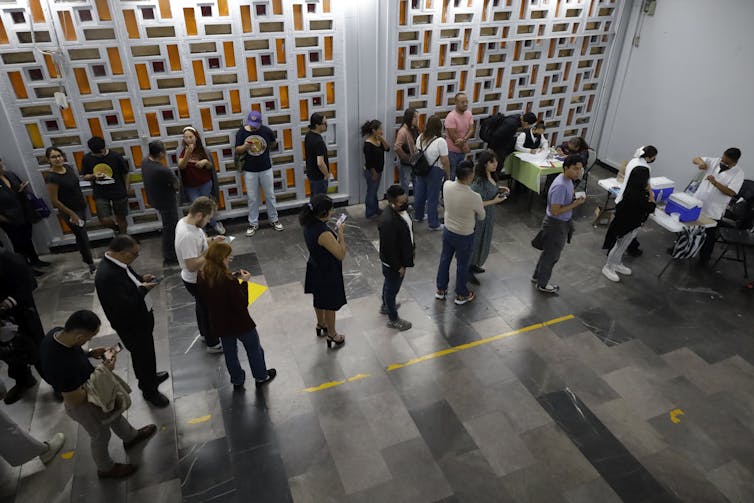
Gerardo Vieyra/NurPhoto via Getty Images
Vaccine hesitancy in faith communities in the Americas
Two years ago the entire region of the Americas – North, Central, and South America and the Caribbean – was classified as a measles-free zone.
Canada officially lost its measles elimination status in November 2025 after more than a year of sustained transmission. Mexico and the U.S. have met the criteria to lose their measles-free status when the Pan American Health Organization’s measles elimination committee meets again in November 2026.
The country reporting the largest number of measles cases in the Americas in 2026 is Guatemala, which has already logged more than 30,000 confirmed cases. The Guatemalan epidemic has been traced back to a gathering in Santiago Atitlán in December 2025 that was organized by a Christian megachurch whose leaders have been vocal about their anti-vaccine views.
Measles began circulating in late 2024 and early 2025 in Canada, Mexico and the U.S. among rural, conservative Mennonite communities where leaving children unvaccinated has become the cultural norm.
In South Carolina and Utah, recent outbreaks have been linked to low vaccination rates among conservative religious groups that are not connected with Mennonite churches. More cases of measles have already been diagnosed in the U.S. in 2026 than in any year since 1991.
The measles virus has moved from religious communities into other undervaccinated population groups. The epidemic that started in Mennonite villages in Mexico spread into neighboring Indigenous communities. An outbreak that started among German-speaking Mennonites in Bolivia crossed the border into Peru and was then amplified by visitors to large cultural festivals who brought the virus home with them.
Stopping the spread
The total number of measles cases per year decreased from an estimated 38 million in 2000 to about 10 million in 2019. That trend has reversed since the COVID-19 pandemic. The number of measles cases and the number of countries experiencing measles epidemics has gone up as the vaccination rate in some populations has gone down.
Getting back on track toward eliminating measles as a global public health problem will look different depending on the circumstances in each country. For low- and middle-income countries, ending measles epidemics will require increasing funding for Gavi and other international partnerships so that the vaccine supply can grow to meet the demand.
The need is different in countries where vaccination rates are falling even though measles vaccines are readily available. Stopping the spread of measles in undervaccinated communities will depend on the challenging task of building vaccine confidence among parents of young children.

























