• Twenty47HealthNews
  • Health & Wellness
  • Disclaimer
    • Terms of Use
    • Privacy Policy
    • DMCA Notice
  • Twenty47HealthNews
  • Health & Wellness
  • Disclaimer
    • Terms of Use
    • Privacy Policy
    • DMCA Notice
24/7 Health News
No Result
View All Result
Struggling with energy, weight, or blood sugar?
Get personalized medical & wellness support at My Healing 365.
Book Your Wellness Strategy Session
Home Article

Extreme heat is taking a toll on firefighters as wildfires stretch crews to the limit

August 27, 2026
in Article
Extreme heat is taking a toll on firefighters as wildfires stretch crews to the limit

When a wildfire threatens a community, most people don’t think to ask whether the firefighters coming to help slept enough the night before, recovered from the previous day’s shift or have enough energy left for another day on the fire line. They simply expect firefighters to show up.

But that workforce is increasingly being stretched to its limits.

The U.S. national fire preparedness level has been at 5 for weeks in summer 2026, its highest level, suggesting firefighting resources are fully committed and some regions may need emergency staffing measures to meet the demand. Crews were battling more than 90 large fires in late August, and firefighters in the Southwest and Texas faced daytime temperatures over 100 degrees Fahrenheit (38 degrees Celius) at times.

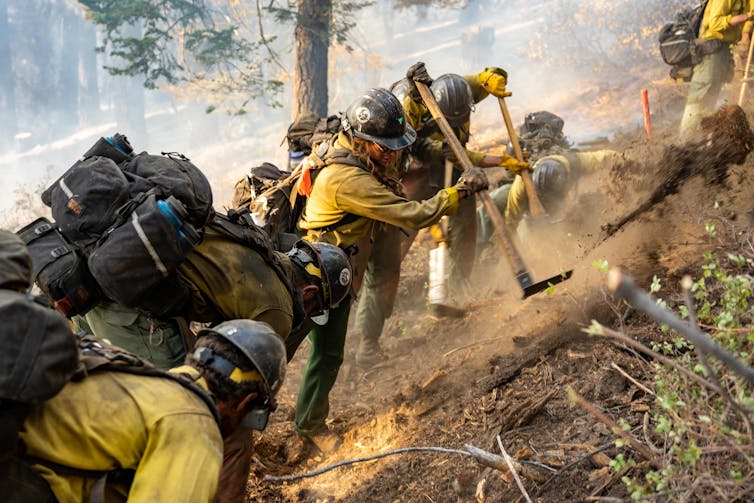
Firefighters cut fireline while carrying heavy packs.

Cutting fire lines to prevent wildfires from spreading is physically exhausting work, and firefighters often work long shifts.
Joe Bradshaw/BLM

In conditions like this, the unrelenting heat, stress and smoke take a toll on firefighters’ bodies.

Training, fitness and protective equipment allow firefighters to work in these extraordinary environments. But as a nurse practitioner, firefighter and founder of Purdue University’s FIRE Lab, I know too well that none of that makes the human body’s capabilities limitless.

Elevate Your Health for Just $29.99/Month

Join the Precision Wellness Subscription at My Healing 365 and get discounted services, priority coaching access, virtual care, and exclusive wellness resources to support your physical, emotional, and hormonal health.

Join for $29.99/Month

Table of Contents

  • Heat hits firefighters from 3 directions
  • Immediate consequences can develop quickly
  • Effects stay with bodies beyond one shift
  • How to lower the risk

Heat hits firefighters from 3 directions

Wildland firefighters face heat from the environment, the fire and their own bodies.

Hiking steep terrain with heavy equipment, clearing brush and cutting fire line to stop fires from spreading creates internal metabolic heat. Sun and high air temperatures add environmental heat, while flames and smoldering fuels contribute radiant heat.

The body responds by sending more blood toward the skin to release that heat while continuing to supply oxygen to working muscles. The heart works harder to support both jobs.

As fluid losses increase, the volume of blood circulating through the body can fall, the heart rate rises, and the work of fighting fires feels harder.

An infographic discusses ways firefighters face heat from the fire, the environment and their own bodies from the exertion when battling wildfires.

How heat affects wildland firefighters.
Purdue University FIRE Lab

Field studies show how this strain can become severe. In one study of 221 wildland firefighters on the job, 61% reached a core temperature of at least 100 F (38 C). About 50% reached a physiological strain index of 6 or greater on a 0-to-10 scale that combines heart rate and core temperature to measure how hard the body is working to cope with heat. Among those whose body temperatures crossed 100 F, the majority remained above that temperature for more than 30 minutes.

A core temperature of 100 F does not by itself mean heat stroke, but it signals substantial physiological strain. Staying hydrated helps the body sweat and keep blood circulating, but even a fully hydrated firefighter can overheat when the body gains and produces heat faster than it can release it.

Immediate consequences can develop quickly

Heat strain may begin with fatigue, headache, dizziness, weakness or nausea and progress to heat exhaustion or heat stroke. Severe hyperthermia can affect the brain, heart, kidneys and liver.

Wildland firefighters can also face rhabdomyolysis, a breakdown of skeletal muscle that can contribute to kidney injury. The National Institute for Occupational Safety and Health reported 62 severe cases among wildland firefighters from 2010 to 2020 and cautioned that the true number was probably higher.

A line of firefighters in soot- and dirt-stained yellow jackets walk along a road carrying equipment.

Fighting wildfires often means walking miles in steep terrain, carrying the equipment and protective gear firefighters need. These firefighters are working on the Timber Fire near Big Sur, Calif., in August 2026.
Andrew Avitt/U.S. Forest Service

Heat adds to fatigue when firefighters must anticipate fire behavior and make rapid decisions.

A 2025 field study found that wildland firefighters averaged 13.8-hour shifts on days when they were fighting fires and got around 6.7 hours of sleep. Poorer sleep and longer shifts were associated with reduced cognitive function, which can affect a firefighter’s ability to make split-second calls, such as when to retreat from an escalating fire.

Effects stay with bodies beyond one shift

The effects of heat and exhaustion can also add up. A firefighter can finish a shift hot, smoke-exposed and physically depleted, sleep in a warm camp and return to the line before fully recovering. Repeating that pattern across days and fire seasons may place ongoing strain on the heart, lungs and kidneys.

Smoke adds another health risk. Wildland firefighters commonly work in smoke without the kind of protection that firefighters use when fighting blazes inside buildings.

A 2019 exposure-modeling study estimated that, depending on the number of fire days worked over a career, cumulative smoke exposure could increase a wildland firefighter’s risk of dying from lung cancer by 8% to 43% and dying from cardiovascular disease by 16% to 30%. These are estimates, but they show why career-long exposure deserves attention.

Firefighters on air mattresses with tents in the background.

Getting quality rest between shifts isn’t always easy during multiday campaigns fighting major fires.
AP Photo/Ted S. Warren

Kidney health is another emerging concern. A 2025 study of 39 wildland firefighters found temporary decreases in kidney function and changes in kidney-injury biomarkers during one midseason fire incident. More research is needed to determine whether firefighting over seasons and years can lead to persistent kidney damage.

These findings raise an important occupational health question: What happens when heat, dehydration, smoke, sleep disruption and extreme physical exertion accumulate not only across one incident but across an entire career?

How to lower the risk

The heat isn’t going away, but there are ways wildfire management agencies can reduce the risk to firefighters.

First, firefighter health should be an important part of national wildfire readiness policies. Having adequate staffing so firefighters aren’t overworked and have meaningful enough recovery time to rehydrate, cool down and sleep between shifts are important. So are conditions that allow real sleep between shifts.

Monitoring firefighters’ health can also help catch early warning signs, such as kidney stress or burnout.

The public can also help by reducing the likelihood of high-stress fire situations.

The National Interagency Fire Center estimates that about 85% of U.S. wildfires are caused by human activities. Some of those can be avoided by fully extinguishing campfires, checking local fire restrictions, avoiding spark-producing activities on dry, windy days when fire risk is high, and maintaining vehicles and trailers so metal does not drag and ignite vegetation.

If you live in wildfire-prone country, creating defensible space and reducing combustible material around your home can reduce the fuel for fires. Evacuating promptly in an emergency also reduces the likelihood firefighters will have to put themselves in high-stress situations to rescue you.

We all expect firefighters to be there when the worst happens. Making sure they can do their jobs and stay healthy will allow them to continue to show up.


ShareTweetSharePin
Next Post
‘Mad honey’ that can stop your heart is now being sold online worldwide

‘Mad honey’ that can stop your heart is now being sold online worldwide

Most Read

What causes stuttering? A speech pathology researcher explains the science and the misconceptions around this speech disorder

What causes stuttering? A speech pathology researcher explains the science and the misconceptions around this speech disorder

December 15, 2022
In war-torn Iran, air pollution from burning oil depots and bombed buildings unleashes invisible health threats

In war-torn cities, air pollution from burning oil depots and bombed buildings unleashes invisible health threats

March 25, 2026
3 women stroke prevention

Silent Stroke Symptoms in Women: What You Might Be Overlooking

February 27, 2026
morning back pain

Morning Again Ache Trigger Is Not the Mattress

October 11, 2021
Socialising, work, exercise: what makes a good day and is there a ‘formula’ for making it better?

Socialising, work, exercise: what makes a good day and is there a ‘formula’ for making it better?

April 12, 2026

4 steps to building a healthier relationship with your phone

January 28, 2025
lower back pain relief exercises

5 decrease again ache aid workouts

October 11, 2021

Why Circadian Rhythms Matter for Your Health

July 30, 2024
bleeding in gum

When The Bleeding in gum Is Severe ?

October 11, 2021
Good Night Sleep

6 Causes of Good Evening Sleep

October 11, 2021
Nasal vaccines promise to stop the COVID-19 virus before it gets to the lungs – an immunologist explains how they work

Nasal vaccines promise to stop the COVID-19 virus before it gets to the lungs – an immunologist explains how they work

December 14, 2022
3 years after legalization, we have shockingly little information about how it changed cannabis use and health harms

3 years after legalization, we have shockingly little information about how it changed cannabis use and health harms

October 15, 2021
Kick up your heels – ballroom dancing offers benefits to the aging brain and could help stave off dementia

Kick up your heels – ballroom dancing offers benefits to the aging brain and could help stave off dementia

January 3, 2023
Ten small changes you can make today to prevent weight gain

Ten small changes you can make today to prevent weight gain

October 12, 2021
Biden is getting prostate cancer treatment, but that’s not the best choice for all men − a cancer researcher describes how she helped her father decide

Biden is getting prostate cancer treatment, but that’s not the best choice for all men − a cancer researcher describes how she helped her father decide

May 20, 2025

COVID vaccines: how one can pace up rollout in poorer international locations

October 5, 2021

Maximize Your Performance – Sync with Your Circadian Rhythms

August 9, 2024
GLP-1 drugs may fight addiction across every major substance, according to a study of 600,000 people

GLP-1 drugs may fight addiction across every major substance, according to a study of 600,000 people

March 6, 2026
woman covered with white blanket

Exploring the Impact of Sleep Patterns on Mental Health

August 4, 2024

This Simple Hygiene Habit Could Cut Your Risk of Stroke, New Research Reveals

February 1, 2025
Five ways to avoid pain and injury when starting a new exercise regime

Five ways to avoid pain and injury when starting a new exercise regime

December 30, 2022
Support and collaboration with health-care providers can help people make health decisions

Support and collaboration with health-care providers can help people make health decisions

December 16, 2021
Greece to make COVID vaccines mandatory for over-60s, but do vaccine mandates work?

Greece to make COVID vaccines mandatory for over-60s, but do vaccine mandates work?

December 1, 2021

Multiple sclerosis: the link with earlier infection just got stronger – new study

October 12, 2021
Six ways to improve your cat’s one wild and precious life

Six ways to improve your cat’s one wild and precious life

June 6, 2026
GPs don’t give useful weight-loss advice – new study

GPs don’t give useful weight-loss advice – new study

December 16, 2022
Four ways to avoid gaining weight over the festive period – but also why you shouldn’t fret about it too much

Four ways to avoid gaining weight over the festive period – but also why you shouldn’t fret about it too much

December 22, 2022
How regulatory agencies, not the courts, are imposing COVID-19 vaccine mandates

How regulatory agencies, not the courts, are imposing COVID-19 vaccine mandates

October 24, 2021
You’ve reached your weight loss goal on GLP-1 medications – what now?

You’ve reached your weight loss goal on GLP-1 medications – what now?

February 5, 2026
Backlash to transgender health care isn’t new − but the faulty science used to justify it has changed to meet the times

Backlash to transgender health care isn’t new − but the faulty science used to justify it has changed to meet the times

January 30, 2024

Ready to take control of your health?

Get a personalized plan for your weight, energy, hormones, and blood sugar with My Healing 365.

Book Your Session Now – Limited Weekly Spots
  • Twenty47HealthNews
  • Health & Wellness
  • Disclaimer

© 2020 DAILY HEALTH NEWS

  • Twenty47HealthNews
  • Health & Wellness
  • Disclaimer
    • Terms of Use
    • Privacy Policy
    • DMCA Notice

© 2020 DAILY HEALTH NEWS















