Ultraprocessed foods have a terrible reputation.
Studies have linked them with multiple chronic diseases. Journalists and health influencers characterize them as poison. Some public health experts call for a global halt to producing and consuming them.
But the debate around ultraprocessed foods is not nearly as settled as it may seem. As a researcher who studies social movements for healthy and sustainable food, I have been documenting the history of processed foods and examining debates around the science and politics of ultraprocessing.
In basic terms, ultraprocessed foods are mass-produced, industrial formulations that use ingredients not typically found in a home kitchen, and that generally contain little to no intact whole foods.
Yet the very definition of ultraprocessed is highly contested. While a growing number of advocates say that ultraprocessing is dangerous to public health, skeptics counter that the fervor around the topic has become a moral panic, and insist that some ultraprocessed foods can be part of a healthy diet.
Elevate Your Health for Just $29.99/Month
Join the Precision Wellness Subscription at My Healing 365 and get discounted services, priority coaching access, virtual care, and exclusive wellness resources to support your physical, emotional, and hormonal health.
Join for $29.99/MonthTable of Contents
A brief history of food processing
People have been processing food – that is, transforming crops and animals into food ingredients and products – for all of human history. Cooking, which historians generally consider the first form of food processing, goes back as far as 2 million years. In the millennia and centuries that followed, people developed and refined other traditional food processing methods, including grinding, baking, fermenting, drying and pressing.
New types of food processing were created during the industrial age, beginning in the mid-18th century. Canning, pasteurization and refrigeration were among the major innovations that reshaped not only how people eat but society as a whole.
Before that time, nearly all food was local food – that is, produced within a few dozen miles – and people consumed fresh foods quickly to avoid spoilage. Food processing promised to improve food safety, shelf life, quality, convenience, taste and healthfulness. The world became more urbanized as regional and international supply chains developed. Geographically dispersed farmers were connected to retailers and consumers across the newly modern food system.
From the mid-20th into the 21st century, food manufacturers added a host of complex technological innovations to the food processing playbook. Their efforts made processed foods more standardized for the mass market and more convenient for consumers. But public health experts warned that processed junk foods were packed with salt, sugar and saturated fat – problematic nutrients linked to obesity, diabetes and other diet-related diseases.
Food processing and the NOVA framework
By the mid-2000s, some healthy food advocates began to argue that the nature and extent of food processing, rather than the presence of specific problematic nutrients, explained diet-related chronic disease. The journalist Michael Pollan famously implored his audience to avoid “edible food-like substances.” Instead, he advised: “Eat food. Not too much. Mostly plants.”
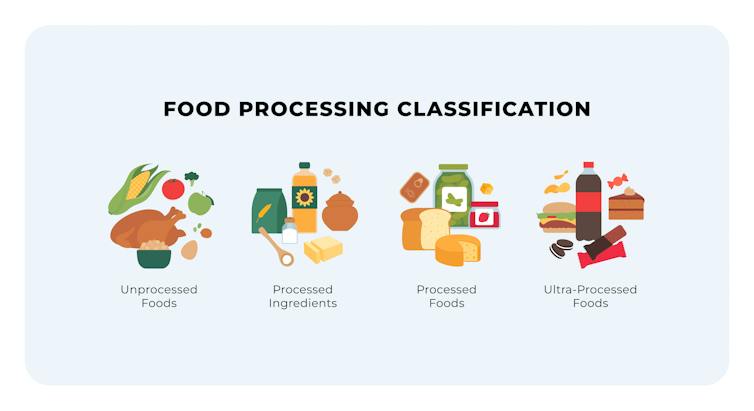
Brazilian epidemiologist Carlos Monteiro coined the term “ultraprocessing” in 2009 as part of his work on what he and colleagues called the NOVA classification. The NOVA framework establishes a four-category system that characterizes a food based on its level of processing.

Anastasia Usenko/iStock via Getty Images Plus
NOVA Category 1 includes unprocessed or minimally processed plant or animal foods that are close to their natural state and contain no additives. Category 2 refers to processed culinary ingredients – that is, products derived from Category 1 via pressing, grinding or similar techniques. Category 3 describes processed foods made by combining Category 1 and Category 2 using traditional methods, such as baking, boiling or canning.
NOVA Category 4 foods are ultraprocessed foods, often described as industrially manufactured food products that can’t be made at home. Examples of ultraprocessing include separating whole foods into substances, chemically formulating foods or using cosmetic additives such as food dyes.
According to the framework, corporations design ultraprocessed foods to be convenient, hyperpalatable and highly profitable. They are packaged attractively, marketed intensively and intended to displace other food groups.
Today, ultraprocessed foods make up an increasingly large share of global diets. They account for more than 50% of total calories in the United States, with many low- and-middle income nations not far behind.
Unsettled science
Since the NOVA framework emerged, researchers have tried to test whether food processing can explain how certain foods affect people’s health.
The vast majority of this work has explored correlations between consuming ultraprocessed foods and developing health problems. One consistent result stands out: People who consume more ultraprocessed foods are at higher risk for multiple chronic diseases and early death.
However, even that conclusion is more complex than it appears. It turns out that certain categories of ultraprocessed foods – such as sweetened beverages like sodas and processed meats like deli meats – are consistently associated with negative health outcomes including heart disease and stroke. But other ultraprocessed products – breads, cold cereals, yogurt and even savory snacks – have actually been correlated with lower rates of these health problems.
Still other ultraprocessed foods – including sauces, condiments and ready-to-heat dishes like frozen dinners – show no consistent links to people’s health one way or the other.
Only a handful of clinical trials that can actually show cause and effect have explored ultraprocessed foods’ effects on health. One prominent study did find that participants who ate a diet of ultraprocessed foods for two weeks consumed more calories and gained more weight than participants who followed a minimally processed diet, but other experiments have found no clear effect. What’s more, these studies generally last just a few weeks – far too short a time frame to draw conclusions about long-term health impacts.
A tricky definition
Some food science researchers are unsurprised by these mixed findings, arguing that the definition of “ultraprocessed” is ambiguous and frequently subjective. For example, a cake prepared by a home baker would be considered a NOVA Category 3 “processed food.” But if that same cake were industrially manufactured using a commercial preservative, then packaged and sold at a grocery store, it would become a NOVA Category 4 “ultraprocessed food” – even if the two cakes were nutritionally identical.
Fundamentally, many nutrition scientists remain unconvinced that processing alone can explain why certain foods are associated with poor health. Instead, they emphasize that unhealthy ultraprocessed foods frequently have poor nutritional profiles and other qualities that make them easy to overeat. And they argue that making ultraprocessed foods healthier, not getting rid of them entirely, can improve public health.
Vilifying ultraprocessed foods may have harms, they suggest, like creating unnecessary fear and promoting disordered eating. It can also stigmatize eco-friendly, plant-based meats or ultraprocessed products such as baby formula that are designed for clinical nutrition.
The wholesale rejection of ultraprocessed foods could also make life more difficult for families who rely on the convenience and affordability the products offer.
Processing versus nutrients
On the other hand, many food policy and public health researchers maintain that the common definition of ultraprocessed is clear enough, especially if exceptions are made for healthy ultraprocessed foods. They also note that many supporters of ultraprocessed foods have ties to the food industry. They insist that the existing evidence is strong enough to take immediate policy action, including making changes to how ultraprocessed foods are produced, purchased and marketed.
Regulating ultraprocessed foods wouldn’t just benefit public health, advocates argue. It could also help rein in harms to food culture, business and the environment.
In this sense, ultraprocessed foods are a symptom of a bigger problem: an unsustainable industrial food system that is dominated by a handful of corporations. That argument, of course, is plenty contested too.
Ultimately, researchers and advocates from all sides of the debate mostly agree that the modern food environment needs to be made healthier. The key point of disagreement, however, is whether policymaking and dietary guidance should directly address ultraprocessing or stick to a more traditional focus on nutrients instead.